
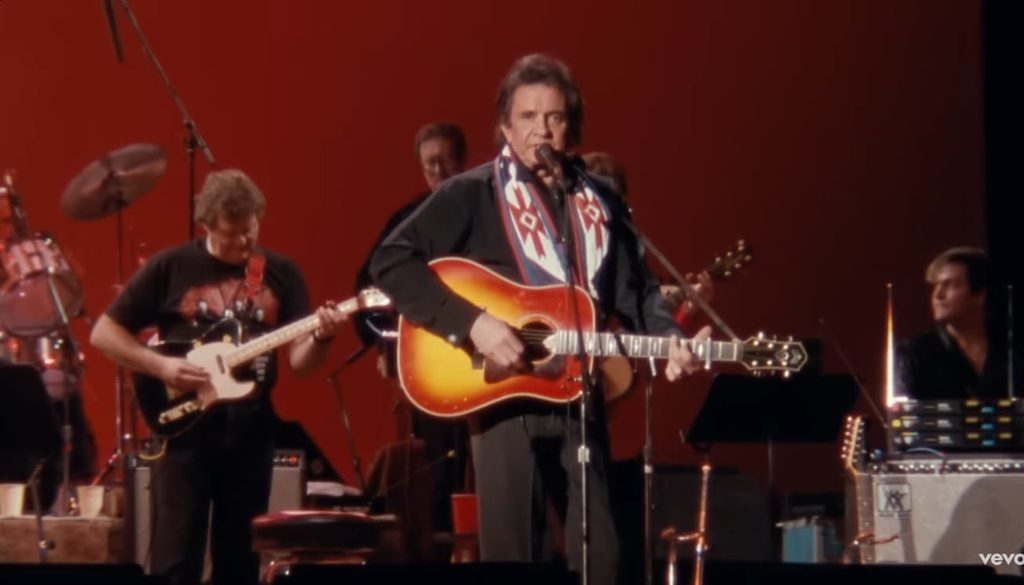
When The Highwaymen performed “Ring of Fire,” Johnny Cash’s immortal song became something even larger: a gathering of four voices carrying the weight of country music’s past into one unforgettable moment.
Few songs are as inseparable from an artist as “Ring of Fire” is from Johnny Cash. Written by June Carter Cash and Merle Kilgore, the song became one of Cash’s defining recordings after its release in 1963. His version reached No. 1 on Billboard’s Hot Country Singles chart and climbed to No. 17 on the Billboard Hot 100, remaining one of the most recognisable records of his career. The unforgettable mariachi inspired horn arrangement, the dark rhythm, and Cash’s deep, commanding voice created something unlike anything else on country radio at the time. But when Johnny Cash later stood beside Willie Nelson, Waylon Jennings, and Kris Kristofferson as part of The Highwaymen, “Ring of Fire” no longer belonged to one man alone. It became part of a shared musical history. The Highwaymen’s performance of the song was recorded live at Nassau Coliseum in Uniondale, New York, on March 14, 1990, during the concert later released as The Highwaymen Live: American Outlaws.
The significance of that performance begins with the song itself. “Ring of Fire” was inspired by the emotional intensity surrounding the relationship between June Carter and Johnny Cash. June had witnessed Cash struggling through a difficult period of his life, and the attraction between them was complicated, powerful, and impossible to reduce to a simple love song. The image of falling into a “ring of fire” captured the feeling of being consumed by love, knowing that it could bring both joy and pain. Cash initially recorded the song without the famous horn section, but after hearing a version by June’s sister Anita Carter, he imagined the Mexican style brass sound that would transform the record into something unforgettable. The result was bold, unusual, and instantly recognisable. More than sixty years later, only a few opening notes are needed before listeners know exactly where the song is going.
By 1990, however, Johnny Cash was not standing alone with that famous song. He was one quarter of The Highwaymen, the country supergroup formed by four artists who had already built separate legends before coming together. Cash, Nelson, Jennings, and Kristofferson first united as The Highwaymen in 1985, and their debut single, “Highwayman,” reached No. 1 on Billboard’s Hot Country Songs chart. Their collaboration was never about creating four identical voices. In fact, the opposite was true. Their greatest strength was that each singer brought an entirely different musical life to the stage. Johnny Cash carried the sound of rockabilly, folk, gospel, and traditional country. Willie Nelson brought his relaxed Texas phrasing and jazz influenced sense of rhythm. Waylon Jennings arrived with the rebellious authority of outlaw country, while Kris Kristofferson carried the voice of the poet and storyteller.
That is what makes their performance of “Ring of Fire” so compelling. The song remains unmistakably Johnny Cash’s, and his voice naturally stands at the centre of it. But the presence of the other three changes the atmosphere. Instead of one legend revisiting one of his greatest hits, the performance feels like a musical conversation among friends who had spent decades travelling different roads through the same country music landscape. Willie Nelson, Waylon Jennings, and Kris Kristofferson did not need to imitate Cash. They simply brought themselves into the room.
The Nassau Coliseum concert was a remarkable event in its own right. Recorded at the height of The Highwaymen’s touring years, it captured the four artists performing not only their collaborative songs but also the great individual recordings that had shaped their careers. The set included “Folsom Prison Blues,” “Blue Eyes Crying in the Rain,” “Sunday Morning Coming Down,” “Help Me Make It Through the Night,” “Amanda,” “Me and Bobby McGee,” and many others. It was a concert built around the extraordinary idea that four men who could each fill an arena on their own were willing to stand together and celebrate one another’s songs. “Ring of Fire” appeared as one of the key moments in the performance, positioned between “There Ain’t No Good Chain Gang” and “Folsom Prison Blues.”
There is something deeply moving about hearing “Ring of Fire” in this setting because the song had already travelled such a long road. It began as an intensely personal song about love and emotional surrender. It became a No. 1 country hit and one of Johnny Cash’s permanent signatures. Then, almost three decades later, it returned to the stage surrounded by three of Cash’s closest musical contemporaries. The song had grown from a private feeling into a piece of American musical history.
The Highwaymen understood something important about great songs: they can belong to one artist without being locked away in the past. “Ring of Fire” was Johnny Cash’s song in the public imagination, but Cash himself was part of a larger brotherhood of musicians who had spent years sharing songs, stages, stories, failures, and victories. When the four men stood together at Nassau Coliseum, they represented different chapters of country music, yet they also represented friendship.
Watching The Highwaymen perform “Ring of Fire,” it is difficult not to think about how extraordinary that stage must have looked. Johnny Cash, Willie Nelson, Waylon Jennings, and Kris Kristofferson were not young men searching for recognition. By 1990, each had already endured the pressures of fame and the changing moods of the music business. Each had faced difficult periods, personal struggles, and moments when the future seemed uncertain. Yet there they were, standing together, still singing.
Perhaps that is what gives the performance its lasting power. “Ring of Fire” is a song about being overwhelmed by something stronger than oneself. In Johnny Cash’s original recording, that force was love. In the hands of The Highwaymen, another kind of meaning quietly emerges: the enduring power of music itself, and the strange journey that can bring four separate lives together on one stage.
Their performance did not replace Johnny Cash’s original. Nothing could, and nothing needed to. Instead, The Highwaymen gave the song another chapter, one in which a voice that had once stood alone was surrounded by three old friends who understood exactly where that voice had been.