
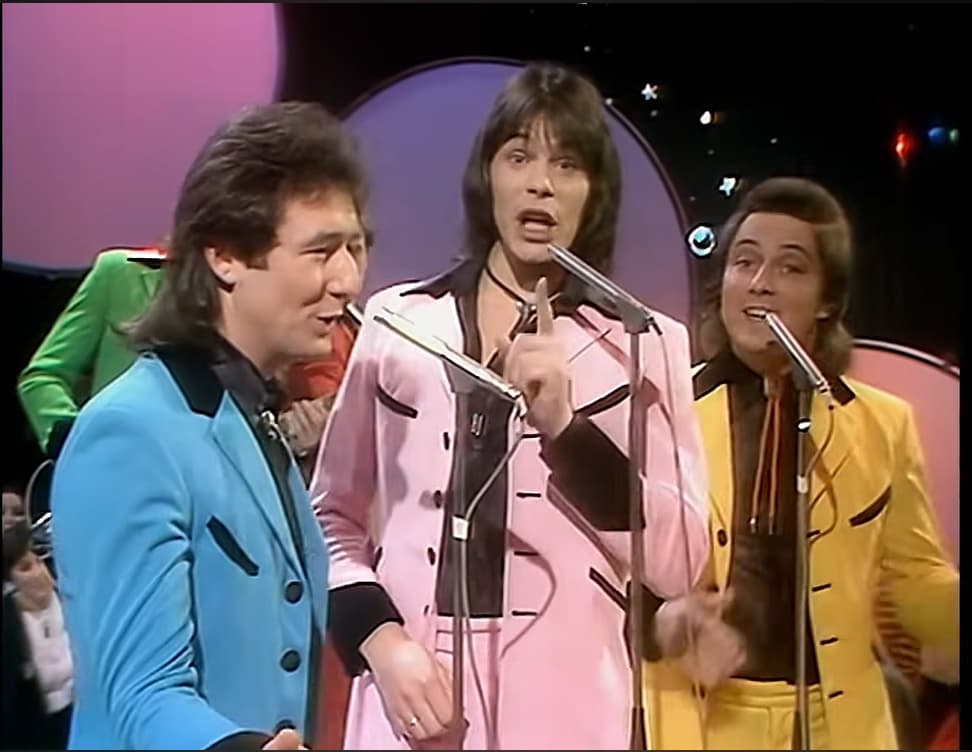
“When” carried the innocence of 1950s romance into the bright, changing world of 1977, giving Showaddywaddy another major hit just months after their unforgettable No. 1 triumph with “Under the Moon of Love.”
When Showaddywaddy appeared on BBC’s Top of the Pops on April 7, 1977, performing “When,” the band was enjoying another remarkable moment in its extraordinary chart career. Released on February 25, 1977, “When” was their first single for Arista Records after leaving the Bell label, and it quickly proved that the enormous success of “Under the Moon of Love” had not been a one time miracle. The single reached No. 3 on the UK Singles Chart, becoming another major hit for the Leicester eight piece. By the week of their April 7 appearance, “When” was still sitting high in the charts, and on the official chart dated April 10 to 16, 1977, it stood at No. 4, having already reached its peak of No. 3.
The song itself had already travelled a long road before Showaddywaddy discovered it. “When” was written by Paul Evans and Jack Reardon and originally recorded by American vocal duo The Kalin Twins in 1958. Their version became a major international hit, reaching No. 5 on the Billboard Hot 100 and No. 1 on the UK Singles Chart. Nearly two decades later, Showaddywaddy brought the song back at exactly the right moment. Their entire career had been built around an understanding that the music of the 1950s still possessed an irresistible emotional pull. But they were never simply copying old records. They gave those songs the power of a modern 1970s band, with fuller instrumentation, stronger rhythms, layered harmonies, and the unmistakable visual energy of eight musicians who knew how to command a television stage.
“When” was particularly suited to their style because it carried the innocence and longing that defined so many of the great teenage love songs of the late 1950s. The lyrics imagine the future with the wide eyed optimism of young love. It is a song built around anticipation, around the dream of the day when love will finally be returned and life will become what the singer hopes it might be. There is no cynicism in its world. That simplicity was one of the reasons the original record had connected so strongly with audiences in 1958, and nearly twenty years later, Showaddywaddy understood that the feeling had not disappeared. People still remembered what it was like to wait for a telephone call, to walk someone home, to imagine a future with the person who had captured their heart.
Their April 7, 1977 appearance on Top of the Pops arrived during a fascinating period in British popular music. The charts were changing rapidly. Disco was rising, with artists such as Boney M beginning to dominate European dance floors, while new musical movements were gathering strength across Britain. Within months, punk would dramatically reshape the cultural conversation. Yet Showaddywaddy remained proudly connected to an earlier era. Their suits, hairstyles, harmonies, and rock and roll arrangements seemed to come from another time, but they were not trapped in nostalgia. They were proving that a great song could survive changes in fashion.
The episode itself was presented by David “Kid” Jensen, and Showaddywaddy appeared alongside artists including Deniece Williams, Elkie Brooks, Cliff Richard, The Manhattans, Maxine Nightingale, O.C. Smith, and ABBA. It was a particularly rich snapshot of the British charts in 1977, with Showaddywaddy performing their revival of a 1958 classic while ABBA were riding high with “Knowing Me, Knowing You.”
For Showaddywaddy, “When” also represented an important new beginning. Their previous single, “Under the Moon of Love,” had been released in October 1976 and had become the band’s only UK No. 1 single, spending three weeks at the top. It was a triumph that could easily have placed enormous pressure on the group. Moving to a new label immediately afterward made the next release even more significant. “When” answered the question quickly. The audience was still there. The band still had the momentum. Their move to Arista had begun successfully. The official Showaddywaddy discography records “When” as their first Arista release, issued in a picture sleeve, and its No. 3 peak confirmed that the band remained one of Britain’s most reliable singles acts.
What makes the performance so enjoyable today is the confidence Showaddywaddy brought to it. By 1977, they were no longer newcomers trying to convince the public that the rock and roll revival had a future. They had already built an impressive run of hits, including “Hey Rock and Roll,” “Three Steps to Heaven,” “Heartbeat,” and “Under the Moon of Love.” The group had found its formula, but more importantly, it had found its personality. The eight members could fill a stage with movement and sound while still maintaining the sense that they were a real band rather than a carefully manufactured pop act.
Listening to “When” now, it is easy to understand why it worked so well for them. The song carries a sweetness that Showaddywaddy knew how to preserve without making it feel old fashioned. Their version is brighter, stronger, and more muscular than the delicate original, but the heart of the song remains intact. Beneath the guitars and harmonies is the same simple dream: the hope that love will eventually arrive and stay.
The Top of the Pops performance on April 7, 1977 therefore captured more than another chart appearance. It caught Showaddywaddy at the beginning of a new chapter, only months after reaching the summit of the British charts and already proving that they could continue the journey. “When” would remain on the UK chart for 11 weeks, and its success helped carry the band into another strong year that would soon bring further major hits, including “You Got What It Takes,” which reached No. 2 later in 1977.
For three minutes on a BBC stage in April 1977, Showaddywaddy made a song from 1958 feel wonderfully alive again. The decade had changed, the fashions had changed, and British music was moving toward another revolution, but the old dream inside “When” remained exactly the same: somewhere in the future was the moment when everything hoped for might finally come true.