
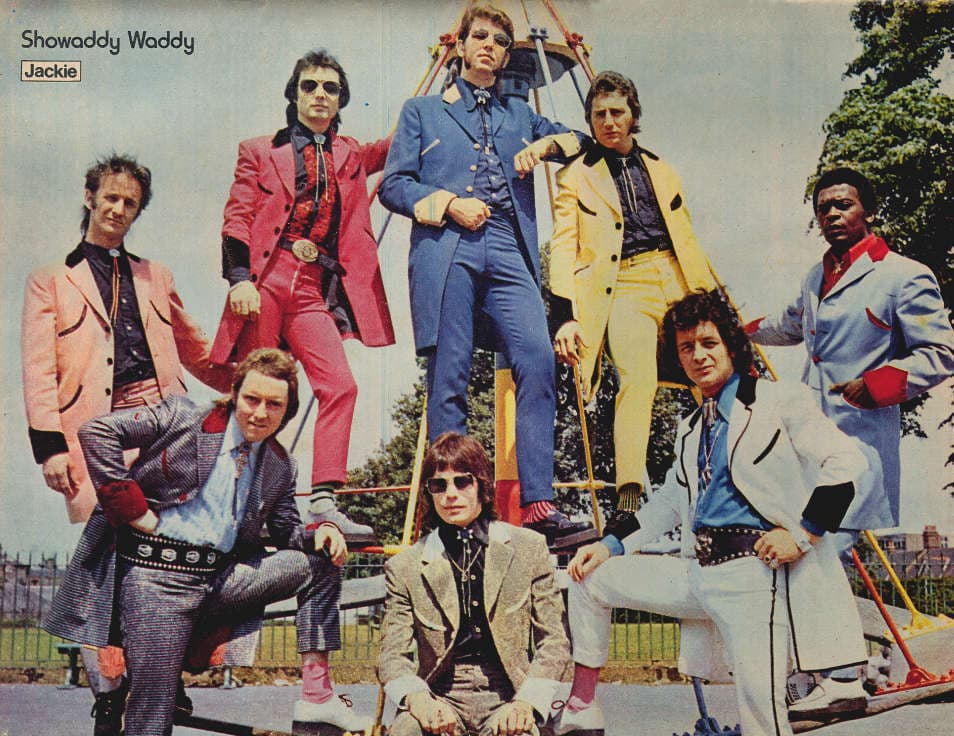
“King of the Jive” captured Showaddywaddy at their most energetic, celebrating the music and dance that had shaped their identity long before they became one of Britain’s biggest chart acts.
When Showaddywaddy performed “King of the Jive” for LWT’s Superpop in July 1976, the Leicester band were already one of the most exciting live attractions in Britain. The performance was recorded on July 7, 1976, at Kent House Studio in the London Television Centre, in front of a theatre audience. It came during a fascinating period in the group’s career, when their chart fortunes were briefly uncertain but their reputation as a powerful live band remained stronger than ever. The summer single “Take Me in Your Arms” had been released on July 16 and failed to enter the UK Singles Chart, while their earlier 1976 album Trocadero had reached only No. 41. Yet Showaddywaddy were constantly touring, appearing on television, and performing with the kind of energy that could make an eight piece band feel like an entire Saturday night dance hall.
“King of the Jive” itself came from an earlier chapter of the band’s story. The song was one of the original compositions included on Showaddywaddy’s self titled debut album, Showaddywaddy, released on November 8, 1974. The album reached an impressive No. 9 on the UK Albums Chart, confirming that the band were more than simply a novelty revival act. Their debut contained nine original songs and three cover versions, and “King of the Jive” stood among the original material that revealed how deeply the group understood the music they were reviving.
Unlike many of Showaddywaddy’s biggest hits, “King of the Jive” was not released as a chart single, so it has no individual UK Singles Chart position. That fact makes the song especially interesting. Its importance was not measured by a peak position or the number of weeks it spent on the charts. Instead, “King of the Jive” became part of the band’s musical personality, a song that appeared regularly in their live sets during the mid 1970s. Their official concert records show it being performed repeatedly in 1975 and 1976, and it remained part of their stage repertoire into 1977.
The song also belonged strongly to Al James, one of Showaddywaddy’s most distinctive performers. James performed the lead vocal on “King of the Jive,” and the song became one of several recordings that demonstrated his importance within the group beyond the famous shared image of eight musicians performing together. Russ Field, the band’s lead guitarist, also played bass on the recording, adding another small but fascinating detail to its history.
Musically, “King of the Jive” is a declaration of loyalty to the world Showaddywaddy loved. The jive was not merely an old dance to them. It represented an entire musical culture: dance halls, leather jackets, jukeboxes, guitars, harmony vocals, and the restless excitement that had defined the first great explosion of rock and roll. By the 1970s, much of that world belonged to memory, but Showaddywaddy understood that memory could still move. Their genius was not simply to reproduce the sounds of the 1950s. They gave those sounds a louder, more theatrical, and distinctly British 1970s identity.
That is what makes the Superpop performance so valuable. Television had become an essential part of Showaddywaddy’s success, but a studio appearance could sometimes reveal a different side of the band from a carefully produced single. Onstage, Showaddywaddy were physical, animated, and deliberately larger than life. With eight members sharing the spotlight, there was always movement somewhere: guitars, drums, harmonies, choreography, and the unmistakable visual style that made them immediately recognisable.
The timing of the performance is equally revealing. In July 1976, Showaddywaddy were approaching one of the most dramatic turning points of their career. Their summer releases had not performed as strongly as their earlier hits, and “Take Me in Your Arms” would fail to chart. But the band never stopped working. They continued touring throughout Britain, appeared regularly on television, and kept faith with the musical style that had brought them success. Just a few months later, that determination would be rewarded beyond anyone’s expectations when “Under the Moon of Love” was released in October 1976 and became Showaddywaddy’s only UK No. 1 single, reaching the top of the chart in December.
Looking back, “King of the Jive” almost feels like a statement of purpose before that extraordinary success returned. The band were not waiting for fashion to approve of them. Punk was beginning to gather momentum, pop music was changing rapidly, and the British charts were becoming increasingly unpredictable. Yet Showaddywaddy continued to sing about the music that had first made them fall in love with performing.
There is something wonderfully honest about that. “King of the Jive” does not carry the melancholy of a lost love song or the polished ambition of a carefully calculated hit. It celebrates movement, rhythm, and the simple pleasure of hearing a band play music that makes people want to get up and dance.
The July 1976 Superpop performance captured Showaddywaddy during that uncertain but exciting moment, before “Under the Moon of Love” would change everything again. For a few minutes, Al James and the rest of Showaddywaddy returned to the roots of their musical world and reminded television audiences exactly what had made them famous in the first place: they did not simply remember rock and roll.