
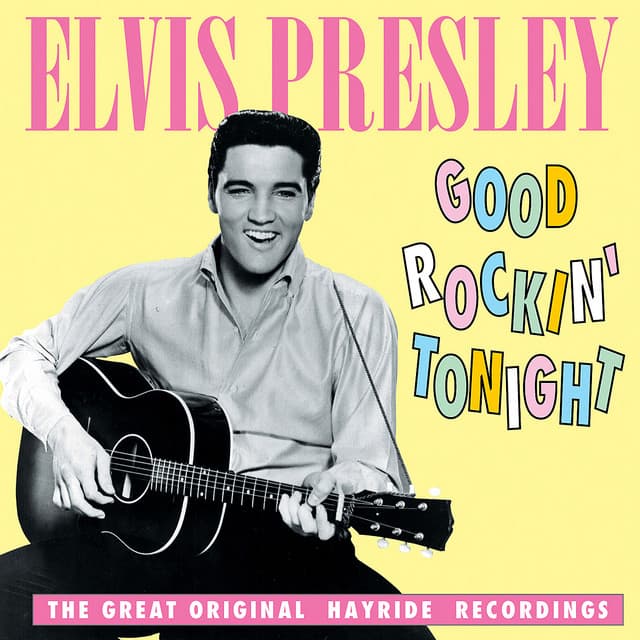
“Good Rockin’ Tonight” captured Elvis Presley at the moment a new musical language was beginning to take shape
There is something almost startling about hearing Elvis Presley’s “Good Rockin’ Tonight” today and remembering that this recording was made when he was only 19. Recorded at Sun Records’ studio in Memphis in September 1954, the song became the A-side of Sun 210, Elvis’s second single, officially released on October 4, 1954. The record followed “That’s All Right,” the July 1954 single that had introduced Elvis to a local Memphis audience, but “Good Rockin’ Tonight” revealed that the young singer was not simply repeating the formula of his debut. He was becoming increasingly fearless about bringing country, blues and rhythm and blues together in a way that felt startlingly fresh.
The song itself was written by Roy Brown, who had turned “Good Rockin’ Tonight” into a major rhythm and blues hit in 1948. Elvis did not treat it as a museum piece. He attacked it with an exuberance that transformed the song into something leaner, faster and more physical. Behind him were Scotty Moore on electric guitar and Bill Black on bass, the two musicians who had already become central to the sound of his early Sun recordings. Elvis also played rhythm guitar. The official Elvis site describes the performance as full of drive and exuberance, while the surviving session information places the recording in mid-September 1954.
What makes the recording historically important is not simply that it was an early Elvis record. It shows Sam Phillips and his young singer pushing against the boundaries separating musical categories. Phillips had already understood that Elvis could connect musical worlds that were usually kept apart. The Library of Congress notes that Elvis’s Sun sessions began on July 5, 1954, and that Phillips was looking for a sound that did not fit neatly into the established categories of country or rhythm and blues. By the time “Good Rockin’ Tonight” was recorded, that search was becoming audible. The country influence was still there in the instrumentation and rhythm, while Roy Brown’s blues foundation remained unmistakable. Elvis stood directly between those traditions and made the tension part of the excitement.
There is also an intriguing sense of momentum surrounding the record. “That’s All Right” had already given Memphis listeners something they had not quite heard before, and Sun Records was now concentrating heavily on its new young artist. The official Elvis Presley site notes that Sam Phillips devoted himself almost exclusively to promoting Elvis and his debut, holding back other new Sun releases while the young singer’s career began to gather speed. “Good Rockin’ Tonight” therefore arrived at a particularly important moment. It was not yet the fully formed cultural phenomenon that Elvis would become, but the ingredients were unmistakable: the rhythmic attack, the blues feeling, Scotty Moore’s sharp guitar, Bill Black’s driving bass and a vocalist who sounded as though he had discovered that restraint was optional.
The record did not become a major national chart hit in 1954, and its importance cannot really be measured by chart position. Its significance lies in what it documented. Elvis was still at the beginning, still making records for a small Memphis label, still far removed from the international fame that awaited him. Yet within those two minutes, the old musical borders were already becoming porous. “Good Rockin’ Tonight” was not the finished blueprint for rock ’n’ roll, but it was one of the early pieces of the puzzle. Hearing it now, there is a remarkable sense of the future pressing through the speakers, while Elvis himself still sounds young enough to be discovering that future along with everyone else.
 Oldies Songs