
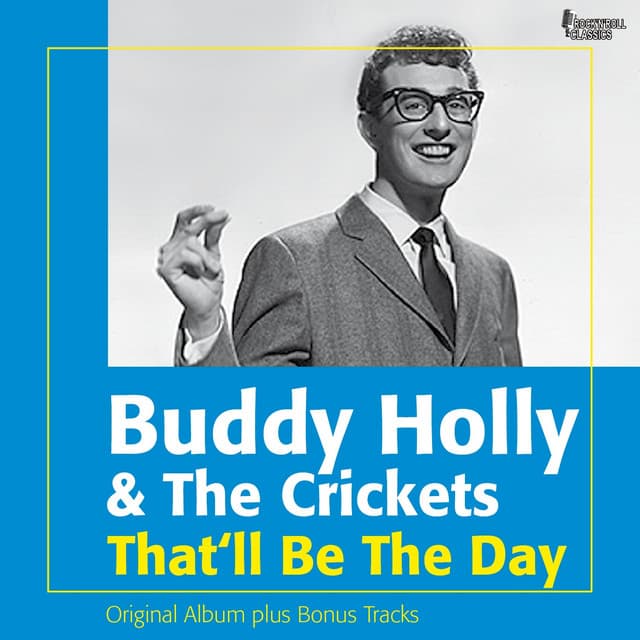
“That’ll Be the Day” was the record that turned Buddy Holly from a promising Texas musician into a defining voice of early rock ’n’ roll
Few recordings from 1957 sound as fresh today as “That’ll Be the Day.” Released by the Crickets, with Buddy Holly at the centre, the song entered the UK Singles Chart at No.12 on 3 October 1957, climbed steadily and reached No.1 on 7 November, remaining at the top for three weeks. It spent 14 weeks on the chart. What makes the record remarkable is not simply its commercial success, but the feeling that Holly and the Crickets had discovered a new way of making rock ’n’ roll sound intimate. The guitars are lean, the rhythm moves with an easy insistence, and Holly’s slightly nasal, unmistakably youthful voice gives the song an almost conversational quality. He never sounds as though he is trying to overpower the record. Instead, he lets personality do the work.
The story behind the title is almost cinematic. Holly, drummer Jerry Allison and songwriter Norman Petty took inspiration from John Wayne’s repeated use of the phrase “that’ll be the day” in the 1956 western The Searchers. Holly and Allison developed the song from that idea, and it became one of the key recordings of Holly’s early career. The road to the finished version was not straightforward. Holly had already recorded an earlier version for Decca in Nashville in 1956, but the sound did not capture what he and his collaborators wanted. The later recording made at Petty’s studio in Clovis, New Mexico, with the Crickets, had a much more direct character and became the version that audiences embraced.
By then, Holly had already been building his musical identity in Lubbock, Texas. Born Charles Hardin Holley in 1936, he had grown up surrounded by country music before becoming increasingly fascinated by rhythm and blues and the new rock ’n’ roll sound. His name was accidentally spelled “Holly” rather than “Holley” on a Decca contract, and the shorter spelling remained. He eventually formed the Crickets with Jerry Allison, Joe B. Mauldin and Niki Sullivan, creating a group whose records would influence generations of musicians. Official Charts credits the Crickets with the 1957 UK No.1 and records Holly’s extraordinary subsequent run of hits, including “Peggy Sue,” “Rave On” and “It Doesn’t Matter Anymore.”
There is also a fascinating difference between the youthful simplicity of “That’ll Be the Day” and the enormous influence it eventually acquired. Nothing about the recording announces that it will become historically important. It is compact, catchy and full of nervous energy. Holly’s vocal almost smiles through the verses, while the backing harmonies and guitar work keep the song moving. That combination became part of the blueprint for countless groups that followed. The record demonstrated that a rock ’n’ roll singer did not need the imposing stage presence of Elvis Presley or the raw attack of Little Richard to command attention. Holly could sound vulnerable and confident at the same time.
The poignancy comes from knowing how little time remained. Buddy Holly died on 3 February 1959, aged only 22, in the plane crash near Clear Lake, Iowa, that also killed Ritchie Valens and J. P. “The Big Bopper” Richardson. Yet “That’ll Be the Day” contains none of the sadness that would later surround Holly’s story. It feels young, restless and completely alive. That is perhaps why the recording remains so powerful. Listening to it is not like looking at the final chapter of Buddy Holly’s life. It is hearing the beginning of something, a young musician discovering how much could be done with a guitar, a few chords, a memorable phrase and a voice that sounded unmistakably his own.