
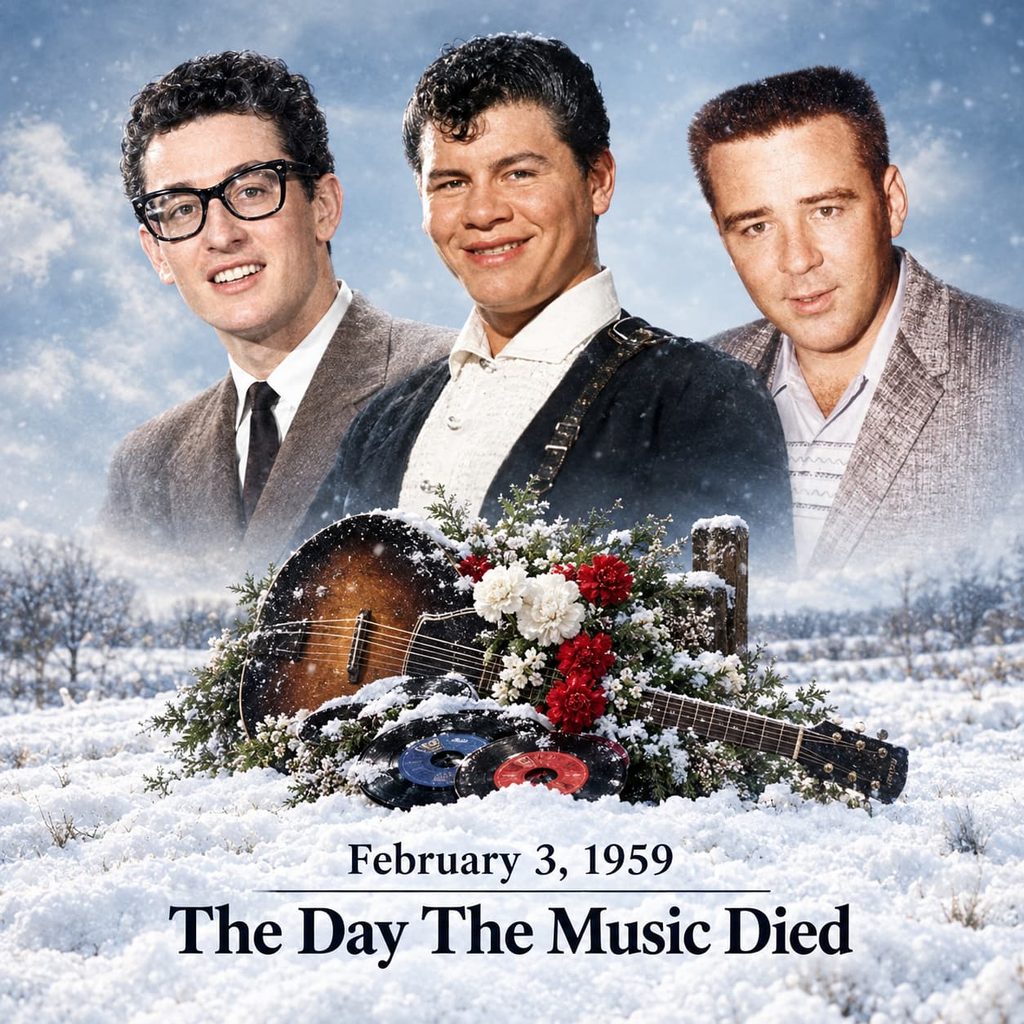
THE DAY THE MUSIC DIED: THREE YOUNG LIVES THAT NEVER HAD THE CHANCE TO FINISH THEIR SONGS
Some nights in music history are remembered for the records they created. February 3, 1959, is remembered for the records that would never be made. In the early hours of that Tuesday morning, a small Beechcraft Bonanza disappeared into the darkness above a snow-covered Iowa field, carrying Buddy Holly, Ritchie Valens, and J.P. “The Big Bopper” Richardson. All three, along with 21-year-old pilot Roger Peterson, were killed shortly after takeoff from Mason City. Holly was only 22, Valens just 17, and Richardson 28. Their deaths would become known as “The Day the Music Died,” a phrase that entered popular culture through Don McLean’s 1971 song “American Pie.” But behind that famous phrase was something much more intimate: three young musicians at very different stages of their lives, each still moving forward, still recording, still performing, and still carrying the unfinished possibilities of a career that suddenly stopped in the Iowa snow.
The tragedy began with a tour that had already become brutally exhausting. The Winter Dance Party had started on January 23, 1959, and the itinerary forced the musicians to travel enormous distances across the Midwest with virtually no days off. The buses were poorly suited to the freezing conditions, and one of Holly’s musicians, drummer Carl Bunch, suffered frostbite. By the time the tour reached the Surf Ballroom in Clear Lake, Iowa, on February 2, the performers were cold, tired and increasingly frustrated with life on the road. After the show, Buddy Holly decided to charter a small plane to fly ahead to Fargo, North Dakota, near the next stop in Moorhead, Minnesota. The flight would save hours on the bus and give the travelers time to rest and deal with their dirty stage clothes. It was not an extravagant escape from the tour. It was a practical decision made by musicians who were simply worn down by an unforgiving winter schedule.
The three passengers were not originally meant to be Holly, Valens and Richardson. Holly had arranged the flight for himself and his bandmates Waylon Jennings and Tommy Allsup. But Richardson was suffering from the flu and persuaded Jennings to give him his seat. Allsup and Valens settled their own place with a coin toss, and the 17-year-old Valens won. Shortly after midnight, the aircraft took off into difficult winter weather. Within minutes, it had crashed into a snow-covered field near Clear Lake. The official investigation attributed the accident to the pilot’s decision to undertake the flight under conditions requiring instrument flight capability and to his loss of control of the aircraft. There would be no arrival in Minnesota, no warm hotel room, no laundry, no next night’s performance. The road that had carried them through eleven performances simply ended in the darkness.
Buddy Holly had already accomplished an extraordinary amount by 22. From “That’ll Be the Day” and “Peggy Sue” to “Oh, Boy!” and “Not Fade Away,” his songs helped establish a new kind of rock and roll built around the singer as songwriter and bandleader. The Library of Congress later placed “That’ll Be the Day” in the National Recording Registry, recognizing its enduring cultural importance. Holly’s influence would reach far beyond the brief span of his recording career, touching musicians who followed, including artists such as Bob Dylan and Paul McCartney. Ritchie Valens, meanwhile, was only beginning to reveal what he might become. His recording of “La Bamba”, released in 1958 as the B-side of “Donna,” transformed a traditional Mexican song into an electrifying rock and roll performance and helped open a path for generations of Chicano musicians. The Library of Congress has described Valens’s success as bringing a new sound into the mainstream. And then there was The Big Bopper, whose larger-than-life personality, songwriting and recording of “Chantilly Lace” had already made him a distinctive presence in the young rock era.
That is perhaps what makes February 3 so haunting. These were not three legends looking backward at careers already completed. They were young men moving toward what came next. Holly was developing new music and building his career beyond the Crickets. Valens had only just begun to establish himself nationally. Richardson had found success as a songwriter, performer and radio personality and was still expanding his ambitions. Their deaths froze them in a particular moment of youth, leaving behind songs that would continue to grow while their creators could not. Years later, Buddy Holly’s glasses, lost in the wreckage and buried beneath the snow, were recovered in Mason City in 1980. The physical object seemed almost impossibly small compared with the cultural shadow cast by that night.
And perhaps that is why “The Day the Music Died” has remained more than a date. It became a symbol of possibility interrupted. Don McLean gave the tragedy its most famous musical memorial with “American Pie,” but the three men never needed a monument in order to remain present. Buddy Holly still arrives through the bright snap of “Peggy Sue.” Ritchie Valens still dances through the guitar and rhythm of “La Bamba.” The Big Bopper still bursts into the room with the unmistakable energy of “Chantilly Lace.” On February 2, they walked onto the stage at the Surf Ballroom in Clear Lake and performed for a crowd of more than a thousand people. A few hours later, the music stopped in an Iowa field. Their lives ended there, but the recordings they left behind continued travelling down the road they never got to finish.
 Oldies Songs