
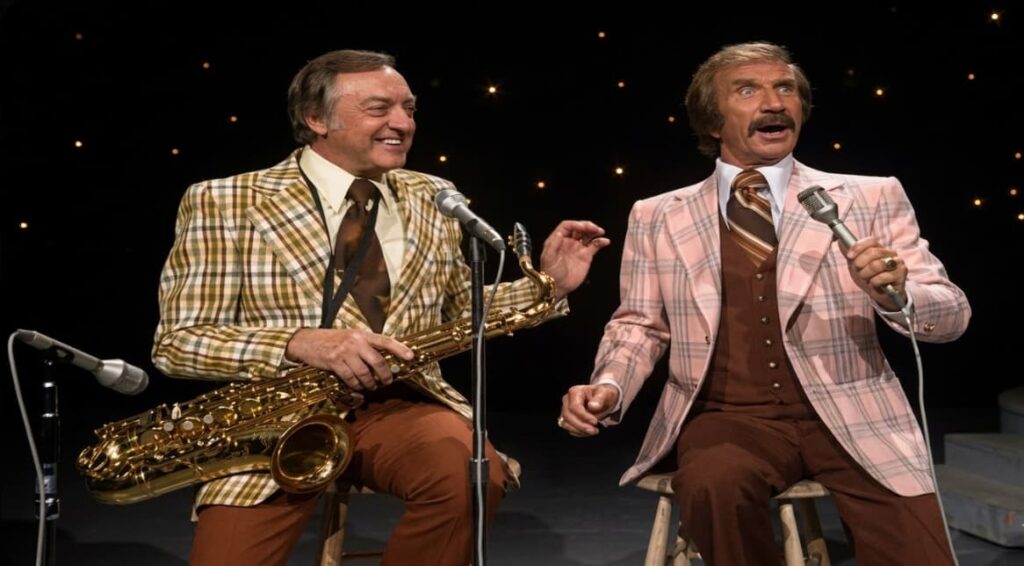
Boots Randolph and Marty Robbins on The Marty Robbins Show: A Dazzling Collision of Saxophone Soul and Country Charisma
In the pantheon of 20th-century entertainment, there were moments captured on celluloid that felt less like scripted television and more like a high-stakes jam session between old friends. Such was the case in the early 1980s when Marty Robbins, the “Boy from Glendale” with the silver tongue and the golden voice, welcomed the incomparable Boots Randolph—the “Yakety Sax” king himself—onto The Marty Robbins Show. For those of us who grew up in an era where musical virtuosity was the standard rather than the exception, this pairing was a feast for the senses. It brought together Marty Robbins, the master storyteller of the West, and Boots Randolph, the man whose saxophone provided the brassy heartbeat of the “Nashville Sound” for decades, appearing on legendary recordings by everyone from Elvis Presley to Roy Orbison.
The “story” of this particular television appearance is one of mutual admiration and a shared sense of mischief. The Marty Robbins Show, which aired in the late 70s and early 80s, was a sanctuary for “real” musicians. When Boots Randolph stepped onto that stage with his selmer tenor sax, the atmosphere shifted. While Boots was synonymous with the frantic, comedic energy of “Yakety Sax” (reaching Number 35 on the Billboard Hot 100 in 1963 and becoming a global pop culture staple), his appearance with Marty showcased the sophisticated, soulful versatility that made him a first-call session man in Nashville. Together, they didn’t just perform songs; they traded energies—Marty with his quick-witted banter and Boots with those growling, rhythmic riffs that seemed to speak a language all their own.
For the discerning viewer who remembers the tactile warmth of a television set in the early 80s, watching these two icons is a deeply nostalgic journey. It evokes memories of a time when “Variety” truly meant variety—where a cowboy ballad could lead seamlessly into a swinging jazz-infused instrumental. The sight of Marty Robbins, often leaning against a stool or playfully “conducting” the band, trying to keep up with Boots’ lightning-fast fingerwork, is a masterclass in stage presence. There was a genuine, unforced joy in their collaboration. As we reflect on these performances today, we realize they represent the peak of a “Craftsman Era” in Nashville, where talent was raw, live, and entirely human.
The meaning behind this collaboration transcends the music itself. It serves as a poignant reminder of a lost art form: the musical conversation. In an age of digital perfection, seeing Boots Randolph break a sweat during a solo while Marty Robbins cheers him on from the sidelines offers a profound sense of connection. It reminds us of our own youth, of late nights spent listening to the radio or watching these titans define what it meant to be an entertainer. They were more than just stars; they were the architects of our musical landscape. To revisit this footage now is to sit once again in the front row of history, feeling the vibration of the saxophone and the charm of the storyteller, knowing that while they are gone, the echoes of their laughter and their notes remain a permanent part of our collective soul.
 Music Legend