
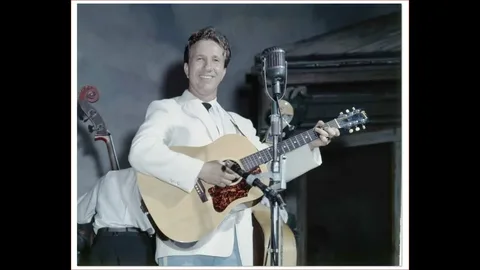
Marty Robbins and “A Lifetime in Love Songs”: The Emotional Odyssey of a Master Troubadour
In the hallowed halls of country music history, there are singers, and then there are storytellers who possess the alchemy to turn a three-minute melody into a cinematic masterpiece. Marty Robbins was undoubtedly the latter. When we look back at his live performances—particularly those captured in the twilight of his career in the late 1970s and early 1980s—we aren’t just watching a concert; we are witnessing a man encapsulating an entire lifetime through the prism of the love song. Whether he was standing center stage at the Grand Ole Opry or hosting his own syndicated television special, Marty Robbins commanded a room with a vocal range that earned him the nickname “The Man with the Velvet Voice.” His ability to pivot from the dusty, tragic trails of “El Paso” to the tender, heart-on-sleeve vulnerability of “My Woman, My Woman, My Wife” remains unparalleled.
The “story” of Marty Robbins live is one of relentless charisma and vocal perfection. Unlike many of his contemporaries who leaned into the rugged “Outlaw” persona, Marty maintained a sophisticated, almost operatic approach to country music. His 1970 masterpiece, “My Woman, My Woman, My Wife,” which soared to Number 1 on the Billboard Hot Country Songs and earned him a Grammy Award, became the cornerstone of his live sets. It was more than a hit; it was a public tribute to his wife, Marizona, and a profound acknowledgment of the sacrifices made in the name of a long-term union. To hear him sing it live, with that slight, signature quiver in his upper register, was to hear a man laying his soul bare before thousands of strangers, turning a personal sentiment into a universal anthem for every husband and wife in the audience.
For those of us who have lived through the decades, watching Marty perform evokes a powerful, lingering nostalgia for a time when “entertainment” meant a suit, a smile, and a voice that didn’t need a single digital correction. His live shows were a tapestry of human experience: the youthful bravado of “A White Sport Coat (And a Pink Carnation),” the haunting loneliness of “Among My Souvenirs,” and the epic, Western tragedies that made him a legend. He had an uncanny knack for making a crowd of thousands feel like a small, intimate gathering in a living room. As we reflect on these performances now, through the lens of our own silver years, the lyrics take on a deeper resonance. We realize that Marty wasn’t just singing about fictional characters; he was singing about the trajectory of our own lives—the first dances, the quiet anniversaries, and the inevitable heartaches that define a life well-lived.
The meaning of a Marty Robbins performance lies in its honesty. He never shied away from the “sentimental,” a word often used as a critique but one that he wore as a badge of honor. He understood that love is the only theme that truly matters as the years go by. In the quiet moments of his live recordings, you can hear a pin drop as he reaches for those high, crystalline notes, reminding us of the beauty that exists in being “all in” on a feeling. To revisit his work today is to be transported back to an era of elegance and emotional depth. The Master Storyteller may no longer be with us to take a final bow, but in every live recording, his spirit remains vibrant, inviting us once more to sit back, close our eyes, and remember the love songs that served as the soundtrack to our own lifetimes.
 Music Legend