
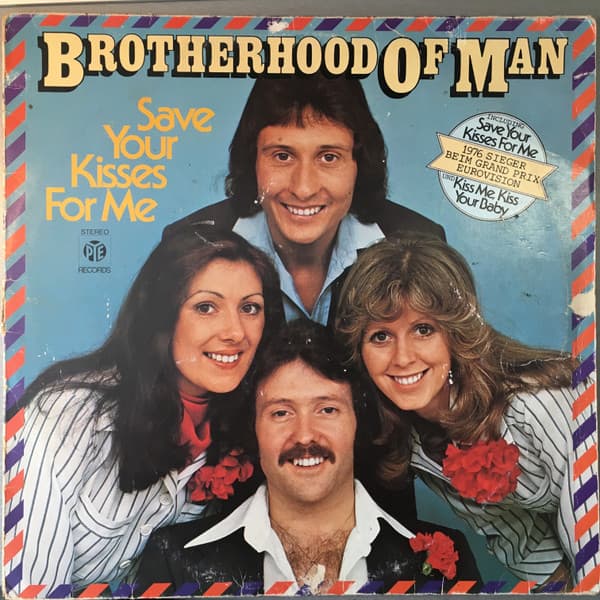
A tender farewell disguised as a love song, “Save Your Kisses for Me” reveals that the purest devotion is not romantic at all—but paternal.
When Brotherhood of Man released “Save Your Kisses for Me” in 1976, few could have predicted that this gentle, almost whimsical tune would become one of the most memorable songs of the decade. Yet the facts speak with clarity: the song won the Eurovision Song Contest 1976 for the United Kingdom with a then-record 164 points, reached No. 1 on the UK Singles Chart, where it remained for six consecutive weeks, and climbed to No. 27 on the Billboard Hot 100 in the United States. It went on to sell over six million copies worldwide, becoming one of the biggest-selling Eurovision winners in history.
Written by Tony Hiller, Lee Sheriden, and Martin Lee, and featured on the album Love and Kisses (1976), the song’s brilliance lies not in vocal acrobatics or grand orchestration, but in its simplicity. The arrangement is light, almost childlike, with a gently bouncing rhythm and close harmonies that evoke warmth rather than spectacle. And yet beneath that cheerful exterior rests one of the most quietly affecting lyrical twists in popular music.
At first listen, “Save Your Kisses for Me” seems like a tender message from a man reluctantly leaving his lover as he heads off to work. “Goodbye, goodbye, baby, don’t cry…” The lines feel familiar, comfortably romantic. For much of the song, we assume we are hearing the voice of a devoted partner offering reassurance and affection. But then comes the final line—“Even though you’re only three.” In that single revelation, the entire meaning shifts. The “baby” is not a lover. She is a child. A father is speaking to his little daughter before leaving for the day.
It is a masterstroke of songwriting—deceptively simple, emotionally resonant, and profoundly human. The twist does not feel manipulative; rather, it deepens the sentiment. What seemed sweet becomes sacred. The farewell is no longer about romance but about the everyday ache of parenthood—the small heartbreak of walking out the door knowing that someone tiny and trusting is watching you leave.
In the context of 1976, when glam rock flamboyance and disco’s rising pulse dominated the airwaves, Brotherhood of Man offered something disarmingly wholesome. Dressed in coordinated white outfits during their Eurovision performance, they stood almost modestly under the stage lights. There were no dramatic gestures, no vocal theatrics—only melody, harmony, and a smile that carried sincerity. It was a reminder that music does not always need grandeur to endure. Sometimes it only needs truth.
The song’s commercial success was remarkable. In the UK, it became the best-selling single of 1976. Across Europe, it topped charts in countries including Belgium, Ireland, Norway, and Spain. Its universal appeal lay in its accessibility. The melody is instantly memorable, the chorus irresistibly singable. But more than that, it tapped into something timeless: the quiet devotion found in ordinary moments.
Listening to “Save Your Kisses for Me” today carries a particular kind of resonance. It evokes an era when songs often told complete stories within three minutes, when harmonies were crafted with care, and when lyrical subtlety could still surprise an audience. There is a certain innocence in its construction—an innocence that feels increasingly rare.
And yet, it is not naïve. It understands that love takes many forms. Romantic love may ignite with drama, but familial love sustains with constancy. The father in the song does not promise grand gestures; he promises return. “Won’t be long before I’m home.” That line alone holds a universe of reassurance.
In retrospect, Brotherhood of Man may not have carried the rebellious mystique of some of their contemporaries, but with “Save Your Kisses for Me”, they achieved something arguably more enduring: they created a song that still brings a gentle smile, a soft sigh, and perhaps a memory of small hands waving from a doorway.
Nearly half a century later, its charm remains intact—not because it shouts for attention, but because it whispers something deeply familiar. And in that whisper, we find ourselves remembering that the simplest goodbyes are often the most meaningful of all.