
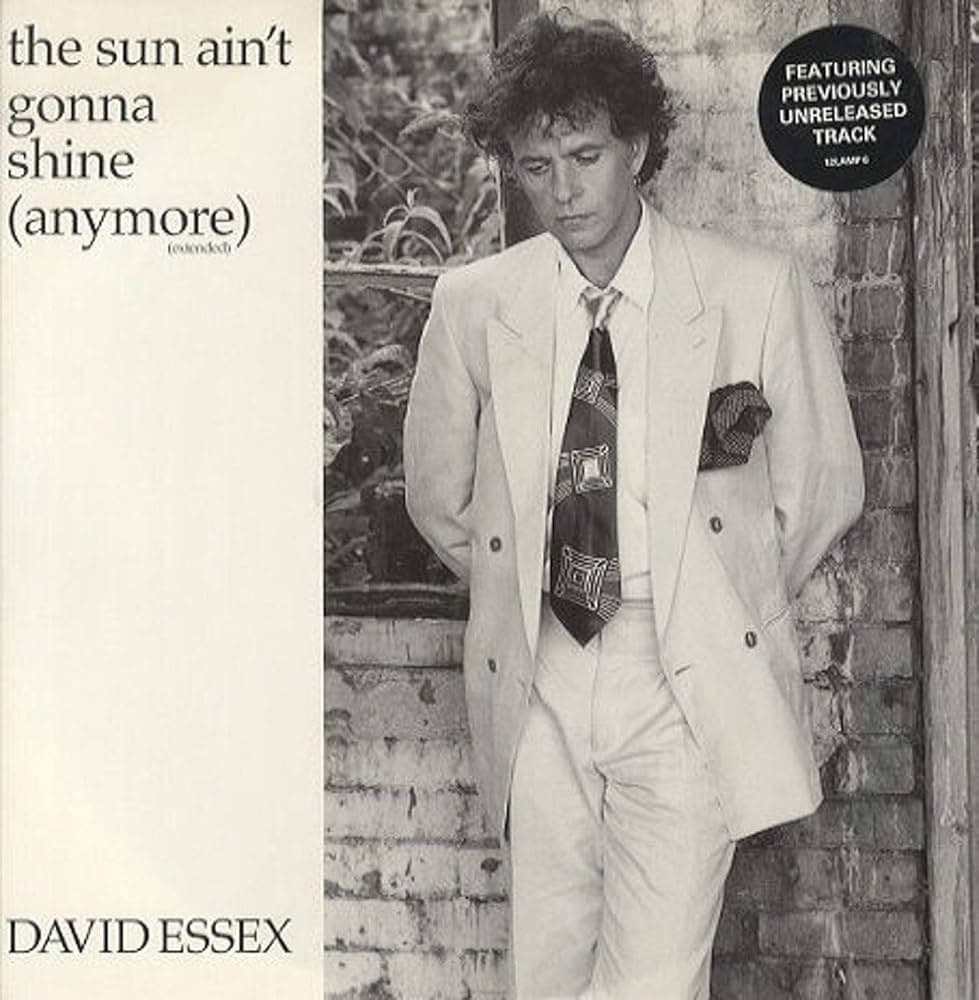
A Song of Solitude and Lost Light — When Love Fades, Even the Sun Refuses to Shine
Released in 1973 as part of the soundtrack to the film That’ll Be the Day, “Sun Ain’t Gonna Shine Any More” by David Essex stands as one of the most emotionally charged interpretations of a song already steeped in pop history. Though famously associated with The Walker Brothers, whose 1966 version soared to No. 1 on the UK Singles Chart and No. 13 on the Billboard Hot 100, Essex’s rendition carried a different weight—rawer, more intimate, and closely tied to his emergence not only as a pop idol but as a serious dramatic presence.
Essex’s version was not released as a major standalone chart single in the same way as his breakthrough hit “Rock On,” which reached No. 3 in the UK and No. 5 in the United States in 1973–74. Instead, “Sun Ain’t Gonna Shine Any More” became woven into the emotional fabric of That’ll Be the Day, the 1973 British coming-of-age film in which Essex starred alongside Ringo Starr. The film itself was a commercial and critical success in the UK, and it played a crucial role in shaping Essex’s early career. His performance—both as an actor and as a singer—introduced audiences to a young artist capable of vulnerability beneath the surface of rising fame.
Originally written by Bob Crewe and Bob Gaudio in 1965, the song was first recorded by Frankie Valli before achieving global recognition through The Walker Brothers. Their orchestral, Phil Spector–inspired production created a grand, almost operatic sense of heartbreak. By contrast, David Essex’s interpretation stripped away some of that sweeping grandeur and leaned into a more personal ache. His voice, slightly hushed yet emotionally exposed, suggested not melodrama but genuine loneliness.
The lyrics themselves remain devastatingly simple: “Loneliness is a cloak you wear / A deep shade of blue is always there.” It is a meditation on abandonment, on the kind of loss that dims the entire world. The “sun” in the title is more than a celestial body—it is hope, warmth, and emotional vitality. When love departs, the song suggests, even nature seems to withdraw its comfort.
What makes Essex’s version particularly compelling is the context of his own ascent. In 1973, he was on the brink of enormous popularity. “Rock On” had already signaled a new voice in British pop—minimalist, rhythmic, almost hypnotic. Soon after, “Gonna Make You a Star” would climb to No. 1 on the UK Singles Chart in late 1974, cementing his status as a household name. Yet in “Sun Ain’t Gonna Shine Any More,” there is no bravado, no glam-rock glitter. There is only introspection.
Listening now, decades later, the recording carries the atmosphere of early 1970s Britain—a time of cultural change, shifting identities, and youthful restlessness. Essex’s performance feels cinematic because it is inseparable from That’ll Be the Day. In the film, the song underscores themes of longing and disillusionment, mirroring a generation searching for meaning beyond the bright promises of the post-war years.
The arrangement in Essex’s version favors clarity over spectacle. The instrumentation supports rather than overwhelms his vocal line. Where The Walker Brothers delivered towering drama, Essex offered something closer to confession. That distinction matters. It reveals an artist who understood that heartbreak need not shout to be heard.
Over time, David Essex would prove himself far more than a fleeting pop sensation. His later successes—such as “Hold Me Close,” another UK No. 1 in 1975—demonstrated his ability to balance commercial appeal with emotional sincerity. But in revisiting “Sun Ain’t Gonna Shine Any More,” one hears the foundations of that sincerity forming.
There is a quiet power in songs about loneliness. They do not age in the way trends do. They remain, waiting patiently for listeners to return. Essex’s rendition may not have dominated the charts like his original hits, but it occupies a unique place in his artistic evolution—a reminder that even at the dawn of fame, he was drawn to material that spoke of fragility and inner shadows.
And perhaps that is why the song still resonates. The fear of losing love, of watching the light recede from one’s world, is universal. Through his measured, heartfelt interpretation, David Essex ensured that this timeless composition would continue to glow softly—even when it sings of a sun that refuses to shine.