
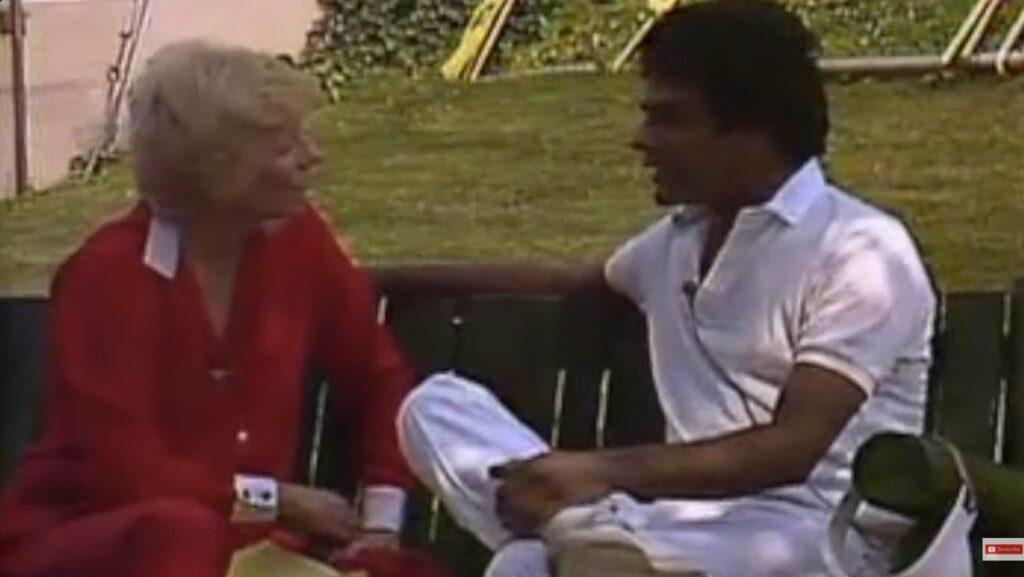
A voice of velvet and a soul of quiet grace—where greatness reveals itself not in grandeur, but in humility and enduring beauty
There are artists whose legacies are measured in chart positions, gold records, and industry accolades—and then there are those rare figures whose true stature is best understood in the spaces between notes, in the gentleness of their character, and in the way they leave a lasting impression on those fortunate enough to encounter them. Johnny Mathis belongs unmistakably to the latter. Long before one considers the remarkable success of albums like Johnny’s Greatest Hits—which spent an astonishing 490 consecutive weeks on the Billboard charts—or timeless songs such as “Chances Are” (No. 1 on the Billboard Hot 100 in 1957) and “Misty” (No. 12 in 1959), one is drawn instead to something far less quantifiable: a sense of sincerity that has never dimmed.
The account of Eileen Prose’s personal interview with Johnny Mathis offers a rare and intimate glimpse into that essence. It confirms what many listeners have long suspected but seldom had the opportunity to witness firsthand—that behind the flawless phrasing and the unmistakable timbre lies a man of genuine kindness, humility, and quiet dignity. These qualities, often spoken of but rarely embodied so consistently, seem to echo through every recording he has ever made.
It is tempting, perhaps, to separate the artist from the individual, to admire the voice while remaining distant from the person. But in the case of Johnny Mathis, such a division feels impossible. His interpretations have always carried an emotional authenticity that suggests a deeply grounded spirit. When he sings, whether it be the tender vulnerability of “Chances Are” or the aching introspection of “Misty,” there is no trace of artifice—only a man who understands the delicate architecture of human feeling.
The meeting described by Eileen Prose becomes, in this light, more than a simple interview. It transforms into a quiet affirmation of a truth that transcends music: that genuine greatness often resides in modesty. Her observation that he was “kind,” “sincere,” and “incredibly humble” resonates with a broader pattern seen across the most enduring figures in music history. The truly great seldom need to announce themselves; their presence alone, gentle yet unmistakable, speaks volumes.
By the time of that encounter, Johnny Mathis had already navigated decades of shifting musical trends. From the lush orchestral pop of the late 1950s and 1960s to the more contemporary stylings of later decades, he remained steadfast—not by resisting change, but by preserving the emotional core that defined his artistry. His catalog, vast and remarkably consistent, reflects a devotion to beauty in all its forms: the elegance of melody, the poetry of lyrics, and the richness of orchestral arrangement.
There is also something profoundly reassuring in the knowledge that Johnny Mathis continues to perform even into recent years. In an age where so much feels fleeting, his enduring presence offers a sense of continuity—a reminder that certain voices, once woven into the fabric of our lives, never truly fade. Each performance becomes not merely a concert, but a living bridge to memories long held, moments quietly cherished. Listening again to his recordings after reading such personal reflections, one cannot help but hear them differently. The voice seems warmer, the phrasing more intimate, as though each note carries with it the weight of a lifetime shaped by grace and humility. It is no longer just about technical perfection—though that remains undeniable—but about something far deeper: a sincerity that cannot be taught, only lived.
In the end, the story shared by Eileen Prose does not simply add to the legacy of Johnny Mathis—it illuminates it. It reminds us that the beauty found in his music is not an isolated phenomenon, but a natural extension of the man himself. And perhaps that is why his songs continue to resonate so profoundly: because they are, in every sense, honest. In a world that often celebrates volume over substance, Johnny Mathis stands as a quiet testament to the enduring power of grace, reminding us that sometimes the softest voices leave the deepest echoes.