
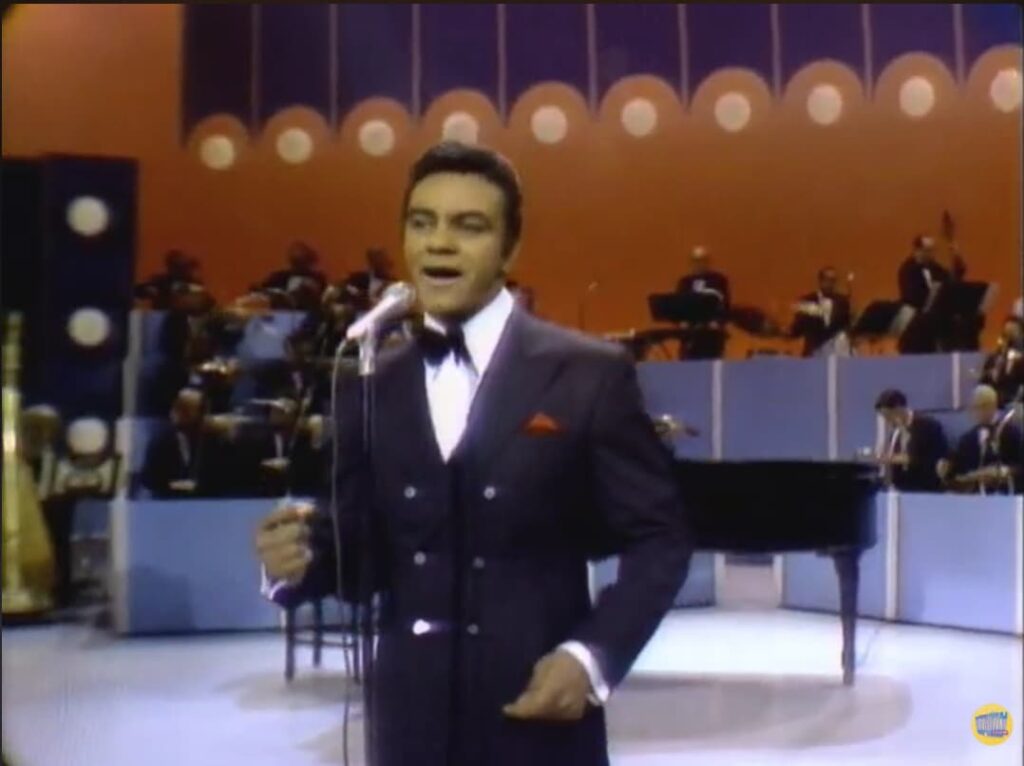
A velvet voice revisits cinematic romance—where elegance, longing, and memory intertwine beneath the glow of a television stage
When Johnny Mathis appeared on The Ed Sullivan Show on January 5, 1969, performing a refined pairing of “Charade” and “It Had Better Be Tonight”, it was more than a routine television booking—it was a quiet reaffirmation of an era when sophistication in popular music still held its rightful place in the cultural imagination. By that point, Mathis had long been established as one of the most enduring interpreters of romantic balladry, his voice carrying a kind of polished tenderness that seemed untouched by time, even as the musical landscape around him shifted dramatically.
The two songs he chose that evening were not arbitrary. “Charade,” originally composed by Henry Mancini with lyrics by Johnny Mercer for the 1963 film of the same name, had already secured its place in the American songbook. The version most associated with its success—performed by Andy Williams—reached No. 4 on the Billboard Hot 100 in late 1963. Though Johnny Mathis’s own recording did not chart as prominently, his interpretation leaned less on commercial momentum and more on emotional nuance, emphasizing the wistful ambiguity that defines the song’s lyrical core. It is, after all, a piece about illusion in love—about the uneasy realization that what we hold dear may not be as certain as we once believed.
In contrast, “It Had Better Be Tonight” (also known as “Meglio Stasera”), another Henry Mancini composition with Italian lyrics by Franco Migliacci and English adaptation by Johnny Mercer, came from the 1963 film The Pink Panther. Unlike “Charade,” this song carries a subtle urgency beneath its elegance—a gentle insistence that love must be seized in the present moment, before it slips away. It is a theme that resonated deeply in an age increasingly aware of time’s fleeting nature.
What made this medley so memorable was not merely the pedigree of the songs, but the way Johnny Mathis wove them together into a seamless emotional narrative. His phrasing was unhurried, almost conversational, yet every note felt carefully placed, as though he were guiding the listener through a private recollection. There was no need for dramatic flourish; the power lay in restraint. On a stage known for spectacle, Mathis offered intimacy instead.
The late 1960s were, of course, a period of transformation in popular music. Rock and soul were redefining the charts, and younger audiences were turning toward more rebellious sounds. Yet performances like this served as a gentle reminder that there remained a profound audience for songs built on melody, lyricism, and emotional clarity. The Ed Sullivan Show, itself a cultural institution, functioned as a bridge between generations—placing artists like Johnny Mathis before millions of viewers who still found comfort in the familiar warmth of a well-sung standard.
Behind the performance, there is also an unspoken narrative about endurance. By 1969, Mathis had already weathered more than a decade of changing tastes. His ability to remain relevant did not come from chasing trends, but from deepening his interpretive style. Songs like “Charade” and “It Had Better Be Tonight” became vessels through which he could explore maturity in love—the kind that acknowledges uncertainty, embraces vulnerability, and understands that romance is often tinged with melancholy.
Listening now, one cannot help but feel the quiet poignancy of that moment. There is a sense of looking back even as the performance unfolds—a recognition that the world these songs evoke is already beginning to fade. And yet, in Mathis’s voice, it remains preserved: a place where elegance still matters, where emotion is expressed with grace, and where every lyric carries the weight of lived experience.
In the end, this medley was not about chart positions or commercial success. It was about preservation—of style, of sentiment, of a musical language that speaks softly but lingers long after the final note has faded.