
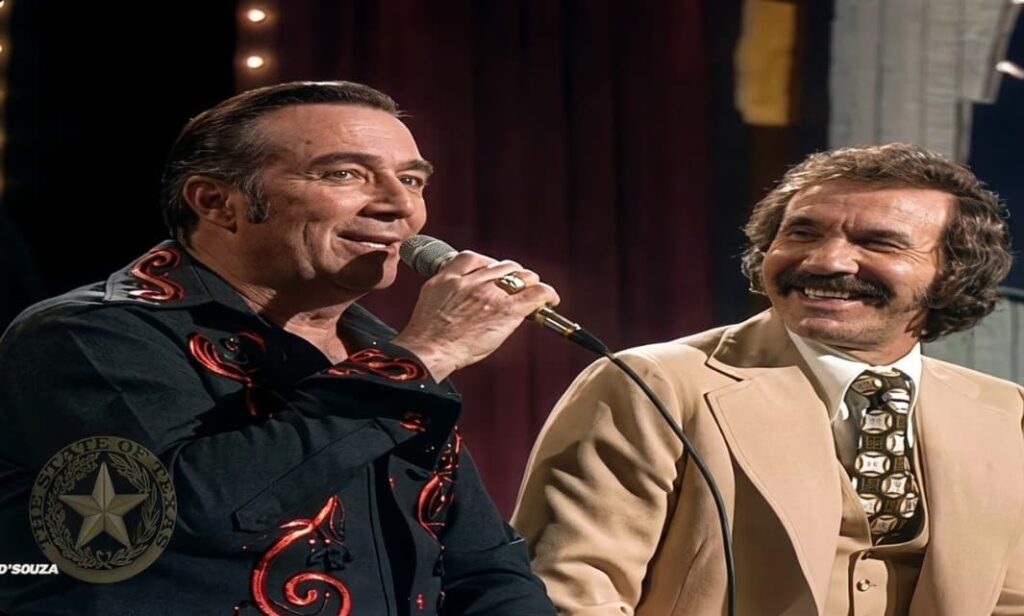
Faron Young and Marty Robbins on The Marty Robbins Show: A Meeting of the Young Sheriff and the Balladeer of the West
For those of us who carry the memories of the Grand Ole Opry and the vibrant, neon-lit nights of 1970s Nashville, few pairings promised as much pure charisma as Faron Young and Marty Robbins. When “The Hillbilly Heartthrob”—as Faron was known in his early days—stepped onto The Marty Robbins Show, particularly during the Spotlight era of the late 70s, it was a collision of two of the most magnetic personalities in the history of the genre. Both men were masters of the stage, possessing a rare combination of vocal brilliance and a quick-witted, often mischievous sense of humor that made every television appearance feel like a high-stakes comedy act as much as a musical performance.
The historical timing of their collaborations found both artists as elder statesmen who still possessed the fire of their youth. Faron Young had been a staple of the charts since the early 50s, with a career defined by massive hits like “Hello Walls” and “It’s Four in the Morning.” When he joined Marty, the “story” was one of two peers who had navigated the rough-and-tumble world of the music business together for over twenty years. To watch them today is to see a masterclass in “professionalism” that doesn’t take itself too seriously. Marty Robbins and Faron Young were famous for their playful rivalry and their ability to “needle” each other on camera, creating a sense of genuine, unscripted camaraderie that is almost entirely absent from modern television.
For the mature viewer, seeing Faron Young on Marty’s stage evokes a deep, resonant nostalgia for the “Classic Nashville” era. It reminds us of a time when a singer was expected to be an “Entertainer” in the truest sense of the word. Faron’s voice, a rich and resonant baritone that could handle a honky-tonk shuffle or a sophisticated ballad with equal ease, was the perfect match for Marty’s smooth, Western-influenced style. For a generation that remembers the first time they heard the haunting opening of “Hello Walls,” seeing Faron trade lines and jokes with Marty Robbins was a deeply moving validation of the music that soundtracked their lives. It speaks to a time when the stars were accessible, human, and genuinely funny.
The meaning of their time together on screen is rooted in the concept of the “Last of the Breed.” Both Marty and Faron were fierce individualists who never let the industry dictate their sound or their personalities. When they joked together between sets—Faron with his brassy, confident swagger and Marty with his quick, sharp-witted charm—there was an underlying sense of brotherhood. They were two men who had seen the world change, but who remained true to the spirit of the Opry. For the reflective heart, this performance is a reminder that while the lights may dim and the styles may fade, the power of a true character is eternal. It is a soundtrack for the memories of Saturday nights past, a reminder of a time when the music was honest and the laughter was real.
Musically, the highlights were the moments where their two distinct voices met in harmony. Whether they were revisiting a classic country standard or performing one of Faron’s legendary hits, the result was always a masterclass in phrasing and delivery. They didn’t need to over-sing; they understood that the most powerful emotions are often found in the space between the notes. Faron’s slightly more traditional, gritty edge provided a beautiful contrast to Marty’s polished, velvet-smooth delivery.
Reflecting on these episodes today, we are reminded of the incredible legacy of The Marty Robbins Show. It was a place where legends were treated with the respect they deserved, but were also allowed to have a little fun. Faron Young and Marty Robbins gave us a glimpse of a Nashville that was confident, talented, and deeply connected to its audience. Their time together remains a glowing testament to a golden age—a memory of two “Young Sheriffs” who conquered the world with nothing but a guitar, a voice, and a joke that could light up a room.
 Music Legend