
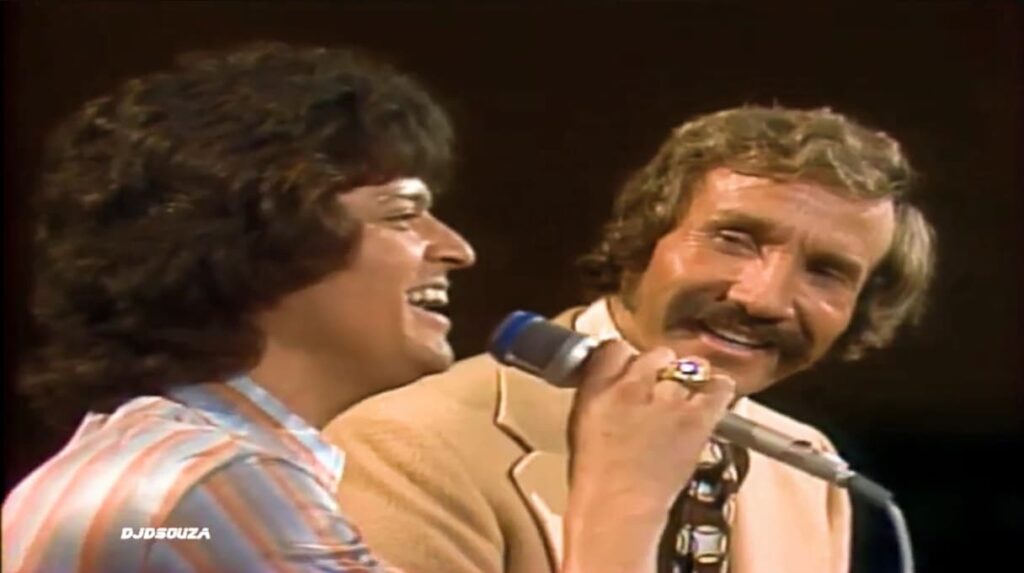
Johnny Rodriguez and Marty Robbins on The Marty Robbins Show: A Seamless Blend of Texas Tradition and Western Elegance
For those of us who appreciate the rich, bicultural soul of country music, there was no more significant moment on The Marty Robbins Show than when Johnny Rodriguez stepped into the spotlight. In the early-to-mid 1970s, Rodriguez was the “new breed” of country star—a young man from Sabinal, Texas, who possessed a voice as smooth as velvet and a heritage that allowed him to bridge the gap between Nashville and the Rio Grande. When he joined Marty Robbins, the master of the “Spanish-flavored” western ballad, it wasn’t just a guest appearance; it was a musical homecoming. Together, they represented the past, present, and future of the “Latin-infused” country sound that had long been a cornerstone of Marty’s legendary career.
The historical significance of their collaboration, particularly during the peak of Johnny’s success with hits like “Pass Me By (If You’re Only Passing Through)” and “You Always Come Back (To Hurting Me),” was a testament to the changing face of country music. At the time, Johnny Rodriguez was the first Mexican-American to achieve major stardom in the genre, and Marty Robbins—who had already immortalized the borderlands with “El Paso” nearly fifteen years earlier—was the perfect mentor. The “story” of their time together was one of deep, mutual respect. Marty, ever the fan of a true singer, clearly delighted in Johnny’s ability to switch effortlessly between English and Spanish, a hallmark of the “Rodriguez sound” that added a layer of romantic sophistication to the show.
For the mature viewer who remembers the 1970s as a time of musical exploration, this pairing carries a profound, sun-drenched nostalgia. It reminds us of an era when the “Texas-Mexican” influence was beginning to reshape the Nashville landscape. Johnny Rodriguez’s voice, a rich and resonant baritone with just a hint of a vulnerable “break,” was the perfect counterpart to Marty’s steady, operatic delivery. For a generation that remembers the first time they heard Johnny’s bilingual rendition of a country classic, seeing him on Marty’s stage was a validation of the diversity that makes our music so enduring. It speaks to a time when we valued the “soul” of the singer over the labels of the industry.
The meaning of their time together on screen is rooted in the concept of “Musical Heritage.” Both Marty and Johnny were deeply influenced by the melodies of the Southwest—the crying steel guitars mixed with the romantic strumming of the Spanish guitar. When they shared a microphone, they weren’t just singing songs; they were honoring a geography. Marty’s playful, charismatic hosting provided a warm backdrop for Johnny’s slightly more reserved, soulful presence. For the reflective heart, this performance is a reminder that the best music has no borders. It is a soundtrack for the quiet evenings when we remember the long drives through the Hill Country and the songs that made the distance seem a little shorter.
Musically, the highlights were inevitably the moments of bilingual harmony. Whether they were tackling a Marty Robbins western classic or one of Johnny’s contemporary hits, the blend of their voices was seamless. The arrangement usually favored a clean, acoustic-driven sound that allowed their phrasing to take center stage. There was a quiet dignity in their collaboration, a sense that they were both guardians of a specific, beautiful tradition.
Reflecting on these episodes today, we are reminded of the incredible foresight of Marty Robbins. He didn’t just host a show; he curated a community of talent. Johnny Rodriguez and Marty Robbins gave us a glimpse of a Nashville that was inclusive, melodic, and deeply connected to its roots. Their time together remains a shining example of the “Golden Age”—a memory of two Texas-influenced legends who proved that the most beautiful harmonies are those that speak a universal language of the heart.
 Music Legend