
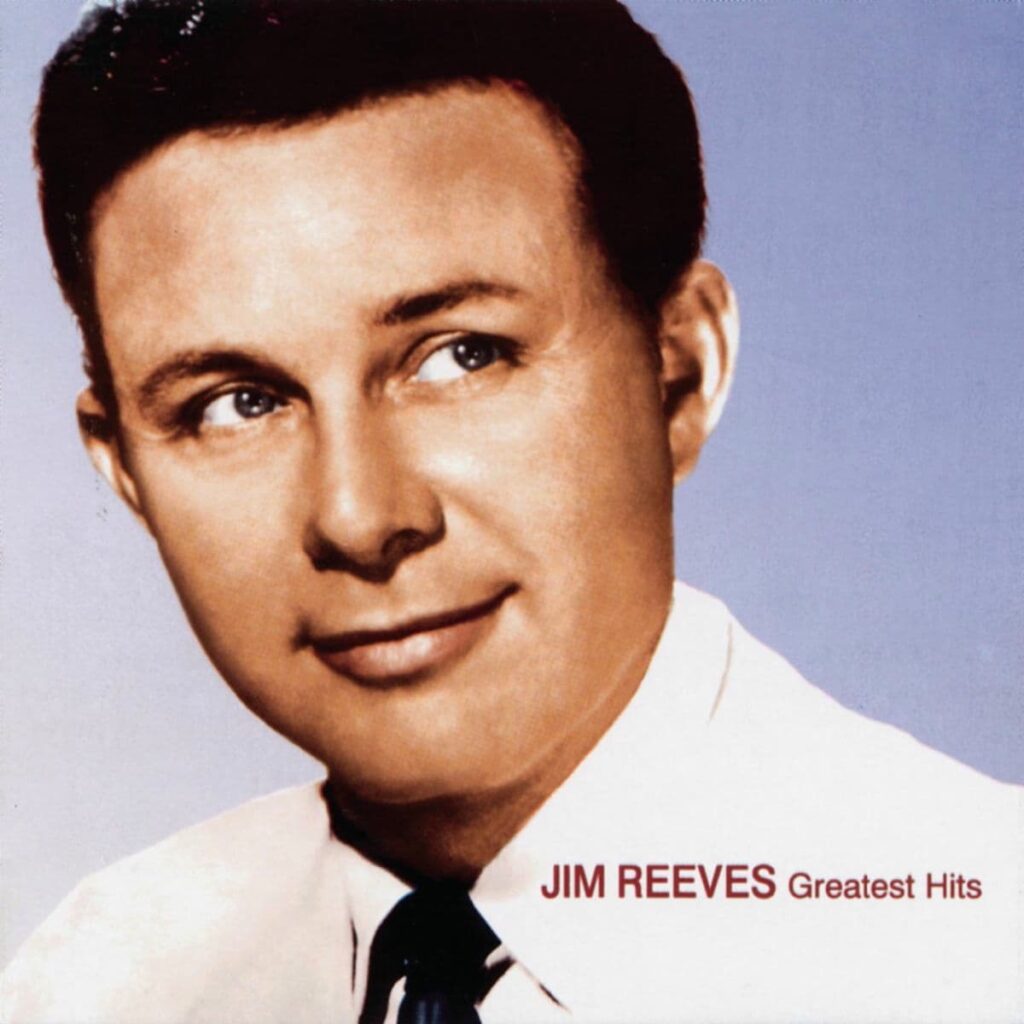
A tender confession where love becomes the last steady light in a life shaped by doubt, regret, and quiet gratitude
You’re the Only Good Thing (That’s Happened to Me) stands as one of the most emotionally direct and gently devastating recordings in the career of Jim Reeves, a singer whose voice seemed designed to speak softly to the heart rather than demand attention. Released as a single in 1960, the song rose to No. 1 on the Billboard Hot Country and Western Singles chart, affirming not only its popularity but its deep resonance with listeners who understood the language of restrained devotion. It was later included on the album According to My Heart, a record that captured Jim Reeves at the height of his mature, reflective style.
The song was written by Don Gibson, one of country music’s most respected craftsmen, whose gift lay in saying painful truths with remarkable simplicity. In You’re the Only Good Thing (That’s Happened to Me), Gibson created a lyric that avoided drama and spectacle. Instead, he focused on something far more enduring: the quiet realization that, amid life’s disappointments, one relationship can become a form of redemption. When Jim Reeves took hold of the song, he did not embellish it. He trusted the words, and more importantly, trusted silence.
By the time this recording was released, Jim Reeves had already refined what came to be known as the Nashville Sound. His baritone was smooth, unhurried, and conversational. There was no strain in his phrasing, no need to prove emotional depth through vocal acrobatics. This approach was perfectly suited to You’re the Only Good Thing (That’s Happened to Me), a song that reads like a confession spoken late in the evening, when defenses have lowered and honesty feels unavoidable.
The emotional core of the song lies in its humility. The narrator does not present himself as a hero or a victim. He admits failure, misjudgment, and a history marked by poor decisions. Against that backdrop, love is not portrayed as thrilling or idealized. It is portrayed as stabilizing. The line that gives the song its title carries a weight that grows heavier with each verse. It suggests not desperation, but clarity. A recognition earned through experience rather than innocence.
Musically, the arrangement is sparse and elegant. Gentle acoustic guitar, subtle backing vocals, and restrained orchestration allow Jim Reeves’s voice to remain the focal point. Nothing competes with the lyric. The tempo moves slowly, not to dramatize sorrow, but to allow reflection. This measured pace mirrors the emotional state of the narrator, a man no longer rushing toward anything, but standing still long enough to acknowledge what truly matters.
The placement of the song at the top of the country charts in 1960 speaks to its universality. It arrived during a period when country music was increasingly polished, yet listeners still sought authenticity. You’re the Only Good Thing (That’s Happened to Me) delivered that authenticity without rough edges. It proved that emotional truth did not require rawness to be believable. Sometimes, calm honesty could cut even deeper.
Within the context of According to My Heart, the song feels especially significant. That album explored themes of love, regret, and emotional dependence with remarkable consistency. Jim Reeves never sounded cynical, even when the lyrics hinted at a troubled past. Instead, he framed love as a quiet refuge. Not a solution to every problem, but a reason to keep going with greater care.
What has allowed You’re the Only Good Thing (That’s Happened to Me) to endure is its refusal to exaggerate feeling. It speaks to a kind of love understood fully only after life has tested expectations. The song does not celebrate perfection. It honors reliability. It suggests that love’s greatest gift may simply be its presence when much else has fallen away.
In the broader arc of Jim Reeves’s legacy, this recording represents his finest strength as an interpreter. He understood that songs do not always need to be sung loudly to be heard. Sometimes, they need to be trusted. With You’re the Only Good Thing (That’s Happened to Me), he offered a performance that feels less like a recording and more like a personal admission preserved in time.
Decades later, the song remains quietly powerful. It does not age because its message does not depend on trends or production styles. It depends on recognition. The moment when someone realizes that amid life’s many wrong turns, one steady presence has made all the difference. In Jim Reeves’s voice, that realization feels neither tragic nor triumphant. It feels simply true.
 Oldies Songs