
A Gentle Admission That Love Is Not About Winning, But Learning to Listen and Let Go
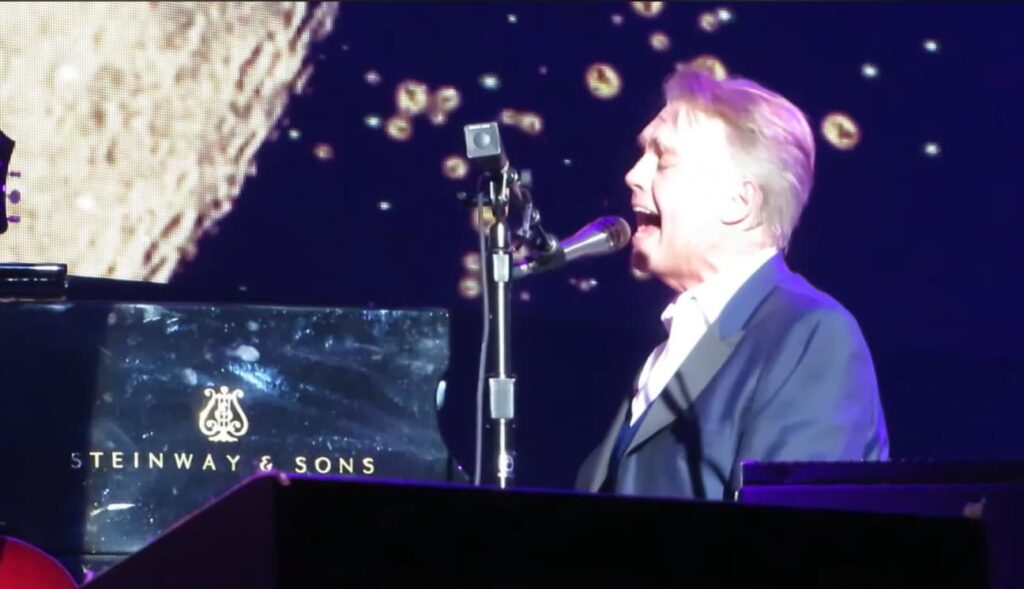
When Shaun Cassidy returned to the stage in Bensalem, Pennsylvania on December 16, 2021, performing “She’s Right”, it was not simply a revival of a familiar voice—it was a quiet reintroduction to an artist who had lived long enough to understand the meaning behind the words he once might have sung differently. Though “She’s Right” was never a charting single in the traditional sense and does not carry the commercial milestones associated with his earlier hits like “Da Doo Ron Ron” (which reached No. 1 on the Billboard Hot 100 in 1977), this later performance holds a different kind of significance—one rooted not in numbers, but in perspective.
To understand the weight of this moment, one must remember who Shaun Cassidy once was in the public imagination. In the late 1970s, he stood at the center of pop culture, a teenage idol whose image was defined by youthful energy, polished charm, and songs that captured the immediacy of young love. Albums like “Shaun Cassidy” (1977) and “Born Late” (1977) dominated the charts, and his voice became a familiar presence across radios and television screens. Yet time, as it inevitably does, shifted the narrative.
By 2021, the stage looked different. The audience listened differently. And most importantly, Cassidy sang differently.
“She’s Right”, in this setting, becomes less a song and more a realization. The title itself carries a quiet humility—an acknowledgment that understanding often arrives later than expected, and that clarity is sometimes found not in argument, but in reflection. There is no urgency in the performance, no need to impress. Instead, there is a measured calm, a sense that every word has been considered, lived with, and finally accepted.
The arrangement is understated, allowing space for the lyrics to settle naturally. Unlike the bright, tightly structured productions of his early career, this performance leans into simplicity. The instrumentation does not demand attention; it supports the narrative gently, creating an atmosphere that feels almost conversational. It is as if the song is being shared rather than performed.
In Shaun Cassidy’s voice, there is an unmistakable shift. The youthful clarity of his early recordings has given way to something more textured, more grounded. Time has softened certain edges while deepening others, and that change brings with it a kind of authenticity that cannot be manufactured. He does not attempt to recapture the past. Instead, he allows the present to speak for itself.
And what it says is quietly profound.
“She’s Right” explores a theme that resonates deeply precisely because it is so universal—the realization that love is not always about being correct, but about understanding. It is about recognizing the moments when pride gives way to truth, when certainty yields to perspective. These are not dramatic revelations. They are small, often private, but they shape the way relationships endure over time.
There is a particular kind of honesty in the way Cassidy delivers these ideas. He does not dramatize regret, nor does he romanticize it. Instead, he presents it as something natural, almost inevitable—a part of living that cannot be avoided, only understood. This restraint gives the song its emotional weight. It trusts the listener to recognize the meaning without needing to emphasize it.
The setting itself—Bensalem, Pennsylvania—adds another quiet layer to the performance. Far removed from the grand arenas of his early fame, it reflects a different kind of connection. More intimate, more immediate. The distance between performer and audience feels smaller, not just physically, but emotionally. It is in these spaces that songs like “She’s Right” find their true voice.
Looking back, it becomes clear that this performance is not about revisiting what once was. It is about acknowledging what has been learned along the way. The journey from youthful certainty to reflective understanding is not always visible, but in moments like this, it becomes unmistakably present.
And perhaps that is why “She’s Right” lingers.
Not because it demands to be remembered, but because it quietly reminds us of something we already know—that time has a way of revealing truths we once overlooked, and that sometimes, the most meaningful words are the simplest ones left unsaid until they are finally understood.