
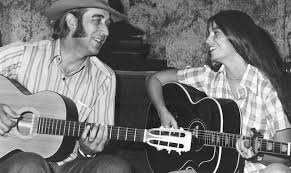
A shared farewell ballad where two voices honor the dignity of loss, memory, and the passing of time
When Marty Robbins and Johnny Cash came together to perform “Streets of Laredo,” the moment carried a gravity that transcended charts, eras, or commercial ambition. This was not a single released to radio, nor a song chasing a position on the Billboard listings. Instead, it was a meeting of two of country music’s most authoritative storytellers, standing shoulder to shoulder inside one of the oldest and most enduring ballads in the American folk tradition. Their collaboration, most famously captured during appearances in the late 1960s, including The Johnny Cash Show, offered something rarer than a hit: a shared act of preservation.
“Streets of Laredo”, sometimes known as “The Cowboy’s Lament,” dates back to the nineteenth century, rooted in British and Irish folk songs that crossed the Atlantic and found new life in the American West. By the time Marty Robbins and Johnny Cash lent their voices to it, the song was already woven into the fabric of traditional music. Its story is stark and restrained: a dying cowboy recounts his life, his mistakes, and his wish for dignity in death. There is no moral lesson delivered with force, only acceptance.
Both artists had deep, personal relationships with this material. Johnny Cash recorded “Streets of Laredo” early in his career, notably in 1965 for his album Sings the Ballads of the True West, an album that reached number 3 on the Billboard Country Albums chart. Cash approached the song as a historian and witness, drawn to its moral weight and plainspoken truth. His voice carried authority, shaped by empathy for lives lived on the margins and stories left unfinished.
Marty Robbins, meanwhile, was perhaps the most natural heir to Western narrative song. His 1959 album Gunfighter Ballads and Trail Songs, which reached number 6 on the Billboard Pop Albums chart and number 1 on the Country chart, reintroduced frontier storytelling to a modern audience. Robbins understood Western ballads not as nostalgia, but as emotional documents. When he sang “Streets of Laredo,” he did so with the instinct of a storyteller who knew when to step back and let the song speak.
When these two voices met, the result was not competitive or theatrical. It was reverent. Johnny Cash’s baritone provided the gravity of judgment and reflection, while Marty Robbins offered warmth and melodic clarity. Together, they allowed the song’s fatalism to unfold naturally. There was no attempt to modernize the narrative or heighten its drama. The power came from restraint.
The meaning of “Streets of Laredo” lies in its calm confrontation with mortality. The dying cowboy does not rage against his fate. He recounts it. He asks to be remembered with respect. In the hands of Cash and Robbins, this request feels deeply sincere. Both artists had spent their careers giving voice to characters shaped by consequence. Their performance feels less like acting and more like acknowledgment.
This collaboration also speaks to a shared philosophy of music. Neither Johnny Cash nor Marty Robbins relied on ornamentation to create impact. They trusted language, melody, and silence. In “Streets of Laredo,” pauses matter as much as lyrics. The listener is given space to absorb the story, to reflect rather than react.
There is something quietly profound in hearing two established artists return to a traditional song with humility. It suggests an understanding that the greatest stories do not belong to any one voice. They are carried forward, generation by generation, each time shaped slightly differently but never diminished. Cash and Robbins act not as owners of the song, but as custodians.
Today, this performance endures because it feels timeless. Not frozen in the past, but existing outside of time altogether. It reminds us that country music, at its best, is not about trends or triumphs. It is about bearing witness. About standing still long enough to listen to a story that has been told before and will be told again.
In “Streets of Laredo,” as shared by Marty Robbins and Johnny Cash, the song becomes a quiet farewell spoken with respect. Two voices, different in texture but united in purpose, guide the listener through loss without spectacle. And when the final line fades, what remains is not sadness alone, but a sense of dignity that lingers, steady and unbroken.
 Music Legend