
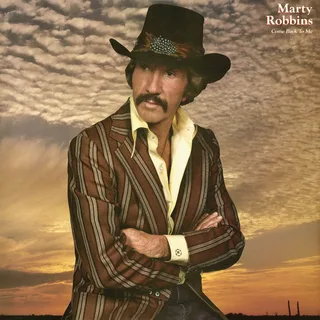
Marty Robbins – Kin To The Wind: The Restless Anthem of the Eternal Drifter
In the sprawling legend of the American West, there is a specific kind of soul that cannot be fenced in, a spirit that finds the four walls of a home more suffocating than the harshest desert storm. Marty Robbins, the “Last Cowboy” of the airwaves, gave this spirit a voice in “Kin To The Wind.” Released on his iconic 1966 album The Drifter, the song served as a cornerstone for a collection that peaked at Number 6 on the Billboard Country Albums chart. It is a song for the restless—for those who have lived long enough to know that some people are born with the horizon in their eyes and a permanent “moving on” in their hearts.
To remember “Kin To The Wind” is to recall the period when Marty Robbins stripped away the polished “Nashville Sound” to return to the raw, high-lonesome echoes of the frontier. When he performed this, often with a solitary Spanish guitar, he didn’t look like a pop star; he looked like a man who had just stepped off a long trail. The story behind this recording is one of atmospheric storytelling. By utilizing a “galloping” acoustic rhythm and his trademark “crying” vocal style, Marty created a piece of music that feels like it’s moving across the landscape, capturing the literal and figurative dust of a life lived on the go.
The story within the lyrics is a poetic confession of unavoidable wandering. The narrator explains to a woman—and perhaps to himself—why he cannot stay. He doesn’t blame a lack of love or a cold heart; instead, he points to a biological, spiritual kinship with the elements. It is a narrative of elemental destiny. He claims the wind as his brother and the stars as his guide, admitting that the “settled” life is a cage he wasn’t built for. It is the story of a man who chooses the loneliness of the trail over the comfort of a lie, understanding that his true home is wherever the next bend in the road takes him.
The profound meaning of this ballad strikes a deep, resonant chord with a mature audience because it honors the complexity of the free spirit:
- The Honesty of the Outsider: It acknowledges that not everyone is meant for the “picket fence” life. For those of us who have felt the pull of the “elsewhere,” the song provides a dignified validation of that restlessness.
- The Cost of Freedom: The song doesn’t shy away from the price of being “kin to the wind”—the solitary campfires, the empty hands, and the hearts left behind. It reflects the mature realization that every choice, even the choice to be free, carries a heavy weight.
- The Nostalgia for the Open Road: In our modern, interconnected world, the song evokes a powerful longing for a time when a man could truly disappear into the landscape. It honors a sense of rugged individualism that defined a generation.
Marty Robbins delivers this performance with a voice that is as wild and unpredictable as the subject matter. He uses his incredible breath control to sustain notes that feel like the long, low whistle of a prairie wind. The arrangement is masterfully sparse—featuring the rhythmic “click-clack” of a guitar that mimics a horse’s hooves and a subtle, minor-key undertone that suggests a lingering sadness beneath the bravado. For our generation, “Kin To The Wind” is a timeless piece of Western philosophy; it reminds us that while most of the world seeks shelter, there will always be a few who find their peace only when they are moving.
 Music Legend