
A familiar folk pop spell reborn as youthful optimism, where innocence, melody, and memory quietly meet
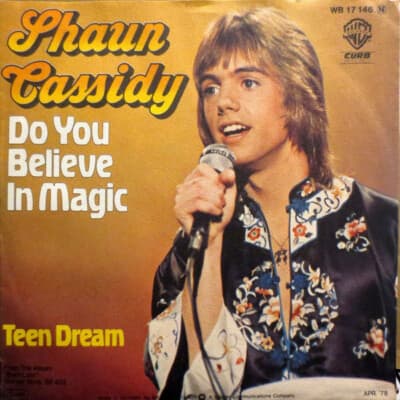
When Shaun Cassidy released his version of “Do You Believe in Magic” in 1978, it arrived not as a radical reinvention, but as a gentle reframing of a song already deeply embedded in popular memory. Originally written by John Sebastian and recorded by The Lovin’ Spoonful in 1965, the song had long stood as a declaration of music’s power to heal, unite, and soften the hard edges of everyday life. Cassidy’s interpretation did not attempt to outshine the original. Instead, it translated that familiar magic into the language of a new generation, shaped by softer production, brighter vocals, and a carefully polished sense of optimism.
Released as a single during the height of his popularity, “Do You Believe in Magic” reached No. 31 on the Billboard Hot 100, comfortably placing it within the Top 40 and reaffirming Cassidy’s ability to connect with a broad listening audience beyond television fame. By this point, Cassidy was already well established as a chart force, following consecutive No. 1 singles and strong album sales. The song was later included on his 1978 album Under Wraps, a record that marked a subtle transition in his musical direction, leaning more toward melodic pop craftsmanship than pure teen idol momentum.
The story behind Cassidy’s decision to record “Do You Believe in Magic” speaks quietly to timing rather than ambition. The late seventies were a period of reflection for pop music, with many artists revisiting earlier material through a more polished, radio friendly lens. Cassidy’s voice, naturally warm and clear, carried an earnestness that suited the song’s message. Where the Lovin’ Spoonful version felt spontaneous and slightly rough around the edges, Cassidy’s reading felt assured and tender, as if the belief in magic had matured rather than faded.
Lyrically, “Do You Believe in Magic” remains deceptively simple. It does not describe grand romance or dramatic revelation. Instead, it speaks of music as a quiet companion, something that can make a bad day tolerable or a good moment linger a little longer. Cassidy’s delivery emphasizes this intimacy. He sings not to persuade, but to remind. There is no urgency in his phrasing, only a calm confidence that the listener already knows the answer to the question being asked.
Musically, the arrangement reflects the production values of its time. Acoustic textures remain present, but they are carefully balanced with clean harmonies and a steady rhythm that keeps the song firmly grounded in late seventies pop. This approach allowed the song to sit comfortably alongside contemporary radio hits while still honoring its folk roots. Cassidy’s vocal performance is restrained, avoiding excessive embellishment, which allows the melody itself to do most of the emotional work.
The deeper meaning of Cassidy’s “Do You Believe in Magic” lies in its sense of continuity. It suggests that while styles change and eras move forward, the emotional role of music remains constant. The song becomes less about youthful discovery and more about quiet reassurance. It acknowledges that belief does not have to be loud to be sincere, and that wonder can exist in familiar places.
Within Shaun Cassidy’s broader career, the song stands as a reflective pause. It does not carry the exuberant drive of “Da Doo Ron Ron”, nor the confident swagger of “That’s Rock ’n’ Roll”. Instead, it offers something gentler, almost conversational. It shows an artist comfortable enough to step back and let the song breathe, trusting its history and its message.
Decades later, Cassidy’s version endures not because it replaced the original, but because it offered another way to hear it. “Do You Believe in Magic” becomes, in his hands, a reminder that belief evolves. It softens, deepens, and becomes less about surprise and more about recognition. In that quiet recognition, the song continues to live, carrying its small, persistent magic forward, one familiar melody at a time.