
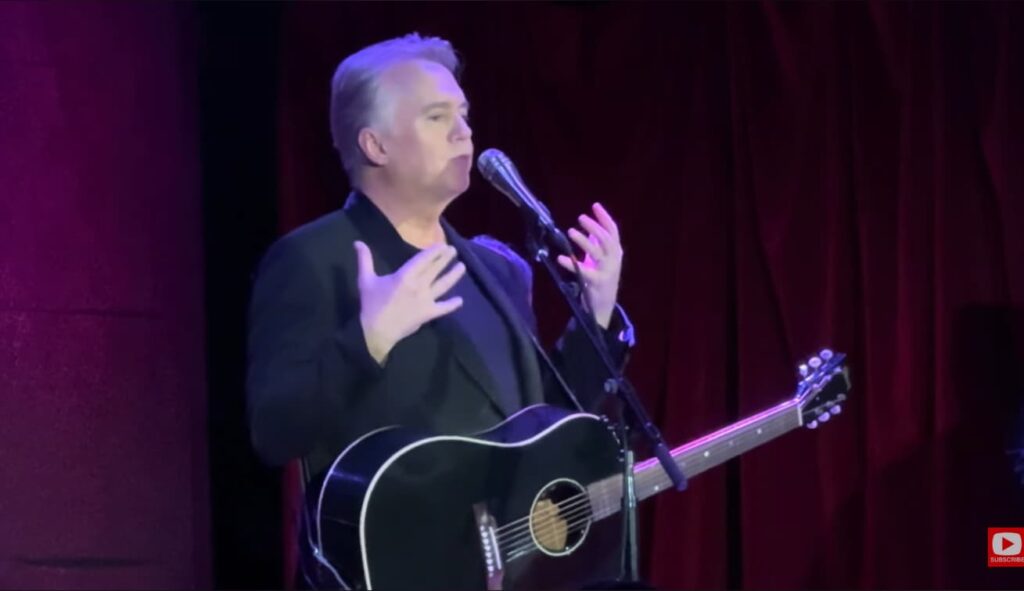
A Gentle Return to Wonder, Where Youthful Joy Finds Its Way Back Through Time
When Shaun Cassidy steps onto the stage at City Winery Boston on a New Year’s Eve night to perform “Do You Believe in Magic,” the moment carries a meaning far deeper than nostalgia alone. The song itself, originally written by John Sebastian and recorded by The Lovin’ Spoonful in 1965, reached No. 9 on the Billboard Hot 100, becoming one of the defining anthems of that hopeful, transitional decade. Years later, Shaun Cassidy—who rose to prominence in the late 1970s as both a singer and television star—would revisit the song not as a chart contender, but as a quiet bridge between eras.
Cassidy’s own version of “Do You Believe in Magic” was never tied to a major chart run the way his hits like “Da Doo Ron Ron” (No. 1 on the Billboard Hot 100 in 1977) were. Instead, his connection to the song feels more personal, almost reflective. By the time of this New Year’s Eve performance, he was no longer the teenage idol framed by magazine covers and stadium screams. He had stepped away from that image, building a respected career behind the scenes as a writer and producer. And yet, here he was, returning to a song that asks a simple question—one that feels more complicated with the passing of time.
There is a quiet story in that return. In the 1970s, Shaun Cassidy represented a kind of youthful certainty, a belief that music could define a moment and carry it forward without losing its shape. Songs were immediate then, tied to a feeling that seemed permanent. But as years pass, even the most familiar melodies begin to change—not in their structure, but in how they are heard.
At City Winery Boston, the arrangement of “Do You Believe in Magic” is more restrained than the original’s bright, folk-pop energy. The tempo is slightly softened, the edges less urgent. It no longer rushes forward with the optimism of the 1960s. Instead, it unfolds with a kind of patience, allowing each line to settle before moving on. And in that space, the meaning of the song begins to shift.
When Shaun Cassidy sings those words now, there is a sense that he is not simply asking the audience a question—he is asking it of himself. The magic described in the song is no longer just about music’s ability to lift and transform in an instant. It becomes something quieter, more enduring. A memory, perhaps. Or a feeling that returns unexpectedly, long after it was thought to have faded.
The original version by The Lovin’ Spoonful captured a moment when popular music was beginning to open up, to move beyond simple structures and embrace a broader emotional palette. It was lighthearted, yes, but not without depth. John Sebastian wrote it as a celebration of music itself—its ability to create connection, to dissolve barriers, to make something ordinary feel extraordinary.
In Cassidy’s performance, that celebration remains, but it is tempered by experience. There is no attempt to recreate the past exactly as it was. Instead, there is an acknowledgment that the past cannot be revisited in the same way—and that perhaps it does not need to be. The song becomes less about recapturing magic and more about recognizing where it still exists.
There are moments in the performance where the audience seems to lean in, not out of excitement, but out of recognition. The melody is familiar, but the feeling it carries has changed. It is no longer the soundtrack of a beginning, but of a continuation—a reminder that certain songs do not belong to a single time, but move with us, adapting quietly as we do.
As the final notes of “Do You Believe in Magic” drift through the room on that New Year’s Eve, there is a subtle sense of transition. Not just from one year to the next, but from one understanding of life to another. The question remains unanswered, as it always has. But perhaps that is the point.
Because in the end, the magic was never something to be proven. It was something to be felt—sometimes in the bright, immediate joy of youth, and sometimes in the softer, more reflective moments that come later.
And in that performance, Shaun Cassidy does not try to define it. He simply lets it linger, trusting that those who are listening will recognize it in their own way, in their own time, carried quietly within a song that refuses to fade.