
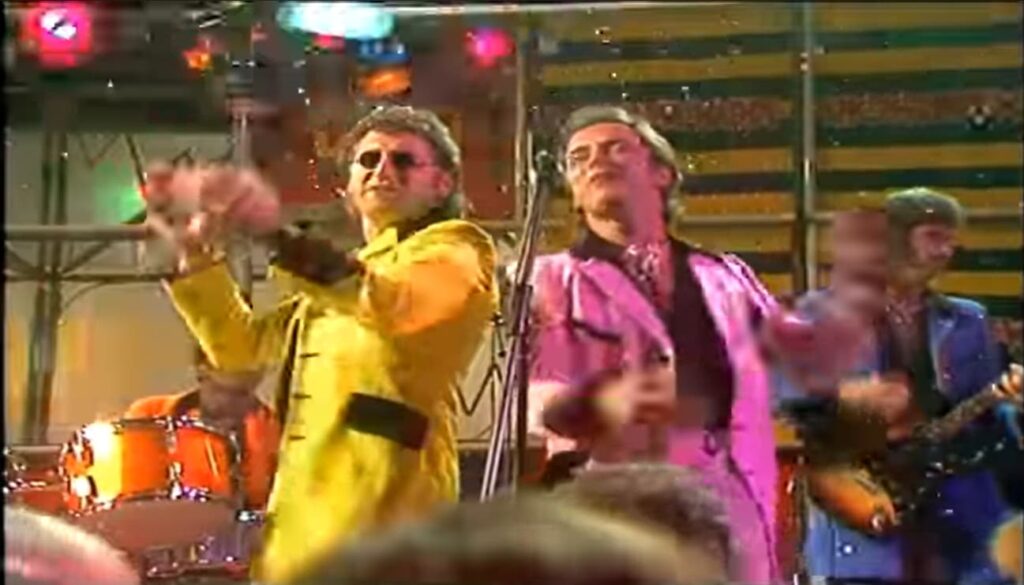
A quiet promise set to melody, where love lingers not in grand gestures but in the gentle certainty of staying
When Showaddywaddy released “Always And Ever” in 1980, it arrived at a time when the musical landscape had already begun to drift away from the sounds that had defined their identity. Yet, in its own unassuming way, the song found space to exist, reaching No. 46 on the UK Singles Chart—a modest position perhaps, but one that does not fully capture the emotional weight carried within its melody.
By 1980, Showaddywaddy had long established themselves as devoted guardians of a bygone era, drawing heavily from the spirit of 1950s rock and roll and early 1960s pop. While many of their earlier hits leaned into upbeat rhythms and nostalgic celebration, “Always And Ever” revealed a different side—more restrained, more reflective, and perhaps more aware of time’s quiet passage.
The song itself is built on a simple but enduring theme: devotion that does not fade with circumstance. There are no dramatic turns in its narrative, no sudden heartbreak or triumphant reunion. Instead, it unfolds steadily, like a conversation that has been carried on for years, where words are no longer needed to affirm what is already understood.
Musically, “Always And Ever” leans into soft harmonies and a gentle arrangement that allows the vocals to remain at the forefront. The instrumentation does not overwhelm. It supports, it frames, it listens. There is a patience in the way the song moves, as though it understands that some emotions cannot be rushed.
What makes this recording particularly compelling is the context in which it was released. The early 1980s were marked by the rise of new wave, electronic textures, and a sense of forward momentum in popular music. Against this backdrop, Showaddywaddy chose not to adapt in the conventional sense. They did not chase trends or reshape their sound to fit the moment. Instead, they remained rooted in their original sensibility, offering something that felt almost out of time.
And perhaps that is where the song finds its true meaning. “Always And Ever” is not simply about romantic commitment. It is about continuity—the idea that certain feelings, certain promises, remain unchanged even as everything around them evolves.
There is also a subtle layer of reflection embedded within the performance. Unlike the youthful exuberance that characterized many earlier rock and roll revival tracks, this song carries a quieter awareness. The vocals do not reach outward with urgency. They settle inward, as though speaking not just to another person, but to memory itself.
Listening closely, one begins to sense that the song is as much about looking back as it is about holding on. The phrase “always and ever” suggests permanence, yet the tone acknowledges the passage of time. It is this delicate balance—between constancy and change—that gives the recording its emotional depth.
For Showaddywaddy, this track stands as a reminder that their artistry was never solely about recreating the past. It was about interpreting it, understanding it, and allowing it to resonate within a different moment. Even as musical trends shifted, they continued to offer songs that spoke in a language shaped by earlier decades, yet still capable of being felt in the present.
There is something quietly reassuring in that approach. The song does not ask for attention. It waits for recognition. It does not attempt to impress. It simply exists, steady and unchanging, much like the sentiment it expresses.
In the end, “Always And Ever” may not be remembered as one of the most commercially successful releases in Showaddywaddy’s catalog, but its significance lies elsewhere. It captures a moment where music chooses sincerity over spectacle, where emotion is allowed to unfold without urgency.
And perhaps that is why it lingers. Not because it demands to be remembered, but because it gently reminds us that some feelings, once formed, do not need to be repeated loudly to remain true.