
A joyful return to the heartbeat of early rock and roll, where rhythm becomes memory and every note feels like a door opening back to simpler nights.
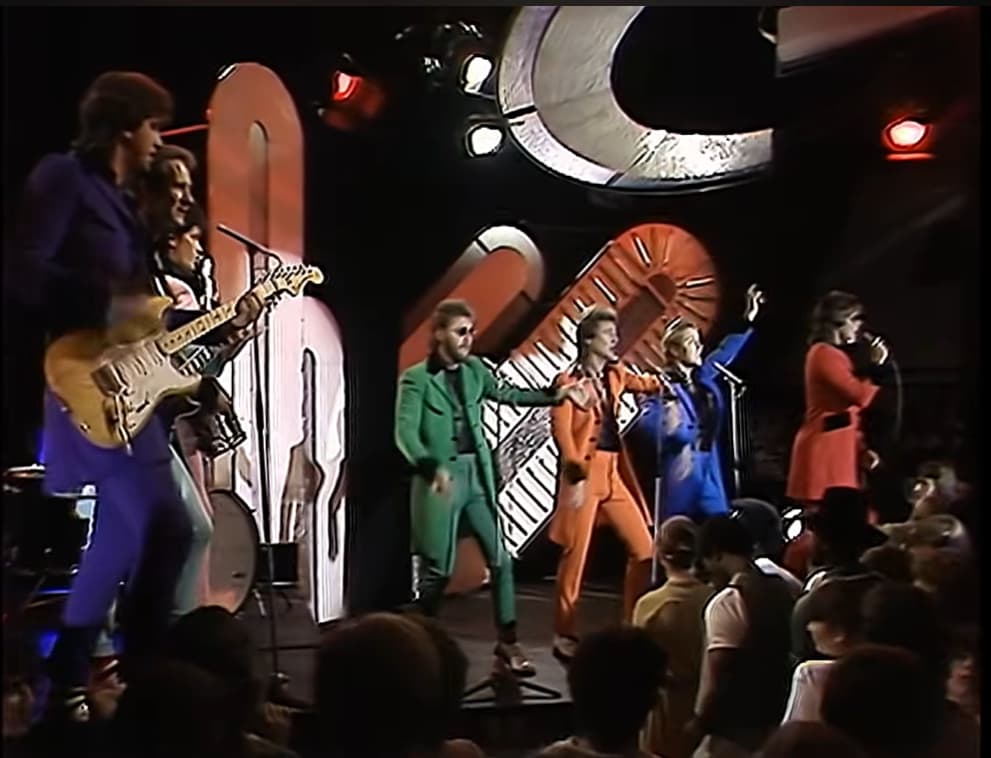
When Showaddywaddy stepped onto the stage of Top of the Pops on July 26, 1979, to perform “Sweet Little Rock ’N’ Roller,” they were carrying more than just a hit single—they were carrying a legacy. Originally recorded by Chuck Berry in 1958, the song had already been etched into the foundations of rock music. But in 1978, when Showaddywaddy released their version, it climbed to No. 4 on the UK Singles Chart, reaffirming the band’s remarkable ability to revive the spirit of an earlier era and make it feel immediate once again.
By the late 1970s, Showaddywaddy had become one of the most reliable chart acts in Britain, not by chasing new trends, but by holding firmly to something older, something rooted in melody, harmony, and rhythm. “Sweet Little Rock ’N’ Roller” fits perfectly within that identity. It is a song that celebrates youth, movement, and the irresistible pull of music itself. Yet in their hands, it becomes more than a simple celebration—it becomes a reflection, a moment where the past is not just remembered, but relived.
The performance on Top of the Pops captures this balance beautifully. There is an undeniable sense of polish in the arrangement—cleaner production, fuller instrumentation, harmonies that are carefully layered. But beneath that polish, the core of the song remains untouched. The rhythm still drives forward with the same unpretentious energy that defined Chuck Berry’s original. It is this combination of refinement and authenticity that allowed Showaddywaddy to resonate so strongly with audiences at the time.
There is also something quietly meaningful in the choice of material. By revisiting “Sweet Little Rock ’N’ Roller,” the band was not simply selecting a well-known song—they were aligning themselves with the very origins of rock and roll. Chuck Berry’s influence on popular music is immeasurable, and by the late 1970s, his work had already become part of the genre’s foundation. To bring that song onto a contemporary stage was to acknowledge that foundation, to remind listeners where it all began.
The late 1970s was a period of contrast in music. While punk was stripping rock down to its rawest elements and disco was dominating dance floors with its polished grooves, Showaddywaddy occupied a space that felt almost separate from both. Their music did not seek to challenge or redefine—it sought to preserve. And in doing so, it offered something that many listeners found deeply comforting: continuity.
Watching that Top of the Pops performance now, one can sense the ease with which the band connects to the song. There is no strain, no attempt to force relevance. Instead, there is a natural flow, as though the music exists independently of time, and the band is simply allowing it to pass through them. The audience, too, responds in kind—not with analysis, but with recognition. It is the kind of response that cannot be manufactured, only remembered.
At its heart, “Sweet Little Rock ’N’ Roller” is about the enduring power of music to bring people together, to create moments that feel both fleeting and permanent. In Showaddywaddy’s version, that idea takes on an added layer of meaning. The song is no longer just about a young girl dancing—it becomes about the act of dancing itself, about the shared experience of rhythm and movement that transcends generations.
In the years since, performances like this have taken on a different kind of significance. They stand as reminders of a time when music could be both simple and profound, when a familiar melody could carry with it a lifetime of associations. The July 1979 appearance on Top of the Pops captures that feeling in a way that feels almost suspended in time.
And perhaps that is the lasting gift of Showaddywaddy’s “Sweet Little Rock ’N’ Roller.” It does not attempt to change the past or redefine it. It simply keeps it alive—steady, joyful, and endlessly moving forward, like a rhythm that refuses to fade.