
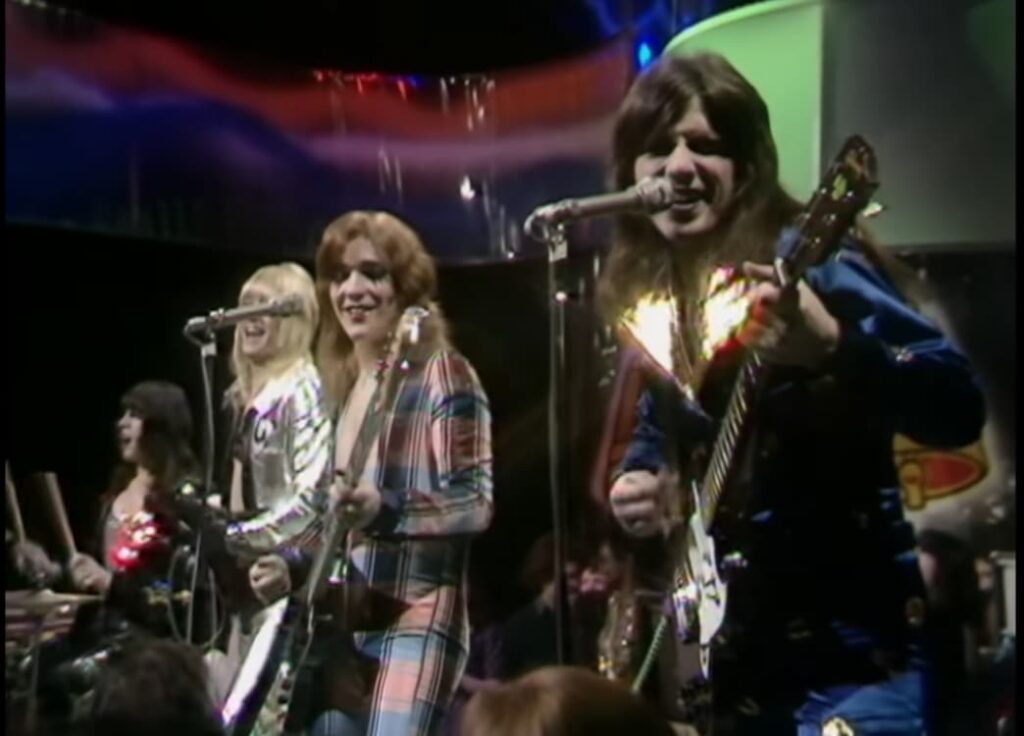
A thunderous glam rock statement where sound, style, and attitude collide, turning a simple riff into a defining moment of early 1970s British pop.
When Sweet appeared on Top of the Pops on January 25, 1973, performing “Blockbuster!”, they were not just presenting a hit single—they were announcing a transformation. Released earlier that year, “Blockbuster!” stormed straight to No. 1 on the UK Singles Chart, holding the top position for five consecutive weeks. It marked the band’s first chart-topper in Britain and established them not merely as participants in the glam rock movement, but as one of its most commanding voices.
From the very first second, “Blockbuster!” does not ease its way in. It arrives with that unmistakable siren-like intro, a sound both theatrical and unsettling, immediately commanding attention. There is no ambiguity about its intent. The track was written by the prolific songwriting team of Nicky Chinn and Mike Chapman, who were instrumental in shaping much of Sweet’s early success. Yet what they crafted here was something that went beyond formula. Inspired in part by the rising fascination with urban crime stories and even drawing loose influence from the theme of the television series Kojak, the song carries a darker edge than many of its contemporaries.
The performance on Top of the Pops that January evening captured the essence of that shift perfectly. Gone was any lingering sense of Sweet as merely a polished pop act. In its place stood a band fully embracing the spectacle and grit of glam rock—platform boots planted firmly, guitars slung low, and an attitude that felt both playful and confrontational. “Blockbuster!” was not just heard; it was embodied. The exaggerated visuals, the sharp gestures, and the almost theatrical delivery turned the performance into something closer to a statement of identity than a simple television appearance.
Behind the scenes, however, the story of Sweet at this moment was one of tension as much as triumph. The band had long sought greater control over their musical direction, often finding themselves at odds with the Chinn-Chapman songwriting machine that had brought them commercial success. “Blockbuster!”, while undeniably a hit, also represented the height of that dynamic—a perfect single crafted for the charts, yet hinting at a deeper, heavier sound the band would later pursue on their own terms. In hindsight, it stands at a crossroads: the point where commercial polish and artistic ambition briefly aligned before diverging.
There is also an undeniable cultural weight to the song’s success. In early 1973, the British music scene was in flux. Glam rock was flourishing, but it was also evolving, stretching beyond glitter and theatrics into something more layered and complex. “Blockbuster!” captured that transition. Its pounding rhythm and chant-like chorus retained the accessibility of pop, while its darker tone suggested a shift toward something more substantial. It is perhaps no coincidence that its rise to No. 1 coincided with a broader appetite for music that could entertain while still carrying an edge.
For those who encountered the song at the time, “Blockbuster!” often left an immediate impression. It was not the kind of record that faded into the background. Its energy demanded attention, its repetition etched itself into memory, and its presence on programs like Top of the Pops ensured that it was seen as much as it was heard. Watching that 1973 performance now, there is a sense of stepping into a moment when music felt both larger than life and intimately connected to everyday experience—a paradox that only the best pop records manage to achieve.
And yet, beneath the surface spectacle, there is something enduringly human about “Blockbuster!”. It speaks, in its own exaggerated way, to the desire for excitement, for drama, for moments that break the routine of ordinary life. The “gang” it describes may be fictional, the narrative stylized, but the feeling it evokes is real—a pulse of adrenaline, a brief escape into something louder, brighter, and more immediate.
In the end, the Top of the Pops performance of “Blockbuster!” remains more than a snapshot of glam rock at its peak. It is a reminder of a time when a single song could dominate the airwaves, define a band’s identity, and capture the imagination of an audience all at once. The sound may belong to 1973, but its echo continues, sharp and unmistakable, like that opening siren cutting through the years.