
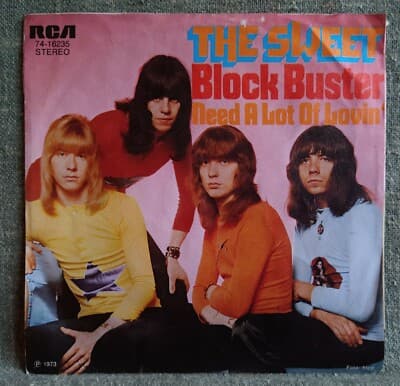
A restless cry for connection, where glam rock energy masks a deeper hunger for affection that never quite finds its end.
When Sweet released “Need a Lot of Lovin’” in 1974 as part of their album Sweet Fanny Adams, they were standing at a crucial crossroads in their career. Known widely for their chart-dominating singles like “Block Buster!” and “Hell Raiser,” both of which reached No. 1 on the UK Singles Chart, the band had already proven their ability to deliver explosive, radio-friendly hits. Yet “Need a Lot of Lovin’” was something different—less polished for immediate chart impact, never released as a standalone single, but deeply revealing of the band’s musical identity beneath the glitter and theatrics.
By 1974, Sweet were beginning to push against the constraints imposed on them by the songwriting duo of Nicky Chinn and Mike Chapman, who had crafted much of their early success. With Sweet Fanny Adams, the band took a decisive step toward creative independence, writing and shaping more of their own material. “Need a Lot of Lovin’” emerges from this moment not as a commercial calculation, but as an honest expression—raw, energetic, and slightly unguarded. It does not carry the immediate hook of their biggest hits, but it lingers in a different way, like a thought that refuses to settle.
Musically, the song leans into a harder rock edge than many might expect from Sweet. The guitars are heavier, the rhythm more insistent, and the vocal delivery by Brian Connolly carries a strain that feels almost confessional. There is a tension running through the track, as though the performance itself is trying to outrun something it cannot quite escape. Beneath the surface, the song speaks of a need that is never fully satisfied—a longing that grows rather than diminishes.
That sense of longing gives “Need a Lot of Lovin’” its quiet depth. On first listen, it may seem like a straightforward rock song, driven by energy and attitude. But with time, it reveals something more reflective. The repetition in its structure mirrors the repetition of desire, the way certain emotional needs return again and again, no matter how often they are met. It is not a song about resolution; it is a song about persistence, about the ongoing search for something that always feels just out of reach.
In the broader context of the 1970s, when glam rock often thrived on spectacle and image, Sweet managed to carve out moments of sincerity within the noise. “Need a Lot of Lovin’” stands as one of those moments. It reminds us that behind the platform boots and bright lights, there were musicians grappling with the same uncertainties and desires that have always defined human experience. The song does not dramatize these feelings; it simply lets them exist, carried forward by a relentless beat.
There is also a certain poignancy in looking back at this period of the band’s history. It was a time of both ascent and tension, of growing success paired with internal struggles and the pressures of maintaining that success. Songs like “Need a Lot of Lovin’” hint at those undercurrents. They suggest that even at the height of visibility, there can be a sense of incompleteness, a quiet awareness that something essential remains unresolved.
Listening to the track now, decades removed from its original release, one can sense how it fits into the larger story of Sweet. It may not have climbed the charts or dominated radio waves, but it contributes something equally valuable: a glimpse into the band’s inner world at a moment of transition. It captures a feeling rather than a moment, a state of mind rather than a narrative.
And perhaps that is why “Need a Lot of Lovin’” continues to resonate. It does not rely on nostalgia alone. Instead, it speaks to something enduring—the idea that no matter how much time passes, the need for connection, for understanding, for something that feels complete, never truly fades. The music drives forward, the voice reaches outward, and the song remains suspended in that space between wanting and finding, where so much of life quietly unfolds.