
A Love Worn Down by Time, Where Two Voices Carry the Weight of What Could Not Last
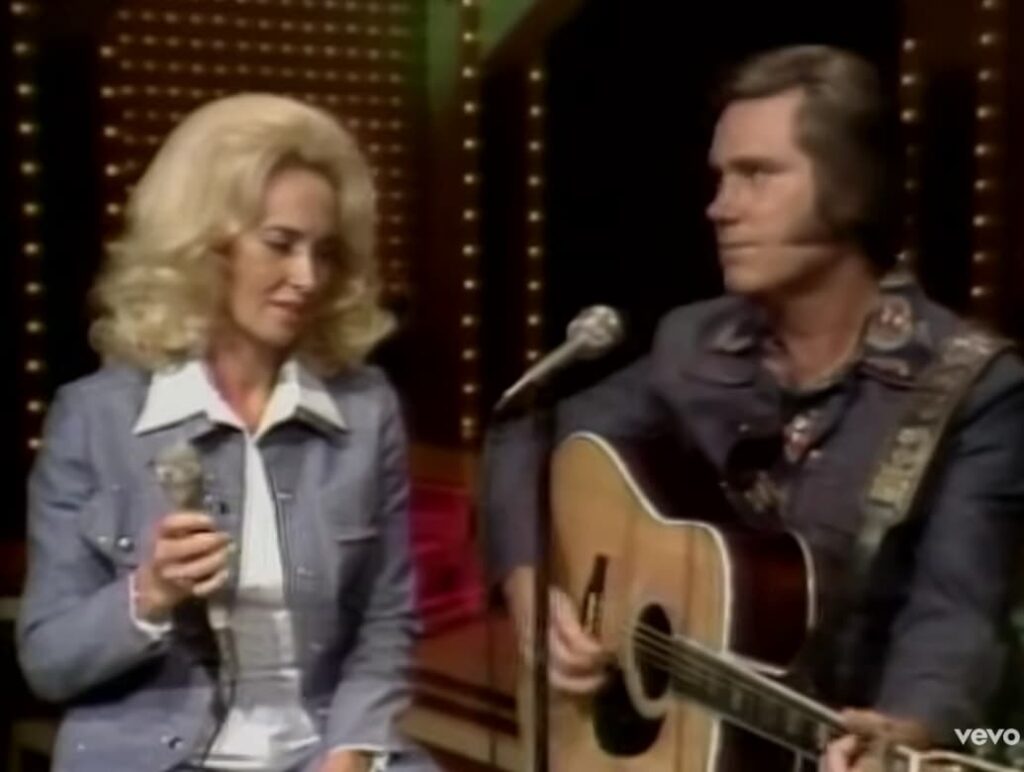
When Tammy Wynette and George Jones performed “We Loved It Away” live on Pop! Goes The Country in 1974, the moment carried a quiet gravity that extended far beyond the stage. Originally released that same year as part of their collaborative album “We Loved It Away,” the song climbed to No. 2 on the Billboard Hot Country Singles chart, reaffirming the extraordinary power of a duo whose personal and musical lives were deeply, and often painfully, intertwined.
Written by Billy Sherrill and Carmol Taylor, “We Loved It Away” is not a song of reconciliation or hope. Instead, it stands as a rare kind of country duet—one that speaks openly about love not as something lost to circumstance, but as something slowly worn down by its own intensity. By 1974, audiences already understood that the relationship between George Jones and Tammy Wynette was far from simple. Their marriage, filled with both devotion and turmoil, had become part of the public consciousness. And so, when they stood together to sing this song, it did not feel like fiction. It felt like truth, carefully shaped into melody.
On Pop! Goes The Country, a program known for its straightforward presentation of country music, the performance unfolds without excess. There are no dramatic gestures, no attempt to heighten the emotion artificially. Instead, Wynette and Jones rely on the one thing they never lacked: authenticity. Their voices, distinct yet perfectly aligned, carry the story with a kind of quiet inevitability.
There is something deeply affecting in the way Tammy Wynette delivers her lines. Her voice, always capable of conveying vulnerability without weakness, seems to hold both resignation and understanding at once. She does not plead, nor does she accuse. She simply acknowledges. George Jones, in turn, responds with a tone that feels equally measured—less about regret, more about recognition. Together, they create a dialogue that feels less like a performance and more like a shared admission.
The meaning of “We Loved It Away” lies in its honesty. It suggests that love, no matter how strong, can sometimes become too much to sustain. Not because it was lacking, but because it burned too intensely, too constantly, until there was nothing left to hold onto. This idea, rarely expressed so directly, gives the song its enduring resonance. It does not offer comfort in the traditional sense. Instead, it offers understanding.
The story behind the song’s success is inseparable from the story of the artists themselves. By the mid-1970s, George Jones and Tammy Wynette had already recorded a series of duets that captured the complexities of love and partnership. Songs like “Take Me” and later “Golden Ring” would continue this exploration, but “We Loved It Away” remains one of the most revealing. It arrived at a time when their personal relationship was under strain, adding a layer of poignancy that could not be manufactured.
Watching that 1974 performance now, there is a sense of something unspoken lingering between them. It is not tension in the usual sense, but rather a quiet awareness—an understanding of what they have shared and what may be slipping away. The audience, though perhaps unaware of every detail, can feel it. And that feeling transforms the song from a simple duet into something far more intimate.
Musically, the arrangement remains understated, allowing the focus to remain on the voices. The instrumentation provides a steady foundation, but never intrudes. This restraint is essential. It gives space for the emotion to unfold naturally, without distraction.
In the end, “We Loved It Away” stands as one of the most honest portrayals of love’s complexity in country music. It does not romanticize, nor does it dramatize unnecessarily. It simply tells the truth—that sometimes, love does not end with a single moment, but fades slowly, shaped by the very passion that once made it so powerful.
And in that live performance on Pop! Goes The Country, Tammy Wynette and George Jones do not just sing the song. They inhabit it. They allow it to exist between them, in all its quiet sorrow and understanding. As the final notes settle, there is no resolution, no sense of closure. Only the lingering echo of something that once was, and the quiet recognition that some stories are not meant to be fixed—only remembered.