
“Desperados Waiting for a Train” is a quiet farewell to a fading generation, where friendship, memory, and the passing of time meet in one of country music’s most deeply human stories.
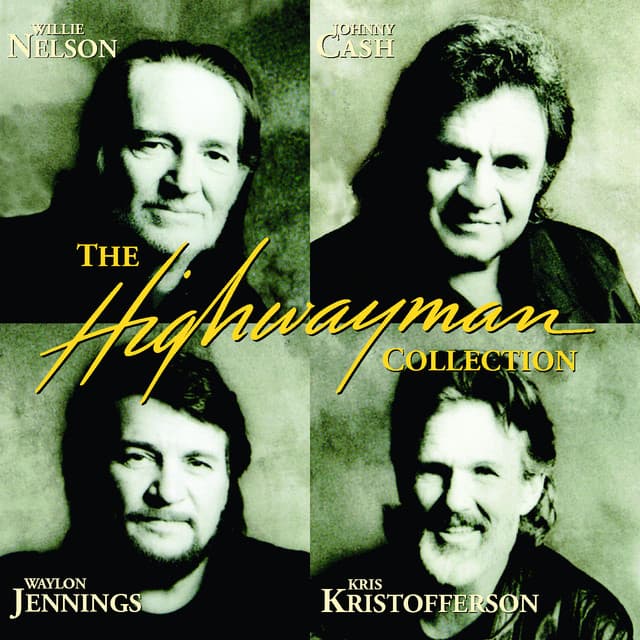
Some songs become more powerful not because their melody changes, but because the voices singing them grow older. “Desperados Waiting for a Train” is one of those songs. Written by the incomparable Guy Clark, it is a ballad built on memory: the recollection of a young boy and the older man who becomes his friend, guide, drinking companion, and eventually a living connection to a world that is slowly disappearing. When The Highwaymen, the celebrated quartet of Johnny Cash, Willie Nelson, Waylon Jennings, and Kris Kristofferson, performed the song, its meaning seemed to deepen almost naturally. Four artists whose careers had already become part of American music history were singing about age, loyalty, and the painful knowledge that no one can remain on the road forever.
The song was written by Guy Clark and first recorded by him for his 1975 debut album, Old No. 1, released on RCA Records. Clark’s original version was not a major Billboard chart hit, but the song quickly became one of the most admired compositions in his catalog. Its influence came not from commercial success, but from the extraordinary precision of its storytelling. Like many of Clark’s finest songs, “Desperados Waiting for a Train” feels almost cinematic without ever becoming overly dramatic. A few details are enough: a young boy, an aging oilfield worker, cheap beer, old stories, and a friendship that continues while the years quietly close in.
The first major chart success for the song came through David Allan Coe, who recorded “Desperados Waiting for a Train” in 1977. His version reached No. 10 on Billboard’s Hot Country Singles chart, giving the song its first substantial commercial breakthrough. That success helped introduce Guy Clark’s writing to a much broader country audience and confirmed what many songwriters already knew: Clark had a rare ability to make an intensely personal story sound universal.
Guy Clark wrote “Desperados Waiting for a Train” partly from memories of his relationship with his grandmother’s uncle, a man named Jack Prigg, who became an important figure during Clark’s childhood in Monahans, Texas. Prigg was an older man from another era, and Clark remembered spending time with him, listening to his stories and absorbing his personality. The song transformed those memories into the character of an aging former oilfield worker who once seemed almost invincible to the young narrator.
At the beginning, the older man appears larger than life. To the boy, he is tough, experienced, and mysterious. He drinks, remembers the past, and carries himself with the confidence of someone who has survived difficult times. The narrator looks at him with the kind of admiration that children often reserve for adults who seem completely outside the ordinary rules of life.
But time changes the perspective. As the narrator grows older, he begins to see what the boy could not see. The man he once considered indestructible is aging. His body weakens. His old friends disappear. The stories remain, but the world that created those stories is slipping away. Eventually, the narrator understands that his friend is not simply an old man waiting for the end. He belongs to a generation of people who have reached the last station of a long journey.
That is where the title becomes so powerful. “Desperados Waiting for a Train” is not literally about outlaws standing beside railway tracks. The phrase works as a metaphor for aging men who have lived hard, travelled far, and now find themselves waiting for something inevitable. They are the last survivors of their own adventures. The train represents time, departure, and mortality. The “desperados” are not glamorous heroes. They are people who once seemed impossible to defeat and who now discover that even the strongest eventually have to leave.
The imagery is especially moving because Guy Clark never forces the emotion. He does not tell the listener to be sad. Instead, he allows the details to do the work. A drink at the bar. A familiar story. A physical decline that arrives almost unnoticed. A younger friend suddenly realizing that the man he admired is approaching the end of his life. The sadness enters quietly, almost before the listener realizes it is there.
For The Highwaymen, this song was an unusually fitting choice. By the time the group formed in 1985, Johnny Cash, Willie Nelson, Waylon Jennings, and Kris Kristofferson were already legendary figures. Their debut album, Highwayman, reached No. 1 on Billboard’s Top Country Albums chart, while the title song became a No. 1 hit on Billboard’s Hot Country Singles chart. Their partnership was built on four distinctly different voices and four different life stories, yet they shared a common history of highways, recording studios, concert halls, rebellion, survival, and reinvention.
When they sang “Desperados Waiting for a Train,” the song could not help but acquire another layer. These were not young performers imagining the passage of time. Each voice carried decades of it. Johnny Cash brought gravity to every line. His voice had the sound of someone who understood loneliness and endurance without needing to explain either. Willie Nelson, with his relaxed phrasing and unmistakable vulnerability, could make even a simple line feel like a personal recollection. Waylon Jennings carried the rough independence of the Texas and Nashville traditions that had shaped him. Kris Kristofferson, himself one of the greatest songwriters of his generation, understood better than almost anyone how much could be contained within a carefully chosen detail.
Together, they did not merely perform the song. They seemed to inhabit its world. There is a particular poignancy in hearing four famous men sing about old friends disappearing and great lives gradually becoming memories. Their fame does not make the story larger than life. Instead, it brings the song back to its simplest truth: everyone eventually looks at someone they once thought would always be there and realizes that time has been moving much faster than expected.
The friendship in “Desperados Waiting for a Train” is also unusual because it crosses generations. The narrator does not describe a father, a teacher, or a conventional mentor. The older man is something less easily defined. He is a companion, an influence, and a witness to another world. Through him, the narrator learns that people do not become important to us only because they are related to us. Sometimes a person enters our life, tells us stories, shares an afternoon or a drink, and gradually becomes part of who we are.
That is one reason Guy Clark’s songwriting continues to command such respect. He understood that memory is rarely organized around grand events. We remember voices, gestures, old chairs, familiar roads, the smell of a room, and the stories someone told repeatedly until we knew them by heart. Years later, those small things become enormous because they are all that remain.
“Desperados Waiting for a Train” has been recorded by several artists, but its journey from Guy Clark’s Old No. 1, through David Allan Coe’s Top 10 country hit, and into the repertoire of The Highwaymen shows how a great song can gather meaning as it travels from one voice to another. The words remain the same, but the age and experience of the singer can change everything.
With The Highwaymen, the song becomes almost a gathering of old friends around a table, remembering the people who once seemed permanent. The performance does not need theatrical excess. The power lies in recognition. Four voices, each carrying its own history, meet inside a song about a man whose history is coming to an end.
And somewhere within that performance is the thought that makes “Desperados Waiting for a Train” impossible to hear casually. We spend much of life believing that the people who shaped us will always remain somewhere in the background, ready to tell the same stories one more time. Then, often without warning, we discover that the stories are now ours to remember.
That is the train Guy Clark was writing about. It keeps coming, whether we are ready or not. And in the hands of Johnny Cash, Willie Nelson, Waylon Jennings, and Kris Kristofferson, the sound of that approaching train becomes less frightening than profoundly human: the sound of time moving forward while friendship, music, and memory struggle beautifully to hold on.