
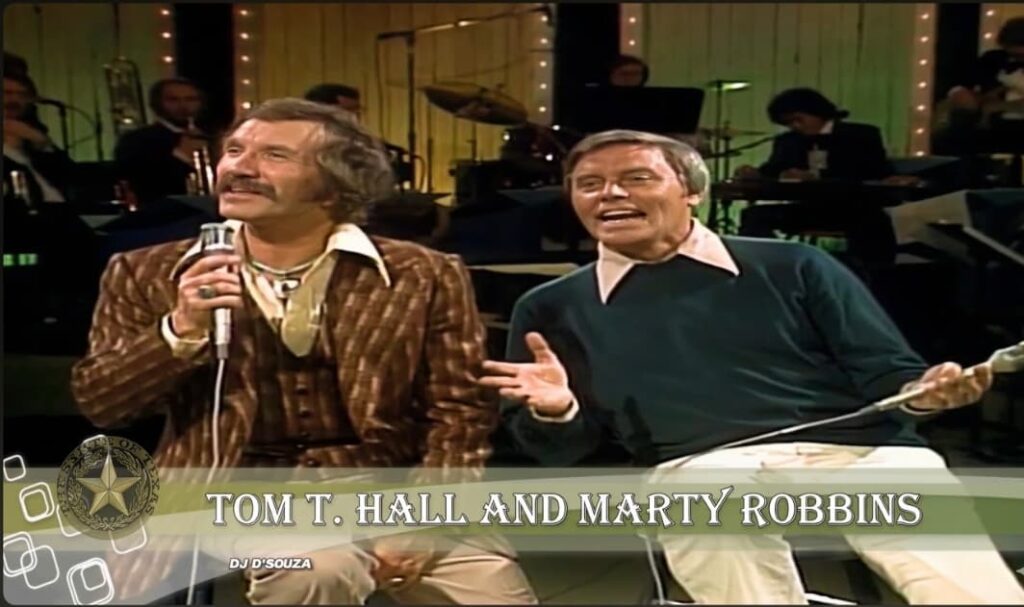
Tom T. Hall and Marty Robbins: A Meeting of the “Storyteller” and the “Balladeer” in an Unforgettable Night of Narrative Magic
In the golden twilight of Nashville’s variety show era, specifically during the early 1980s, a broadcast occurred that felt less like a television production and more like a gathering of musical prophets. When Tom T. Hall, universally revered as “The Storyteller,” sat down across from Marty Robbins, the “Boy from Glendale” with the velvet touch, the air in the studio thickened with a rare, literate kind of charisma. For those of us who grew up measuring our lives by the quality of the stories we told, this pairing on The Marty Robbins Show was a monumental event. It brought together two men who had single-handedly elevated country music lyrics from simple rhymes to high literature—Marty Robbins, the master of the epic Western tragedy, and Tom T. Hall, the man who could find the cosmic meaning in a cup of coffee or a conversation with a janitor.
The “story” behind this specific appearance is one of profound mutual respect and the playful intellectual sparring of two titans. Tom T. Hall had redefined the genre in the late 60s and 70s with hits like “Harper Valley PTA” and the deeply philosophical “Old Dogs, Children and Watermelon Wine,” which spent weeks at Number 1 on the Billboard Hot Country Songs chart. When he stepped onto Marty’s stage, the dynamic was electric. Marty Robbins, ever the mischievous host, delighted in trying to “out-story” the man who literally owned the title. They traded quips with a sharpness that only comes from decades of songwriting excellence. It wasn’t just about the songs they sang; it was about the way they spoke about the human condition—with a mixture of weary wisdom and an almost boyish curiosity that resonated deeply with a sophisticated, older audience.
For the listener who remembers the quiet dignity of a 1980s living room, watching Tom T. Hall and Marty Robbins interact is a journey into a lost world of “Grown-Up” music. It evokes memories of a time when a song’s value was found in its narrative arc rather than its tempo. The sight of Marty, leaning in with a glint in his eye, while Tom delivered a deadpan observation about life on the road, is a masterclass in screen presence. They represented a generation that didn’t need to shout to be heard; they simply needed to observe. For a “qualified” reader who has seen the seasons of life change many times, this performance is a mirror. It speaks to the realization that as we age, we become the stories we tell, and having two such masters tell them back to us is a rare, cherished gift.
The meaning of this collaboration lies in its quiet rebellion against the “flashy” trends of the early eighties. While the world was turning toward synthesizers and neon, Marty and Tom remained anchored in the acoustic truth of the guitar and the power of the word. They reminded us that a “Gentle Giant” isn’t defined by volume, but by the weight of his convictions. As we reflect on this footage today, through the lens of our own silver years, we feel a powerful, bittersweet nostalgia. It is a reminder of an era when music was a sanctuary of sincerity—a place where two friends could sit on a stage, share a laugh, and remind us all that while singers may fade, a great story is eternal.
 Music Legend