
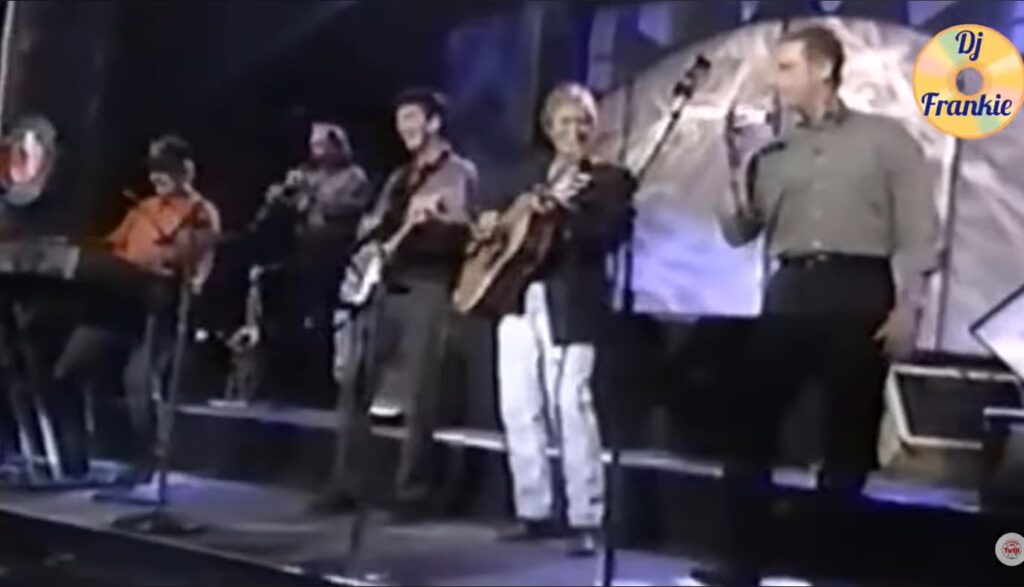
A quiet, luminous reminder that in a restless world, love remains the simplest and most enduring answer
Released in early 1979, “Love Is the Answer” by England Dan & John Ford Coley emerged as one of those rare songs that seemed to arrive not merely as entertainment, but as a gentle reassurance. Issued as the lead single from their seventh studio album “Dr. Heckle and Mr. Jive,” the track achieved notable commercial success, climbing to No. 10 on the Billboard Hot 100 in May 1979 and holding the No. 1 position on the Billboard Adult Contemporary chart for two consecutive weeks. In an era saturated with stylistic experimentation—from disco’s pulse to rock’s growing edge—this song offered something quieter, more reflective, and perhaps more lasting.
It is worth remembering that England Dan Seals and John Ford Coley had already established themselves as masters of soft rock by the time this single was released. Their sound was unmistakable: smooth harmonies, carefully crafted melodies, and an emotional sincerity that never felt forced. Yet with “Love Is the Answer,” they seemed to reach beyond their established formula into something almost spiritual. The song carries a sense of calm conviction, as though it were less written than discovered.
Interestingly, the song itself was originally composed and recorded by Todd Rundgren in 1978. However, it was the version by England Dan & John Ford Coley that brought it into the broader public consciousness. Their interpretation softened the edges, emphasizing warmth and accessibility while preserving the philosophical core of the original. In doing so, they transformed the song into a kind of shared meditation—one that listeners could return to in moments of uncertainty.
John Ford Coley later reflected that this was his favorite among their singles, noting its unique structure: a classical foundation intertwined with a gospel-inspired middle section. That observation reveals much about the song’s enduring appeal. The arrangement unfolds gradually, almost like a quiet conversation that deepens over time. The verses are introspective, even slightly hesitant, while the chorus opens outward, offering a sense of release. Then comes that subtle gospel influence—never overpowering, but unmistakable—lifting the song into something that feels communal, almost sacred.
Lyrically, “Love Is the Answer” does not rely on elaborate imagery or complex storytelling. Instead, it speaks in simple, direct phrases, as though aware that its message needs no embellishment. At its heart lies a universal truth: in a world often defined by confusion, conflict, and change, love remains the one constant capable of bridging divides. Yet the song does not present this idea as naïve optimism. There is a quiet acknowledgment of life’s difficulties woven into the lines, which makes its message feel earned rather than idealized.
Listening now, decades removed from its release, the song carries with it a certain stillness. It evokes memories not through grand gestures, but through its restraint—the way it allows space for reflection. One can almost imagine it playing softly in the background of a late evening, when thoughts turn inward and the noise of the day begins to fade. There is a sense of time suspended within its melody, a gentle reminder of moments when simplicity felt sufficient.
In the broader context of late 1970s music, “Love Is the Answer” stands as a quiet counterpoint to the era’s more flamboyant trends. It does not demand attention; it invites it. And perhaps that is why it has endured. While many songs of the time are tied to specific cultural moments, this one feels unanchored—capable of resonating across years without losing its meaning.
Ultimately, England Dan & John Ford Coley offered more than a hit single with this recording. They offered a sentiment that continues to echo softly through time. “Love Is the Answer” remains not just a song, but a gentle reassurance—one that asks nothing more than a willingness to listen, and perhaps, to believe.