
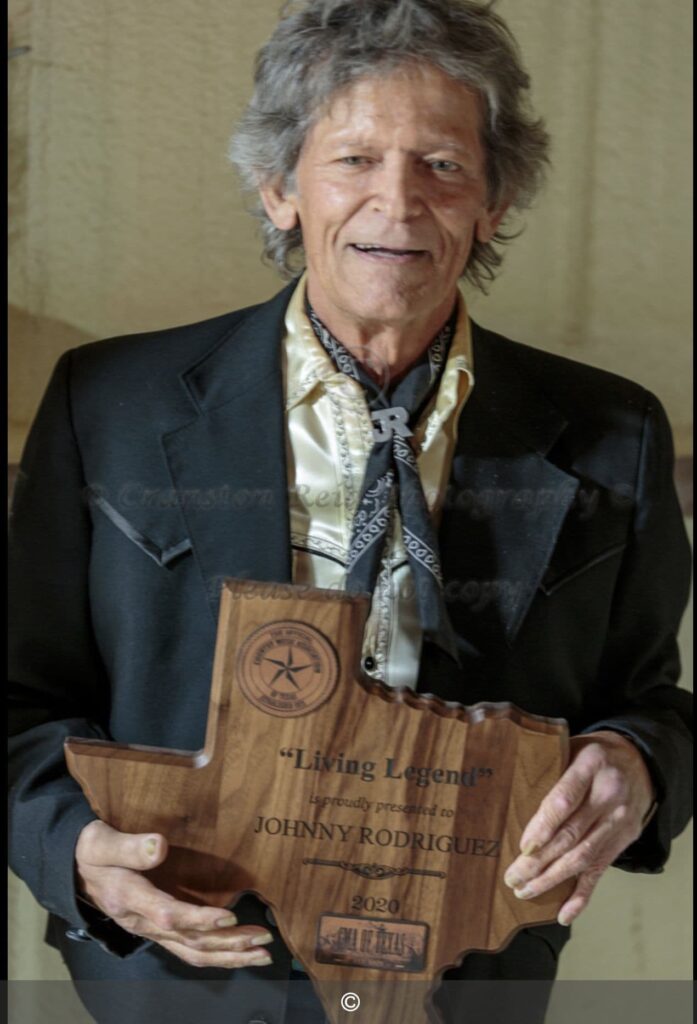
A voice that crossed borders and carried home within it, turning quiet beginnings into a legacy that outlived time
From the modest streets of Sabinal, Texas, to the bright and demanding stages of Nashville, the life of Johnny Rodriguez unfolded like a song that refused to remain confined by expectation. Born in 1951, and passing in 2025, his journey was never simply about success in music. It was about presence, identity, and the quiet determination to be heard in a space that had not always made room for voices like his.
At a time when country music was still largely defined by a narrow cultural lens, Johnny Rodriguez emerged not as an exception, but as a turning point. In the early 1970s, he became one of the first Mexican American artists to achieve sustained, nationwide success in the genre—an achievement that was not only musical, but deeply symbolic. His rise did not come through reinvention of the form, but through sincerity. He sang country music as it was meant to be sung: grounded, emotional, and unadorned. Yet within that familiar structure, there was something quietly new.
His early recordings spoke directly to listeners, carried by a voice that felt both intimate and assured. Songs like “You Always Come Back (To Hurting Me)” (No. 1 on the Billboard Hot Country Singles chart, 1973), “Ridin’ My Thumb to Mexico” (No. 1, 1973), and “That’s the Way Love Goes” (No. 1, 1973) did more than climb the charts—they established him as a defining voice of the decade. These were not fleeting successes. They were confirmations of something deeper: that authenticity could transcend boundaries.
What set Johnny Rodriguez apart was not only his chart performance, but the subtle integration of his heritage into his music. He would occasionally weave Spanish lyrics into his songs, not as a statement, but as a natural extension of who he was. In doing so, he reshaped the expectations of country music without ever confronting them directly. His presence alone was enough to shift the landscape.
Behind the success, there was a story shaped by both hardship and chance. As a young man, Rodriguez faced personal struggles that could have easily altered his path entirely. It was through a series of unexpected encounters—including being discovered while singing informally—that he found his way to Nashville. There is something almost understated in that origin, as though his career began not with intention, but with inevitability.
By the mid 1970s, his place in country music was firmly established. Yet his journey was never defined solely by its peak years. It extended beyond the charts, into a legacy that continued to resonate long after the industry had shifted its focus elsewhere. In 2007, his contributions were formally recognized with his induction into the Texas Country Music Hall of Fame, a moment that acknowledged not just his success, but his significance.
There is a quiet dignity in the way Johnny Rodriguez’s story unfolds when viewed in full. It is not marked by constant reinvention or dramatic transformation. Instead, it is defined by consistency—by a voice that remained true to itself, even as the world around it changed.
Listening back to his recordings now, one can sense that his music was never about crossing over into new territories. It was about expanding the space of what was already there. He did not step outside of country music. He broadened its boundaries from within.
And perhaps that is where his lasting meaning resides. Not in the milestones alone, though they are many, but in the quiet influence that followed. The understanding that a song, when sung honestly, does not belong to one place or one people. It travels. It carries stories with it.
From Sabinal to Nashville, from local stages to national recognition, Johnny Rodriguez left behind more than a catalog of songs. He left behind a presence—one that continues to echo, gently but unmistakably, in the spaces where music remembers its roots and, at the same time, reaches beyond them.