
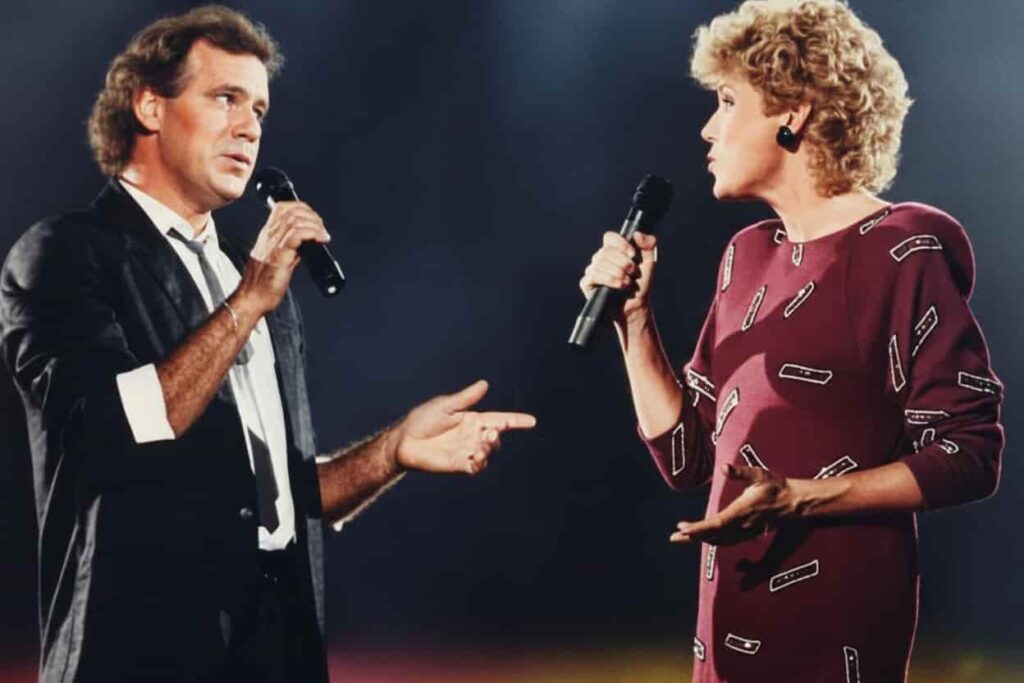
Nobody Loves Me Like You Do — a quietly radiant story of love and musical kinship
When Nobody Loves Me Like You Do first entered the airwaves in the autumn of 1984, it did so in a way that felt almost like a gentle confession whispered between old friends. Recorded as a duet by Anne Murray and Dave Loggins, this song became one of those timeless country ballads that found its way into both the charts and the hearts of listeners who longed for songs that sounded like lived-in truth. It was released as the lead single from Murray’s album Heart Over Mind, and on December 15, 1984 it reached number one on the U.S. Billboard Hot Country Songs chart, marking Murray’s ninth American number-one country hit and, notably, the only country chart success of Loggins’ recording career. The song also reached the Top Ten on the Billboard Adult Contemporary chart, confirming its broader appeal beyond the pure country audience.
From the outset, the genesis of Nobody Loves Me Like You Do reveals a layered and somewhat melodramatic path. Originally penned by James Dunne and Pamela Phillips-Oland, the composition first appeared not on country radio but on the CBS soap As the World Turns, where it was performed by Dunne with actress Tonya Pinkins. Another early recording was made by Jermaine Jackson and a then-unknown Whitney Houston, whose version featured on Houston’s 1985 debut album. However, it was the Murray–Loggins version that etched the song into the collective memory of adult contemporary and country listeners of the 1980s.
To place this duet in the context of its time, consider the musical landscape of 1984: pop was splashed with synths and glam, rock guitars echoed in arenas, and country music was in the midst of a renaissance that bridged traditional storytelling with pop sensibilities. Amid those swirling currents, Anne Murray’s voice — smooth, warm, and unwavering served as a reassurance, a sound that whispered of enduring love rather than fleeting passion. Her collaborator, Dave Loggins, already respected as a songwriter and known for his own pop hit “Please Come to Boston,” brought a subtle, complementary emotional palette to the recording. This was not a grandiose duet; it was a partnership in sound, a musical handshake that spoke of mutual respect and shared artistic purpose.
The lyrics of Nobody Loves Me Like You Do unfold like a conversation between two souls who have seen love falter and rise again. Imagery of light and wind, of dreams realized, carry with them a sense of gratitude — not just for romantic connection but for the very possibility of feeling understood. In its simplest moments, the song reaches deeply into that universal human longing: to be seen, cherished, and held in a love that feels both rare and reassuring. In the decades since its release, it has become a staple on classic country playlists and lends itself to slow dances in quiet living rooms, wedding receptions, and reflections at dusk.
The success of this single also anchored Heart Over Mind as a significant entry in Murray’s catalog. The album itself peaked at number four on the Billboard Top Country Albums chart and was later certified Gold, emblematic of a career that consistently bridged genres and generations. For Murray, the song reaffirmed her place as a storyteller whose voice resonated with sincerity and emotional clarity. For Loggins, it was a rare moment in which his own performances rather than just his songwriting joined the chorus of voices defining the era.
Listening to Nobody Loves Me Like You Do today is like opening a familiar old book on a rainy afternoon, finding that the words still shine with the same gentle light they carried on that first autumn morning more than four decades ago. It stands not only as a key moment in the careers of its performers but as a testament to a time when love songs invited us to sit a little closer, listen a little longer, and remember that music can be both a mirror and a balm to the heart.