
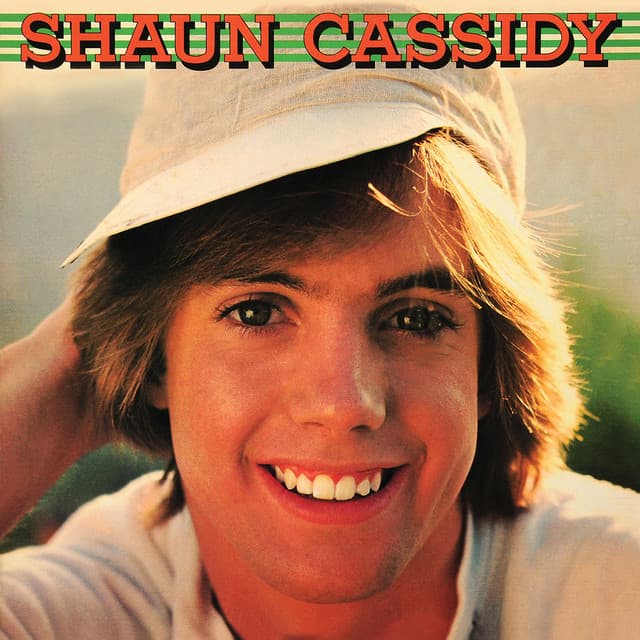
A fleeting portrait of teenage longing and bright-eyed innocence captured at the height of 1970s pop stardom
When “A Girl Like You” was released in 1977, it marked a defining moment in the brief but dazzling ascent of Shaun Cassidy. Issued as the second single from his self-titled debut album, Shaun Cassidy, the song climbed to No. 3 on the Billboard Hot 100 in the United States, confirming that Cassidy was not merely a television heartthrob but a genuine chart presence in the late 1970s pop landscape. The album itself soared to No. 1 on the Billboard 200 and achieved multi-platinum status, becoming one of the year’s biggest commercial successes. For a season in American pop culture, Shaun Cassidy was everywhere — on the radio, on magazine covers, and on prime-time television screens.
Yet behind the gleaming surfaces of teen-idol hysteria was a carefully crafted pop single that deserves a closer, more reflective listen. Written by songwriter Peter Anders and produced by Michael Lloyd, “A Girl Like You” was built with the polished precision typical of mid-1970s Los Angeles pop production. Its buoyant tempo, shimmering guitars, and sweetly layered harmonies evoke the era’s fascination with youthful romance — not cynical, not complicated, but full of wonder and breathless anticipation.
The song’s lyrical theme is simple, almost disarmingly so: a young man marveling at the presence of a girl who seems too perfect, too luminous to be real. But it is precisely this simplicity that gives the record its enduring charm. There is no heartbreak here, no bruised regret. Instead, there is the soft astonishment of first love — the feeling that someone extraordinary has stepped into one’s ordinary world. Listening to it now, decades removed from its original chart run, one hears not just a teenage anthem but a time capsule of emotional innocence.
In 1977, the music world was shifting. Disco rhythms pulsed through dance floors, punk was beginning to challenge established sounds, and arena rock was growing louder and more theatrical. Amid those currents, Shaun Cassidy offered something gentler. His clean-cut image and unguarded vocal tone provided a counterpoint to the growing edge in popular music. “A Girl Like You” did not strive to revolutionize; it aimed to reassure. It carried the warmth of AM radio afternoons and transistor radios tucked under pillows after lights-out.
Cassidy’s background also added a layer of intrigue. As the son of Shirley Jones and the half-brother of David Cassidy, he inherited a legacy of entertainment stardom. Yet he carved out his own brief chapter. His concurrent role on the television series The Hardy Boys Mysteries amplified his popularity, creating a synergy between screen and song rarely matched at the time. The record-buying public responded enthusiastically, propelling both “Da Doo Ron Ron” — his breakout No. 1 hit — and “A Girl Like You” into the upper reaches of the charts within months of each other.
What makes “A Girl Like You” resonate today is not technical virtuosity or lyrical depth, but atmosphere. It evokes a world before digital immediacy, when a three-minute single could define an entire season of life. The melody moves with an easy optimism, never rushing, never straining. Cassidy’s voice carries a natural vulnerability — not polished to perfection, but earnest enough to feel believable. That vulnerability, in retrospect, may be the song’s most powerful element.
Time has inevitably softened the once-deafening screams that accompanied Cassidy’s concerts. The posters have faded; the magazine covers have yellowed. But the record remains — bright, buoyant, and suspended in its own golden moment. In the broader history of 1970s pop, “A Girl Like You” stands as a testament to an era when innocence could still top the charts, when longing was expressed without irony, and when the promise of love felt uncomplicated and immediate.
Listening now, one does not merely revisit a teenage idol’s hit single. One revisits the texture of a cultural moment — a season when melodies were carried on open-hearted optimism, and when a simple declaration of admiration could fill a room with light.