
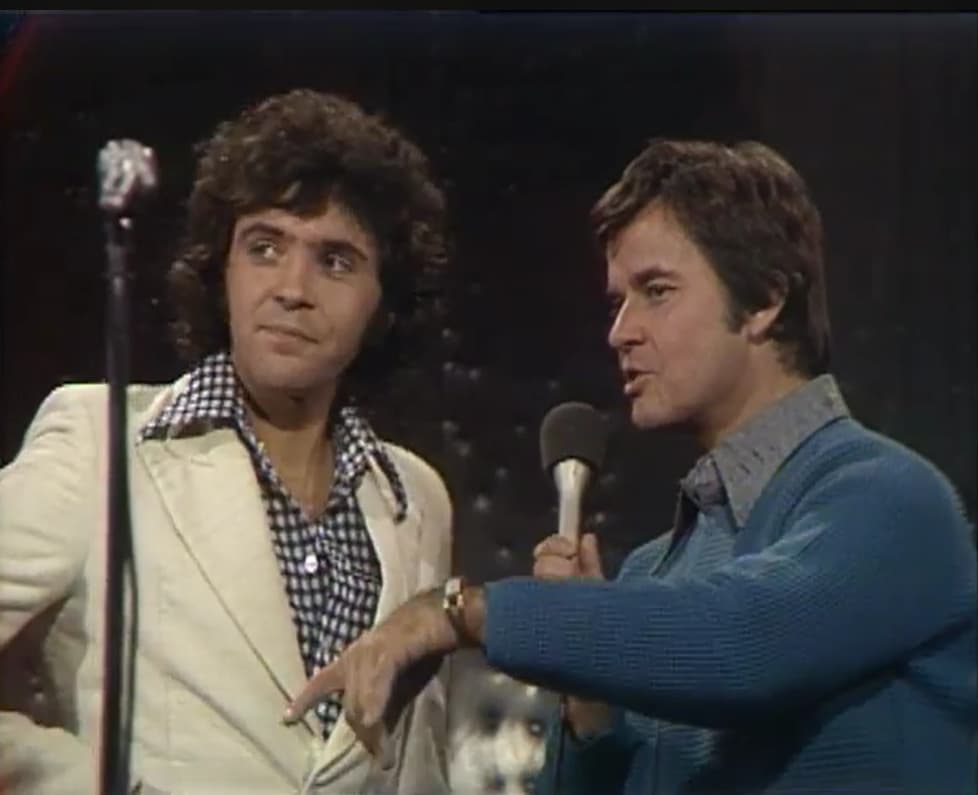
A young artist in motion—David Essex speaks not just about success, but about discovering a world larger than the one he came from
When David Essex sat down with Dick Clark on Action 74, there was a noticeable contrast between them—not in personality, but in position. Clark, composed and precise as ever, asked questions with the ease of someone who had seen countless careers rise and settle. Essex, on the other hand, carried the energy of someone still in motion, still figuring out where all of this was leading.
The conversation begins simply enough—how much of America he has seen. It’s the kind of question that could easily pass without weight, but Essex doesn’t rush through it. You can sense that he’s still absorbing what’s around him, that the experience hasn’t yet become routine. America, to him at that moment, isn’t just a market or a destination. It’s something unfamiliar, something wide and slightly overwhelming. There’s a kind of honesty in the way he answers, as if he hasn’t yet learned to package his experiences into neat conclusions.
When asked what feels different, he doesn’t overstate it. There’s no attempt to dramatize the contrast between England and the United States. Instead, there’s a quiet acknowledgment—things feel bigger, faster, perhaps a little less contained. And in that observation, you begin to understand where Essex stands in his career at that time. He isn’t speaking as someone who has fully arrived. He’s speaking as someone who is still looking, still measuring the distance between where he started and where he suddenly finds himself.
The conversation shifts to film, to That’ll Be The Day, and here something changes. There’s a subtle confidence when he speaks about it—not arrogance, but familiarity. This is ground he understands. The film itself, rooted in the early days of British rock and roll, mirrors Essex’s own artistic identity. It’s not just a role he played; it’s a reflection of the world that shaped him.
And then comes Stardust, the sequel, which carries a different weight altogether. Where That’ll Be The Day looks at beginnings, Stardust deals with what comes after—the complications, the expectations, the cost of being seen. Listening to Essex speak about it, there’s a sense that he recognizes this shift, even if he doesn’t fully articulate it. He understands that success changes the conversation, that it introduces questions that didn’t exist before.
What makes the interview compelling is not any single answer, but the space it creates. Clark doesn’t press too hard, and Essex doesn’t try to fill every silence. There’s room for thought, for hesitation, for the kind of responses that feel unpolished in the best possible way. It’s a reminder of a time when artists were not yet expected to have a defined narrative ready at all times, when uncertainty was still allowed to exist in public.
There’s also something quietly revealing in the way Essex carries himself throughout the exchange. He doesn’t lean into performance. He doesn’t try to project an image beyond what’s already there. Instead, he remains present, attentive, slightly reserved. And in that restraint, you begin to see the shape of his artistry—not just in music or film, but in the way he navigates the moment.
Looking back, the interview feels less like a milestone and more like a snapshot—one point along a path that had not yet fully revealed itself. David Essex would go on to achieve significant success, both as a musician and as an actor, but here, in this brief conversation, he is still in transition. Still observing, still adjusting, still learning how to exist within a world that is opening up faster than he might have expected.
And perhaps that is what gives the interview its quiet resonance. It captures something that cannot be recreated once it has passed—the early stage of recognition, where possibility is still larger than certainty, and where every answer feels like it is being discovered in real time rather than recalled from memory.