
A Mother’s Memory Held in Fabric: The Enduring Legacy Behind “Sweet Dreams”
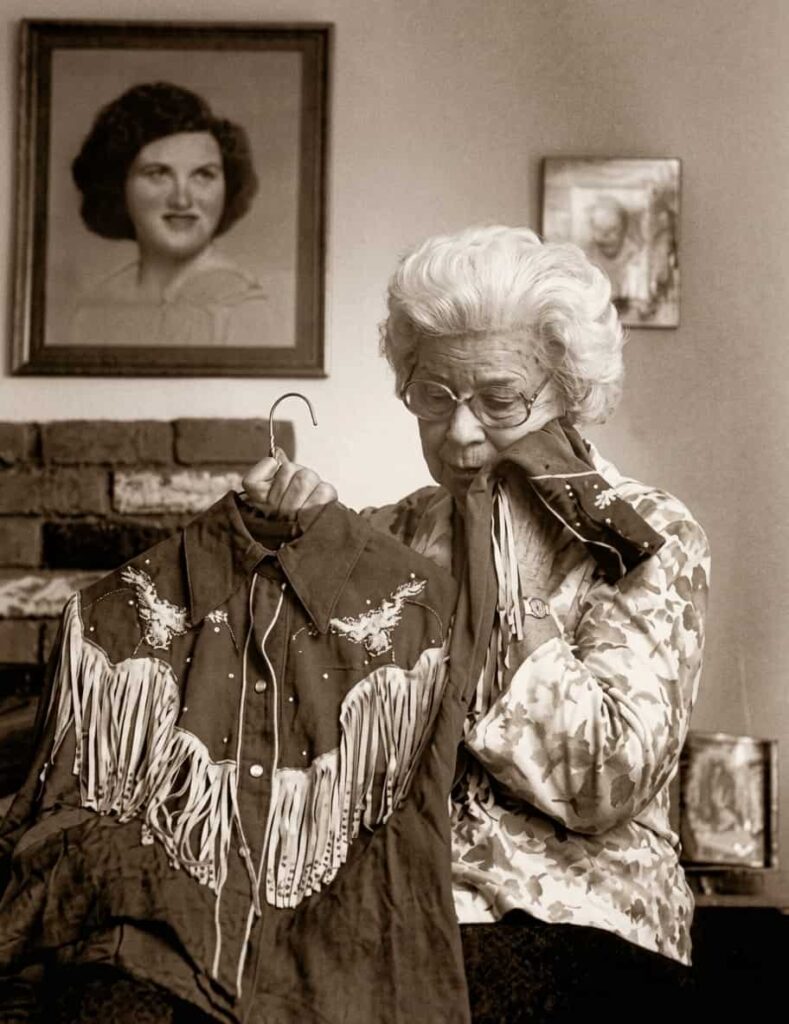
In the late 1980s, many country music fans encountered a powerful wave of nostalgia when the film “Sweet Dreams” retold the remarkable life of Patsy Cline. Around that same time, an issue of People magazine featured a deeply touching photograph that quietly said more than any headline could. In it, Patsy’s mother, Hilda Hensley, gently held one of the many stage outfits she had sewn for her daughter during her early Cowgirl days. The image was simple, almost ordinary at first glance. But for those who understood the story behind it, the photograph carried the weight of memory, love, and a life interrupted far too soon.
Many of us remember first seeing that magazine cover as young students, perhaps just starting high school, flipping through the pages without realizing we were looking at a piece of country music history. The photograph stopped readers in their tracks. Hilda wasn’t simply holding a costume. She was holding a memory. The fringed western shirt, stitched by hand years earlier, represented a time when Patsy Cline was still a hopeful young singer performing in small venues, long before the bright lights of Nashville and the recording studio.
Before the fame that came with timeless recordings like “Sweet Dreams”, Patsy was a working country girl chasing a dream with the quiet support of her family. Her mother played a part that rarely appears in headlines. Hilda not only believed in her daughter’s talent but quite literally helped dress the dream, sewing stage outfits that would help Patsy look the part of a rising country star. Those fringed shirts and western costumes were part of the visual identity of early country performers, especially for singers trying to carve out a place on regional stages.
Looking at that late-1980s photograph, you can almost feel the silence in the room. Hilda’s expression is tender and reflective, the way only a mother can look at something that once belonged to a child she loved deeply. She clutches the shirt carefully, almost protectively, as if the fabric itself still carries her daughter’s presence. In that moment, the years between the 1950s Cowgirl era and the renewed public interest sparked by the “Sweet Dreams” film seem to disappear.
For longtime fans of Patsy Cline, the photograph reminds us that behind every legendary voice stands a story of family, sacrifice, and ordinary moments that shaped an extraordinary life. The music may live forever on records and radio waves, but sometimes the most powerful memories are preserved in the quiet things left behind. A stitched seam. A worn collar. A mother holding on to the past with both hands.
 Oldies Songs