
A Fragile Heart Laid Bare — “I Fall to Pieces” Reveals the Quiet Pain of Love That Never Truly Ends
Few voices in the history of American music carry the same emotional gravity as Patsy Cline, and few songs capture the delicate ache of lost love as powerfully as “I Fall to Pieces.” First released in 1961, the song quickly became one of the defining recordings of Cline’s career and a cornerstone of the evolving Nashville Sound. With its gentle arrangement, restrained heartbreak, and haunting vocal performance, “I Fall to Pieces” remains a timeless portrait of emotional vulnerability.
The single was released by Decca Records in early 1961 and became a major breakthrough for Patsy Cline. The song climbed to No. 1 on the Billboard Hot Country Songs chart, holding that position for two consecutive weeks, and also crossed over to reach No. 12 on the Billboard Hot 100. At a time when country artists rarely penetrated the pop charts, this success was significant. It signaled that Cline’s voice—rich, expressive, and unmistakably human—could transcend genre boundaries.
The song itself was written by Hank Cochran and Harlan Howard, two of Nashville’s most respected songwriters. Interestingly, “I Fall to Pieces” was initially rejected by several artists before it finally reached Patsy Cline. Even Cline herself reportedly had reservations during the recording process, partly because the arrangement felt different from the more traditional country style she had previously recorded. Yet producer Owen Bradley, one of the architects of the Nashville Sound, believed deeply in the song’s emotional potential.
Bradley’s production approach was revolutionary for country music at the time. Instead of the rough honky-tonk sound common in the 1950s, he surrounded Cline’s voice with smooth background vocals from The Jordanaires, soft piano lines, and subtle steel guitar. The result was a polished yet deeply intimate recording that allowed the fragile emotion of the lyric to take center stage.
The opening line alone—simple and devastating—sets the tone: a quiet confession of someone who still cannot escape the memory of a love that has already slipped away. In “I Fall to Pieces,” heartbreak is not dramatic or explosive. Instead, it appears in small, painfully familiar moments: seeing someone across the room, hearing their voice, realizing that time has not healed what the heart still remembers.
What made Patsy Cline’s performance so extraordinary was her ability to communicate restraint. She never oversings the song. Instead, each phrase seems to hover gently between strength and vulnerability. Her voice carries the weight of experience, delivering the lyric with a quiet dignity that transforms sorrow into something deeply human.
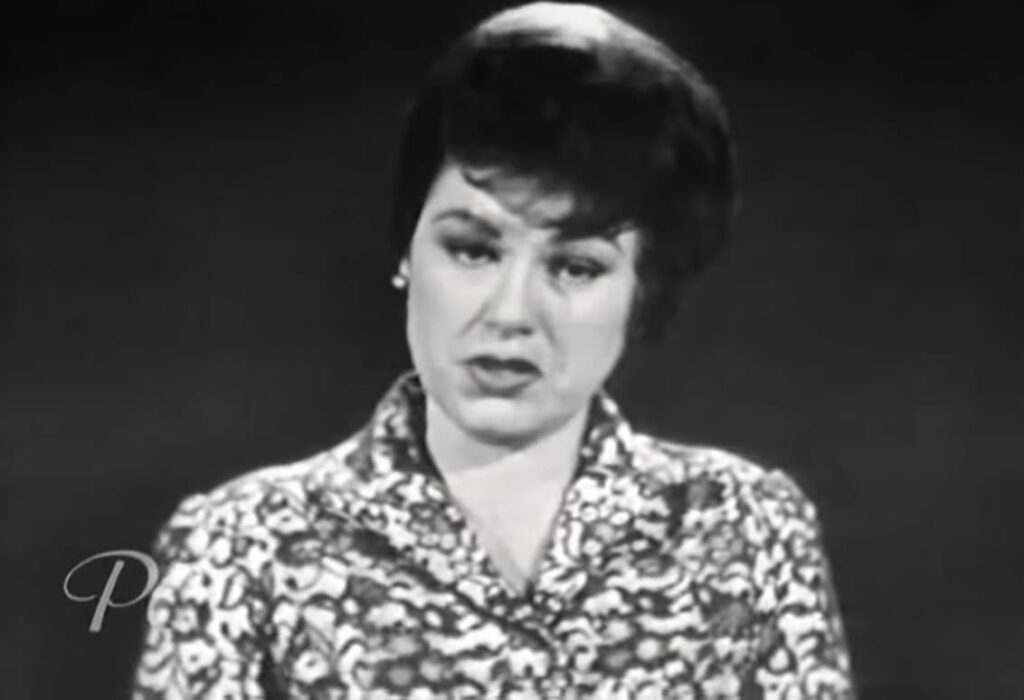
By 1963, the song had already become closely associated with Cline’s public appearances. One particularly memorable performance came on “The Glenn Reeves Show” on February 23, 1963. Broadcast only weeks before the tragic plane crash that would claim her life on March 5, 1963, this performance now carries a poignant historical resonance. Watching Cline perform “I Fall to Pieces” during this period reveals an artist at the height of her interpretive power—calm, confident, and completely immersed in the emotional truth of the song.
There is something quietly mesmerizing about these performances. The audience may hear a simple country ballad, yet what unfolds is far deeper: a meditation on memory, longing, and the strange persistence of love. Patsy Cline did not merely sing about heartbreak—she illuminated its quiet corners.
Over the decades, “I Fall to Pieces” has been recorded by numerous artists and frequently appears on lists of the greatest country songs ever written. It also became a central piece of Patsy Cline’s legacy, later featured on collections such as “The Patsy Cline Story” and countless retrospective albums.
Yet the magic of the song remains tied to that original voice. There is a stillness in Cline’s delivery that feels almost timeless. Listening today, one can sense the atmosphere of an earlier era—radio stations humming softly late at night, the glow of jukebox lights, and melodies that linger long after the room has gone quiet.
In the end, “I Fall to Pieces” endures because it speaks to something universal. Love does not always disappear simply because it must. Sometimes it lingers in memory, resurfacing in unexpected moments, carried by a melody that refuses to fade.
And in that fragile space between memory and music, the voice of Patsy Cline still echoes with extraordinary grace.
 Oldies Songs