
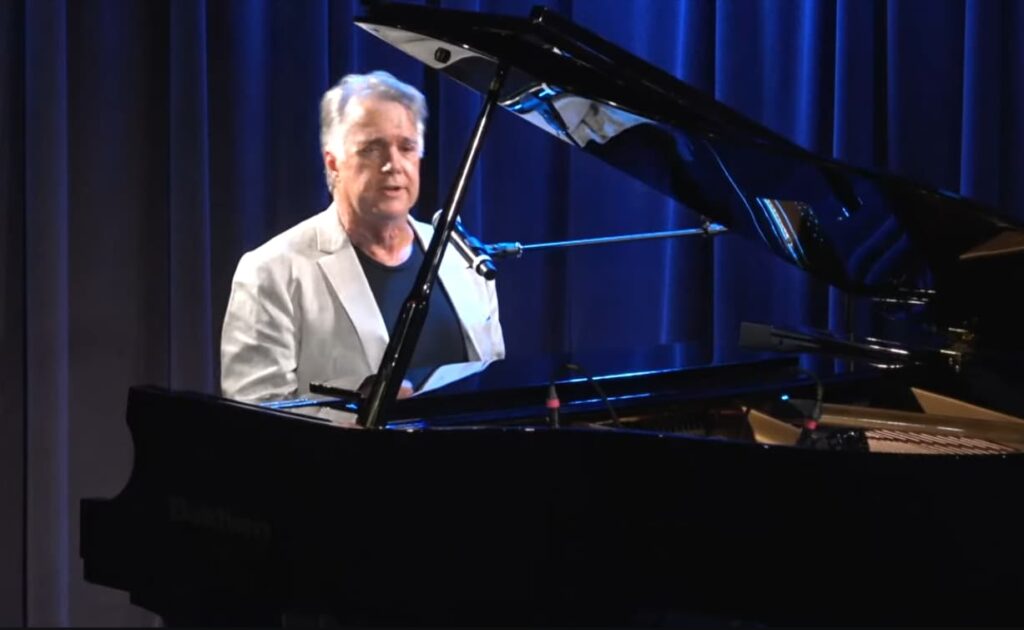
A Song About Letting Go — “The Last Song” Reveals the Quiet Emotional Depth Behind Shaun Cassidy’s Voice
Some songs are remembered not for their spectacle, but for the quiet honesty they carry within a simple melody. “The Last Song”, performed by Shaun Cassidy at the GRAMMY Museum, belongs to that kind of music. It is not built on dramatic production or flashy arrangements. Instead, it rests gently on reflection — the kind that arrives when a chapter of life begins to close and memory starts to speak more clearly than words.
Originally written by the legendary songwriting duo Paul Williams and Roger Nichols, “The Last Song” first gained wide recognition through Edward Bear’s recording in 1972, which reached No. 3 on the Billboard Hot 100. The song quickly became known for its emotional sincerity, telling the story of reconciliation between a father and son after a long period of silence and misunderstanding. Its lyric does not dramatize the conflict. Instead, it focuses on the quiet courage required to forgive, to reconnect, and to say what was left unsaid.
When Shaun Cassidy later interpreted “The Last Song”, he brought a different emotional color to the piece. Known primarily for his youthful pop success during the late 1970s, Cassidy had built his career on bright melodies and energetic performances. His debut album Shaun Cassidy (1977) introduced him to international audiences and produced the chart topping single “Da Doo Ron Ron,” which reached No. 1 on the Billboard Hot 100. The album itself climbed to No. 6 on the Billboard 200, confirming that Cassidy had quickly become one of the defining pop voices of his generation.
Another major hit soon followed with “That’s Rock ’n’ Roll,” which reached No. 3 on the Billboard Hot 100 in 1977, reinforcing his presence on radio stations across the United States and abroad. During those early years, Cassidy’s music was often associated with youthful excitement and the vibrant pop culture of the era.
Yet “The Last Song” reveals a more introspective side of his artistry. When he performs the song in an intimate setting such as the GRAMMY Museum, the atmosphere changes entirely. Without the distance of large stage productions or the exuberance of teenage pop anthems, Cassidy’s voice takes on a reflective warmth that allows the song’s message to resonate more deeply.
The story at the heart of “The Last Song” is one of reconciliation and emotional honesty. The narrator describes a father who realizes that time is running short and that pride must give way to love. In a moment of quiet humility, he reaches out to his son, hoping that one final conversation might heal years of distance.
What makes the lyric so powerful is its simplicity. There are no dramatic accusations or elaborate explanations. Instead, the song captures the quiet vulnerability of someone who understands that relationships are fragile, and that words left unsaid can become the heaviest burdens of all.
Musically, the arrangement surrounding Cassidy’s performance emphasizes intimacy. Soft piano chords carry the melody, while subtle accompaniment allows each lyric to emerge clearly. The tempo moves gently, almost like a conversation unfolding between two people who have waited far too long to speak openly.
Listening to Shaun Cassidy sing “The Last Song” in this setting creates a sense of quiet reflection. His voice carries a maturity shaped by years of artistic growth, far removed from the youthful excitement that first brought him fame. The performance feels less like a concert and more like a moment of shared remembrance.
In many ways, that is exactly what makes the song so enduring. The themes explored in “The Last Song” — forgiveness, reconciliation, and the courage to speak honestly — remain deeply human experiences that transcend generations.
As the final lines fade in the stillness of the GRAMMY Museum performance, the song leaves behind a lingering thought. Life rarely provides perfect opportunities for reconciliation. Sometimes the most meaningful moments arrive quietly, in a single conversation, in a final chance to say what truly matters.
And through the reflective voice of Shaun Cassidy, that message feels timeless — a gentle reminder that even the last song can carry the beginning of understanding.