
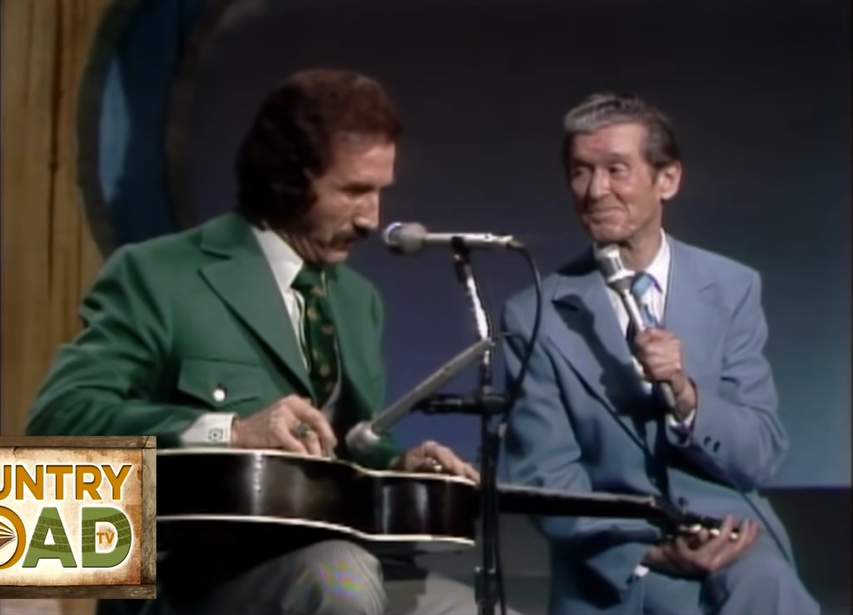
Marty Robbins and Roy Acuff – Blue Eyes Crying in the Rain: A Sacred Meeting of Country Royalty Under a Canopy of Sorrow
In the long, echoing hallway of country music history, there are moments that feel less like a performance and more like a passing of the torch. For those of us who carry the memories of the Grand Ole Opry and the flickering screens of the 1970s variety shows in our hearts, few images are as indelible as seeing Marty Robbins and Roy Acuff stand side-by-side to deliver “Blue Eyes Crying in the Rain.” When these two titans shared the microphone on The Marty Robbins Show, it wasn’t just a duet; it was a bridge between the foundational, “high lonesome” era of the 1940s and the sophisticated, crossover success of the modern age. It was a meeting of the “King of Country Music” and the “Gentle Balladeer of the West,” and together, they turned a simple song of regret into a timeless hymn for the broken-hearted.
The song itself, written by the legendary Fred Rose, had long been a staple of the genre, but it saw a massive resurgence in the mid-70s thanks to Willie Nelson’s Red Headed Stranger album. However, when Roy Acuff—the man who helped build Nashville—and Marty Robbins took it on, they stripped away the commercial sheen and returned it to its soulful roots. Acuff, who had first achieved stardom with “The Great Speckled Bird” decades earlier, brought a raw, Appalachian authenticity to the track. Meanwhile, Marty Robbins, whose velvet-smooth baritone had conquered the charts with “El Paso,” provided a melodic cushion that made the sorrow feel bearable. It was a performance that reminded a generation of older listeners that while the world was changing, the fundamental truths of heartache remained the same.
The story behind this collaboration is steeped in mutual respect. Roy Acuff was more than a singer; he was the patriarch of the Opry, a man who demanded dignity for the music he loved. Marty Robbins, despite his immense fame and “Pop” appeal, never lost his reverence for the masters like Acuff. Seeing them together on The Marty Robbins Show was a testament to the community of Nashville—a place where the new guard always took a moment to bow to the old guard. For the mature viewer, this performance is a powerful reminder of the importance of roots. It speaks to a time when we honored our elders not just with words, but by inviting them into our spotlight.
The meaning of “Blue Eyes Crying in the Rain” in the hands of these two men is particularly poignant for those of us in the sunset of our lives. It is a song about the finality of goodbye and the lingering “twilight” of a memory. The lyrics speak of a love that was “lost in the drifting snow” and the hope that “some day when we meet up yonder, we’ll stroll hand in hand again.” To an audience that has navigated the departure of friends, spouses, and family, these words are not mere poetry; they are a prayer. Marty’s polished delivery and Roy’s slightly nasal, traditional tenor created a harmony that felt like the blending of the present and the past—a reminder that love, even when lost, defines the story of our lives.
Musically, the performance on the show was beautifully sparse. With the gentle strumming of guitars and perhaps a soft, weeping fiddle in the background, the focus remained entirely on the voices. Roy Acuff’s presence brought a sense of historical weight, while Marty’s effortless charm kept the mood intimate. It was a sound that didn’t need to shout to be heard; it whispered to the parts of us that still remember the “blue eyes” of our own youth.
As we look back on this performance today, it serves as a beautiful snapshot of a lost era. It reminds us of a time when music was an honest conversation between friends and a gift to the audience. Marty Robbins and Roy Acuff gave us a version of this song that feels like a warm embrace on a cold evening—a reminder that even in the midst of “crying in the rain,” there is a quiet dignity in having loved at all.
 Music Legend