
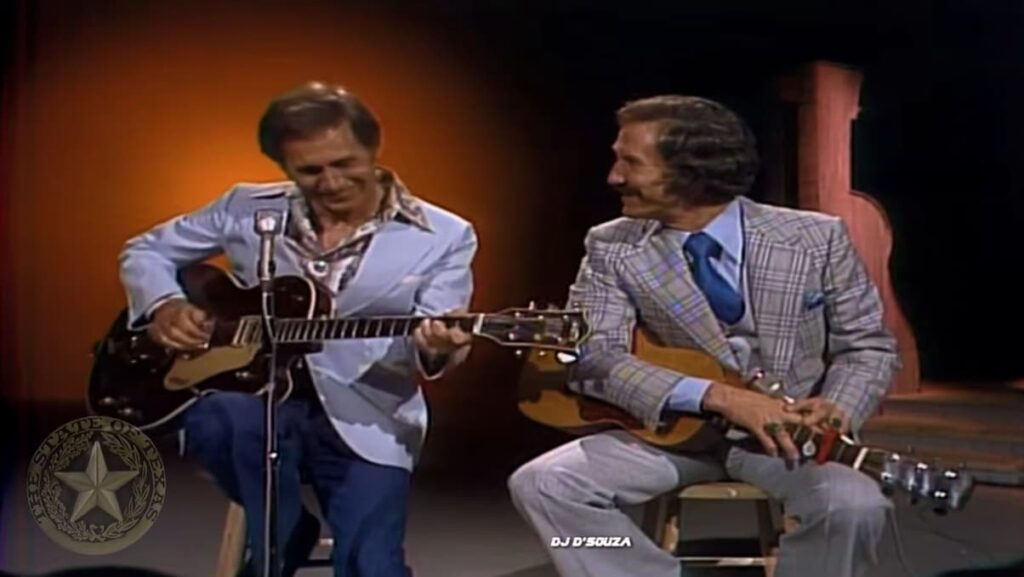
Chet Atkins and Marty Robbins on the Marty Robbins Show: When the Architect of Nashville Met the Voice of the West
In the hallowed halls of country music history, there are moments that feel less like a television broadcast and more like a gathering of royalty. For those of us who grew up watching The Marty Robbins Show in the late 1960s, few pairings were as prestigious as when the host welcomed “Mr. Guitar” himself, Chet Atkins. This wasn’t merely a meeting of two stars; it was a summit of the two men most responsible for the “Nashville Sound”—the sophisticated, polished era of music that allowed country to grace the grandest stages of the world. While Marty Robbins was the consummate showman with a voice like fine silk, Chet Atkins was the quiet visionary at RCA Records who had redesigned the landscape of American music with his thumb-picked melodies.
The debut of Chet Atkins on Marty’s show was a landmark event for any lover of the instrument. At the time, Atkins was arguably the most influential man in Nashville, yet when he sat down across from Marty, all the industry titles fell away. What remained was a pure, unadulterated passion for the strings. The “story” of their collaboration is one of mutual admiration. Marty Robbins was an underrated guitarist in his own right, often seen cradling his signature acoustic, but in the presence of Chet, he became the ultimate fan. For the mature viewer, watching Marty watch Chet was a lesson in humility and the shared language of craftsmen who had spent their lives perfecting a single, beautiful trade.
The meaning of their time together on screen carries a heavy, sweet nostalgia. It represents an era when talent was measured by the callouses on one’s fingers and the sincerity in one’s tone. When Chet would perform a solo—perhaps a dazzling arrangement of “Freight Train” or a jazzy rendition of a pop standard—the air in the studio seemed to change. It wasn’t about the volume; it was about the “notes between the notes.” For those of us who have lived through the transition from analog to digital, seeing Chet’s fingers dance across the fretboard of his Gretsch guitar is a reminder of the human touch we often miss in today’s world. It speaks to a generation that values the slow mastery of a skill over the instant fame of a moment.
The chemistry between them was anchored in a sophisticated, dry wit. Chet was known for his “certified guitar player” (C.G.P.) humor, a quiet, self-deprecating style that perfectly balanced Marty’s more outgoing, charismatic energy. To see them sit together, trading stories about the road or the early days of the Grand Ole Opry, felt like being invited into a private club of legends. Their music together was a blend of Marty’s Southwestern flair and Chet’s eclectic, thumb-style precision. It was a sound that didn’t just fill a room; it filled a heart.
Reflecting on these episodes today, we are reminded of the dignity that Chet Atkins and Marty Robbins brought to the genre. They proved that country music could be elegant, complex, and timelessly cool. As we look back through the soft grain of those old television tapes, we don’t just see two performers; we see the architects of our youth. Their collaboration on The Marty Robbins Show remains a high-water mark of musical television—a quiet, brilliant fire that still provides warmth to those of us who remember when the guitar was king.
 Music Legend