
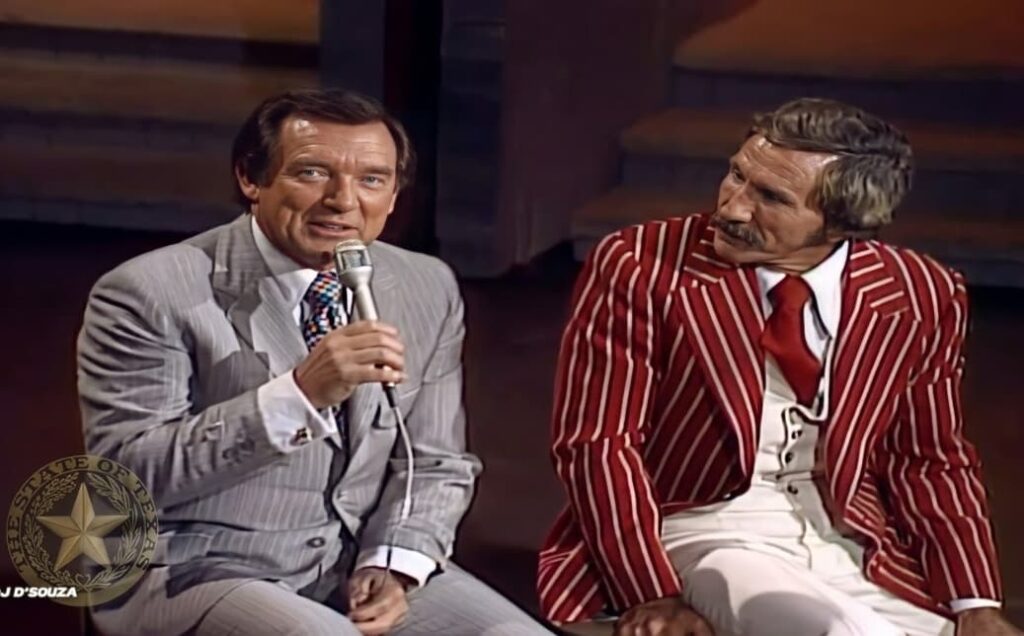
Ray Price and Marty Robbins on The Marty Robbins Show: A Meeting of the Cherokee Cowboy and the King of the West
For those of us who carry the 1960s and 70s in our hearts as the high-water mark of vocal sophistication, there was no greater thrill than seeing Ray Price take his place beside Marty Robbins. This was more than a television guest appearance; it was a summit of the two men who arguably did more to refine the sound of Nashville than any others. While Marty Robbins was the versatile master of the cowboy ballad and the Hawaiian song, Ray Price—the legendary “Cherokee Cowboy”—was the man who traded his honky-tonk boots for a tuxedo, bringing lush strings and a soaring, operatic baritone to the country charts. When they shared the stage on The Marty Robbins Show, it felt as if the Grand Ole Opry had been transported to a grand ballroom.
The historical timing of their collaborations, particularly during the late 60s and the Marty Robbins Spotlight era of the late 70s, found both men at the zenith of their artistic powers. Ray Price had already revolutionized the genre twice: first with the hard-driving “shuffled” beat of “City Lights,” and later with the crooning brilliance of “For the Good Times.” When he appeared with Marty, the “story” was one of mutual evolution. Both men had started in the rough-and-tumble world of post-war country and had blossomed into world-class stylists. To watch them together was to see a masterclass in the “Nashville Sound”—a polished, dignified version of country music that wasn’t afraid to be beautiful.
For the mature viewer, this pairing evokes a deep, resonant nostalgia for a time when “country” was synonymous with class. It reminds us of an era when a singer’s reputation was built on his phrasing and his ability to hold a note until it shimmered. Ray Price possessed a voice that was like aged mahogany—rich, dark, and perfectly polished. When he sang, even the most crowded room fell silent. For a generation that remembers the first time they heard the sweeping violins of a Ray Price record, seeing him trade lines with Marty Robbins was a deeply moving validation of their own musical tastes. It speaks to a time when we looked up to our entertainers as symbols of poise and professional excellence.
The meaning of their time together on screen is rooted in the concept of the “Velvet Revolution.” Both Marty and Ray were pioneers who proved that country music didn’t have to stay in the barn; it could travel to the city and hold its own with the best of the pop world. When they joked together on set, there was a sense of shared victory. They were survivors who had outlasted the trends by simply being better than everyone else. For the reflective heart, this performance is a reminder that while styles may change, the power of a truly great voice is eternal. It is a soundtrack for the quiet hours, a reminder of a time when the world seemed a bit more elegant and the music had a lot more soul.
Musically, the highlights were the moments where their two distinct baritones met. Marty’s voice had a lighter, more agile quality, while Ray’s was steady and profound. Whether they were revisiting an old Hank Williams standard—as both had deep ties to Hank’s legacy—or performing one of Ray’s contemporary hits, the result was always a masterpiece of restraint. They didn’t need to over-sing; they understood that the most powerful emotions are often found in the quietest melodies.
Reflecting on these episodes today, we are reminded of the incredible legacy of The Marty Robbins Show. It was a place where legends were treated with the respect they deserved. Ray Price and Marty Robbins gave us a glimpse of a Nashville that was confident, sophisticated, and deeply rooted in the art of the song. Their time together remains a glowing testament to a golden age—a memory of two “Cherokee Cowboys” who conquered the world with nothing but a guitar and a voice that could break your heart and mend it all in the same breath.
 Music Legend