
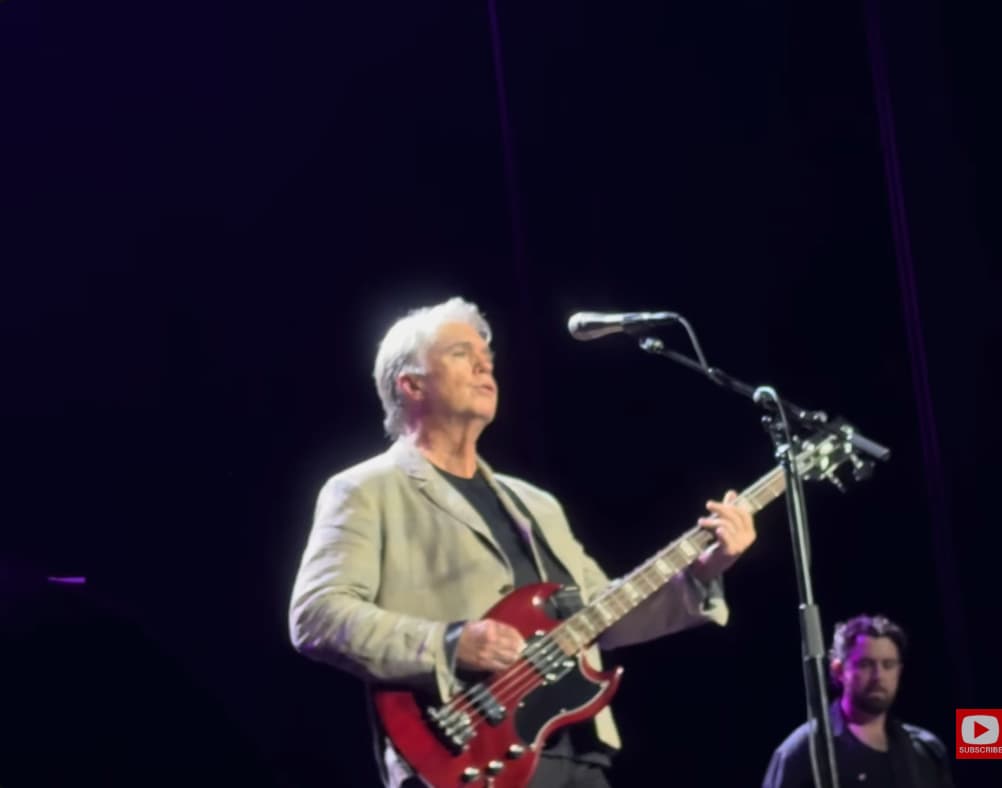
A Song That Refuses to Age — “Be My Baby” Lives Again Through Shaun Cassidy’s 2025 Stage Revival
When Shaun Cassidy stepped onto the stage in Beverly, Massachusetts during his 2025 tour, delivering a live rendition of “Be My Baby,” it was more than a performance. It was a bridge across decades, a moment where a song born in the early 1960s found new breath in a voice shaped by time, experience, and quiet resilience.
Originally recorded by The Ronettes in 1963, “Be My Baby” stands as one of the defining recordings of the Phil Spector “Wall of Sound” era. Produced by Spector and driven by that unmistakable opening drum beat from Hal Blaine, the song reached No. 2 on the Billboard Hot 100 and secured its place as one of the most influential pop recordings of all time. Sung by Ronnie Spector, it carried a youthful longing that felt immediate, almost fragile, yet wrapped in a grand, echoing arrangement that made every emotion sound monumental.
By the time Shaun Cassidy chose to revisit “Be My Baby” on stage in 2025, the song had already traveled more than sixty years through the fabric of popular music. It had been covered, studied, and revered. Yet, in Cassidy’s hands, it was neither an imitation nor a nostalgic exercise. It became something more personal, something reflective.
For those who remember Shaun Cassidy’s rise in the late 1970s, his presence was once defined by youthful energy and a certain effortless charm. Hits like “Da Doo Ron Ron” (which reached No. 1 on the Billboard Hot 100 in 1977) positioned him as a central figure in that era’s pop landscape. But as the years moved forward, Cassidy stepped away from the spotlight, turning toward writing and production, allowing his musical identity to evolve away from the immediacy of teen stardom.
That evolution becomes evident in performances like this.
In Beverly, the arrangement of “Be My Baby” is notably different from the original. Gone is the towering orchestration of Spector’s production. In its place, there is a tighter, more intimate band sound, one that allows space for interpretation. The rhythm remains steady, respectful of the song’s iconic structure, but the emphasis shifts toward the vocal — toward the telling of the story rather than the spectacle of sound.
And it is in that vocal where the transformation truly occurs.
Where Ronnie Spector’s original delivery carried the hopeful urgency of youth, Shaun Cassidy approaches the lyric with a kind of reflective calm. The words “be my baby” no longer feel like a plea filled with uncertainty. Instead, they carry the weight of understanding — the knowledge of what it means to ask, and perhaps what it means to have once asked and waited for an answer.
This subtle shift in perspective changes the entire emotional landscape of the song.
It is no longer simply about longing. It becomes about memory, about the echo of feelings that have lived long enough to settle into something quieter, yet no less significant.
The audience response during the 2025 tour stop in Beverly, MA reflects this connection. There is recognition, certainly — the familiarity of a song that has never quite left the cultural consciousness. But there is also something deeper, a shared acknowledgment of time passing, of music accompanying life through its many turns.
What makes this performance particularly compelling is its restraint. Shaun Cassidy does not attempt to overpower the original legacy of “Be My Baby.” Instead, he steps alongside it, offering his own perspective without diminishing what came before. It is an act of respect, both to the song and to the audience.
In doing so, he reveals something essential about enduring music.
Songs like “Be My Baby” do not survive because they remain unchanged. They endure because they are capable of being reinterpreted, of finding new meaning in different voices, in different moments.
And in that Beverly performance, under the lights of a modest stage rather than the vast echo of a 1960s studio, the song proves once again that it belongs not to a single era, but to every moment in which it is sincerely felt.
Through Shaun Cassidy’s voice, it becomes clear that some songs are not meant to stay in the past.
They are meant to return, quietly, and remind us of who we once were — and who we have become.