
A Psychedelic Echo Revisited, Where a Wild Youthful Experiment Meets the Calm Weight of Experience
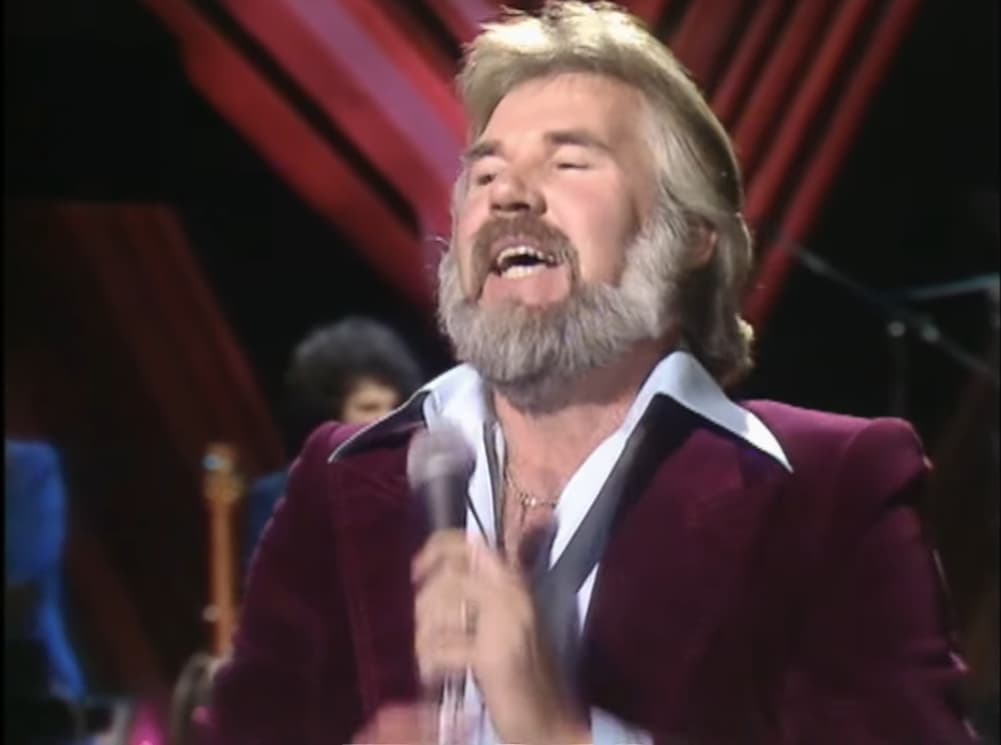
When Kenny Rogers stepped onto the stage in January 1979 to perform “Just Dropped In (To See What Condition My Condition Is In)” live, he was revisiting a song that belonged to an entirely different chapter of his life. Long before the polished storytelling of “The Gambler” (No. 1 on the Billboard Hot Country Singles chart in 1978) or the crossover success of “Lucille” (No. 1 country, No. 5 Billboard Hot 100 in 1977), Rogers had been the voice behind one of the most unusual hits of the late 1960s.
Originally released in 1967 by The First Edition, the group led by Kenny Rogers, “Just Dropped In (To See What Condition My Condition Is In)” climbed to No. 5 on the Billboard Hot 100 in early 1968. Written by Mickey Newbury, the song stood apart from nearly everything else in Rogers’ later catalog. It was psychedelic, experimental, and tinged with a sense of disorientation that reflected the cultural shifts of its time. Its swirling production, unusual phrasing, and cryptic lyrics made it both a curiosity and a landmark—a song that captured a moment when music itself seemed to be searching for new forms.
By 1979, however, Kenny Rogers was no longer that artist. He had transformed into a figure associated with narrative clarity, emotional restraint, and a distinctly grounded approach to storytelling. Songs like “Daytime Friends,” “Coward of the County,” and “The Gambler” had redefined his image, placing him firmly within the traditions of country and pop crossover success.
This is what makes the 1979 live performance of “Just Dropped In (To See What Condition My Condition Is In)” so compelling. It is not simply a revival; it is a confrontation between past and present.
From the opening lines, there is an immediate difference. The wild, almost chaotic energy of the original recording is tempered. The arrangement, while still acknowledging the song’s roots, feels more controlled, more deliberate. And at the center of it all is Rogers’ voice—older, steadier, carrying a depth that could not have existed in 1967.
There is a subtle shift in meaning as well. In its original form, the song was often interpreted as a reflection of altered states, a commentary—whether intentional or not—on the experimentation that defined much of the late 1960s. Its lyrics, filled with surreal imagery, seemed to mirror a world that was itself in flux.
But in 1979, those same words take on a different tone. They feel less like a description of experience and more like a memory of it. When Kenny Rogers sings them now, there is a sense of distance, as though he is observing that earlier version of himself from afar. The confusion remains in the lyrics, but the delivery suggests understanding rather than immersion.
This transformation is not forced. Rogers does not attempt to reinterpret the song dramatically. Instead, he allows his own evolution as an artist to shape the performance naturally. The result is something quietly fascinating—a song that exists in two times at once.
There is also an element of acknowledgment in choosing to perform it at that stage of his career. By 1979, Rogers could have easily focused solely on his recent successes, leaving behind the more experimental aspects of his past. Instead, he brings them forward, not to reclaim them, but to place them within a broader narrative.
The audience, familiar with his later work, hears something unexpected. And in that moment, there is a recognition that an artist is never defined by a single style or period. The journey is always more complex, more layered.
Musically, the performance balances respect for the original with the clarity of Rogers’ later sound. The instrumentation is cleaner, less saturated, allowing the structure of the song to emerge more clearly. This shift highlights the composition itself, revealing strengths that might have been overshadowed by the production of the original recording.
As the song unfolds, there is no attempt to recreate the past exactly as it was. Instead, it is allowed to exist as it is now—changed, matured, shaped by time. And in that acceptance, the performance finds its authenticity.
In the end, Kenny Rogers does not simply revisit “Just Dropped In (To See What Condition My Condition Is In)”—he recontextualizes it. He transforms it from a snapshot of a particular era into a reflection on change itself.
And perhaps that is what lingers most after the final note fades. Not the strangeness of the song, nor even its history, but the quiet understanding that every artist carries multiple selves within them—each one shaped by the moments that came before, and each one finding its place, eventually, in the music that remains.