
A Flash of Youthful Defiance, Where the Night Burns Bright Before It Fades
When David Essex stepped onto the stage of The Midnight Special to perform “Streetfight,” he carried with him the restless energy of a decade that thrived on urgency, attitude, and the need to be heard. The song itself was released in 1975 as part of the album “All the Fun of the Fair,” arriving during a period when Essex was not just a pop figure, but a cultural presence—an artist navigating the blurred line between rock star, actor, and storyteller.
Though “Streetfight” was not issued as a major chart-topping single like “Gonna Make You a Star” (which reached No. 1 on the UK Singles Chart in 1974), it remains an essential piece within the album’s narrative. “All the Fun of the Fair” itself was a conceptual work, built around the character of a traveling fair performer named Jim MacLaine—a role David Essex had already embodied in the film Stardust. Within that context, “Streetfight” is not merely a song; it is a moment in a larger story, one that captures confrontation, pride, and the fragile edge between bravado and consequence.
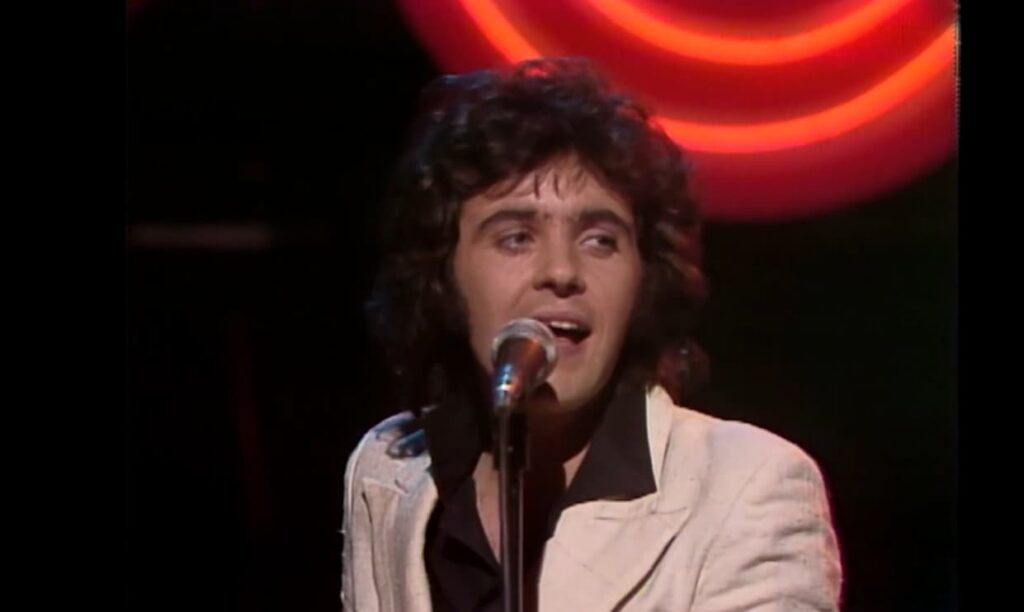
The Midnight Special performance gives the song a different kind of life. On record, “Streetfight” carries a controlled tension, its rhythm steady, its atmosphere carefully shaped. But live, there is a sharper edge. The guitars feel more immediate, the pulse more insistent. And at the center of it all, David Essex delivers the vocal not as a distant narrator, but as someone standing in the middle of the moment.
There is something unmistakably cinematic in the way the song unfolds. It does not rush into conflict; it circles it. The lyrics suggest a confrontation that is as much emotional as it is physical. Pride hangs in the air, unspoken but unmistakable. And when the tension finally breaks, it does so not with chaos, but with a kind of inevitability—as though the outcome had already been decided long before the first word was sung.
This sense of inevitability is what gives “Streetfight” its lasting resonance. Beneath its surface energy lies a quieter reflection on youth—the kind that burns brightly, often without pause for consequence. It is not a celebration of conflict, but an observation of it. A recognition that moments of defiance, once passed, leave behind something more complicated than victory or defeat.
In the live performance, David Essex leans into this duality. His presence is confident, almost casual, yet there is an undercurrent of something more restrained. He does not overplay the drama. Instead, he allows the song’s natural tension to carry forward, trusting the rhythm and the words to do their work.
Visually, the staging of The Midnight Special adds to the atmosphere without overwhelming it. The lighting, the framing, the simplicity of the setup—all of it reflects a time when performance was still rooted in immediacy rather than spectacle. There is no distance between artist and audience, only the shared space of the moment.
It is worth remembering that by the mid-1970s, David Essex occupied a unique place in popular music. He was not confined to a single genre or identity. His work moved between rock, pop, and narrative storytelling, often blurring the boundaries between them. “Streetfight” exemplifies this versatility. It is structured like a rock song, but it carries the weight of a scene, a fragment of a larger life.
Over time, songs like this often become overshadowed by more commercially successful hits. Yet “Streetfight” endures in a different way. It remains a snapshot—of an artist in motion, of a moment in music that valued both style and substance, and of a story that feels as relevant in its quiet observations as it does in its outward energy.
As the performance draws to a close, there is no grand resolution. The tension settles, the moment passes, and what remains is a feeling rather than a conclusion.
Because “Streetfight” was never about the fight itself.
It was about everything that leads up to it—and everything that lingers after it’s gone.