
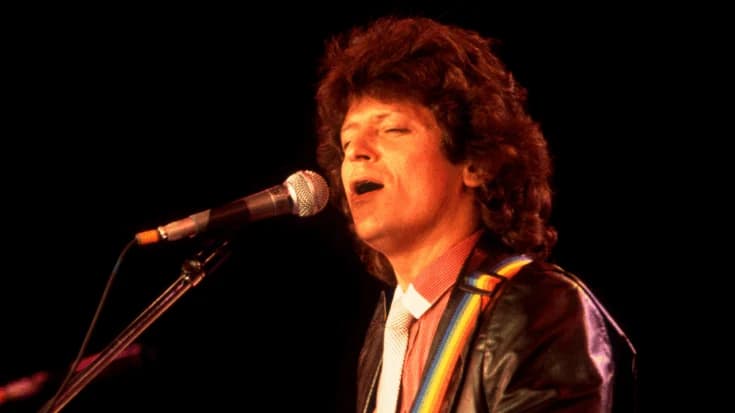
A Farewell That Never Quite Finds Its Words, Where Letting Go Feels More Like Quiet Defeat Than Resolution
When Johnny Rodriguez recorded “I’m Not That Good at Goodbye” in the mid-1970s, he was already a familiar voice on country radio, known for blending traditional Nashville storytelling with a smooth, almost conversational delivery. The song appeared on the 1975 album “Just Get Up and Close the Door”, a record that itself produced a No. 1 hit on the Billboard Hot Country Singles chart with its title track. While “I’m Not That Good at Goodbye” was not released as a major charting single, it found its place quietly within the album’s emotional landscape — one of those songs that does not need chart statistics to endure, because its truth is immediate and unmistakable.
Written by Tom T. Hall, one of country music’s most perceptive and plainspoken songwriters, the song carries his signature ability to say something deeply human without raising his voice. Hall never relied on elaborate metaphors or dramatic twists. Instead, he trusted the weight of simple words, arranged carefully enough to reveal what most people struggle to express. In “I’m Not That Good at Goodbye”, that philosophy is fully realized. The title itself feels like a confession — not proud, not poetic, just honest.
At the time, Johnny Rodriguez was in a remarkable run of success. Having emerged in the early 1970s with a string of chart-topping hits, he brought a fresh tone to country music, one that balanced warmth with restraint. His voice carried a kind of ease that made even the most painful lines feel approachable. He did not dramatize sorrow; he allowed it to settle, to exist without explanation. That quality makes his interpretation of this song particularly effective. There is no sense of performance in the traditional sense. It feels closer to a quiet admission, spoken rather than sung.
Musically, the arrangement reflects the understated strength of mid-1970s Nashville production. The instrumentation is gentle — steel guitar, soft rhythm, a subtle presence of piano — all working together to support rather than overshadow the vocal. There is space in the recording, a kind of breathing room that allows each line to land with clarity. Nothing feels rushed. Nothing feels forced. It is a sound built on patience.
The meaning of “I’m Not That Good at Goodbye” lies in its refusal to offer closure. Unlike many songs about parting, it does not build toward a final resolution or a moment of acceptance. Instead, it lingers in the discomfort of separation — in that space where words fail, where emotions remain unresolved. The narrator does not claim strength or understanding. He simply acknowledges a limitation: the inability to say goodbye in a way that feels complete.
There is something profoundly relatable in that admission. Goodbyes, in real life, are rarely as clean as they are in stories. They are often unfinished, filled with things left unsaid, shaped as much by hesitation as by decision. This song captures that reality with quiet precision. It does not attempt to fix the feeling. It allows it to remain.
For Johnny Rodriguez, recordings like this helped define his legacy. While his chart-topping hits brought him widespread recognition, it is songs of this nature — understated, reflective, deeply human — that reveal the full depth of his artistry. He had a way of choosing material that did not demand attention, but rewarded those who listened closely.
Hearing the song now, decades removed from its original context, it carries an even deeper resonance. Time has a way of reshaping how such songs are understood. What once may have felt like a simple statement of regret begins to sound more like a universal truth. The voice, the arrangement, the words — all of it seems to echo a shared experience that extends far beyond the moment of recording.
In the end, “I’m Not That Good at Goodbye” is not about endings in the conventional sense. It is about the difficulty of endings, the awkwardness, the incompleteness. It reminds us that not every departure comes with clarity, and not every farewell offers peace. Sometimes, all that remains is the quiet acknowledgment that we were never quite prepared to let go.
And in that quiet, Johnny Rodriguez finds something enduring — a way to give voice to a feeling that many carry, but few can articulate.