
A Life Reflected in Love, Where Identity and Devotion Become One Quiet Truth
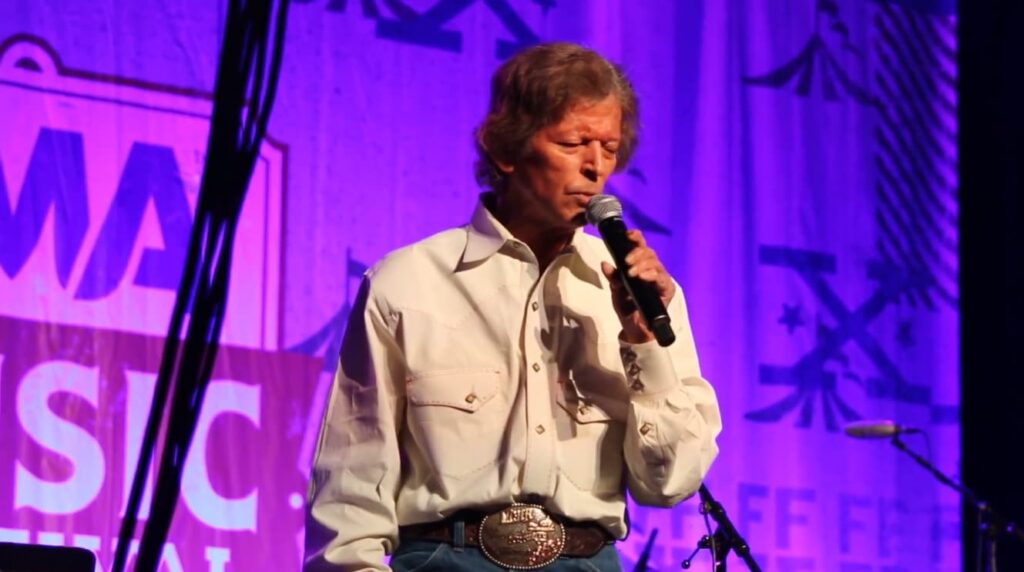
On the evening of June 7, 2017, in Nashville, Johnny Rodriguez stood before an audience not as a chart-chasing star, but as a man carrying decades of memory in his voice. When he sang “I Couldn’t Be Me Without You”, the moment felt less like a performance and more like a quiet reckoning with time itself. Originally released in 1976 as part of the album “I Wonder If I Ever Said Goodbye”, the song had already secured its place in country music history, reaching No. 3 on the Billboard Hot Country Singles chart. But on that Nashville stage, more than forty years later, it seemed to take on a deeper meaning — no longer just a love song, but a reflection of a life lived in full awareness of what truly matters.
Written by Billy Joe Shaver, one of the most respected and quietly profound songwriters in country music, the song carries a sincerity that cannot be manufactured. Shaver had a rare gift for writing about love not as something fleeting or dramatic, but as something steady, almost elemental. In “I Couldn’t Be Me Without You”, love is not portrayed as passion alone, but as identity itself — the idea that who we are is shaped, defined, and sometimes even sustained by the presence of another.
When Johnny Rodriguez first recorded the song, he was already at the height of his powers. Having emerged in the early 1970s as one of the first major Mexican-American stars in country music, he brought with him a voice that was both smooth and deeply expressive, capable of conveying vulnerability without ever losing strength. By the time this song was released, he had already amassed a string of No. 1 hits, and yet this particular recording stood apart. It was quieter, more introspective, less concerned with chart dominance and more focused on emotional truth.
The 2017 Nashville performance adds another layer to that truth. Time has a way of reshaping songs, especially those built on reflection. The youthful certainty that may have once underpinned the lyrics gives way to something more complex — a sense of gratitude mixed with the understanding of loss, endurance, and change. Rodriguez’s voice, weathered but still unmistakably his own, carries the song with a different kind of authority. Every line feels earned. Every pause feels intentional.
Musically, the arrangement remains faithful to the traditions that defined the golden era of country music. Gentle steel guitar lines drift through the background, accompanied by a restrained rhythm section that allows the vocal to remain at the center. There is no excess, no unnecessary flourish. It is a sound that trusts the song itself — and the man delivering it.
The story behind the song, and its enduring appeal, lies in its simplicity. There is no grand narrative, no dramatic twist. Instead, it speaks to something far more universal: the quiet realization that love, at its best, becomes part of who we are. It is not about dependency, but about connection — the kind that shapes decisions, memories, and even the way one understands oneself.
Over the years, many songs have tried to capture this idea, but few have done so with the same level of restraint and honesty. Johnny Rodriguez does not overstate the emotion. He allows it to unfold naturally, trusting that the listener will recognize the truth within it. And perhaps that is why the song has endured, why it continues to resonate long after its chart run has ended.
Listening to that 2017 performance, one cannot help but feel the passage of time — not as something to be feared, but as something to be acknowledged. The song becomes less about a single relationship and more about a lifetime of connections, choices, and moments that shape a person. It is a reminder that identity is never formed in isolation, that the people who walk alongside us leave an imprint that cannot be erased.
In the end, “I Couldn’t Be Me Without You” is not just a love song. It is a statement of understanding, delivered with quiet dignity by a man who has lived long enough to know exactly what those words mean. And in that Nashville performance, Johnny Rodriguez does not simply revisit the past — he gives it new life, allowing it to speak once more, softly but unmistakably, to anyone willing to listen.