
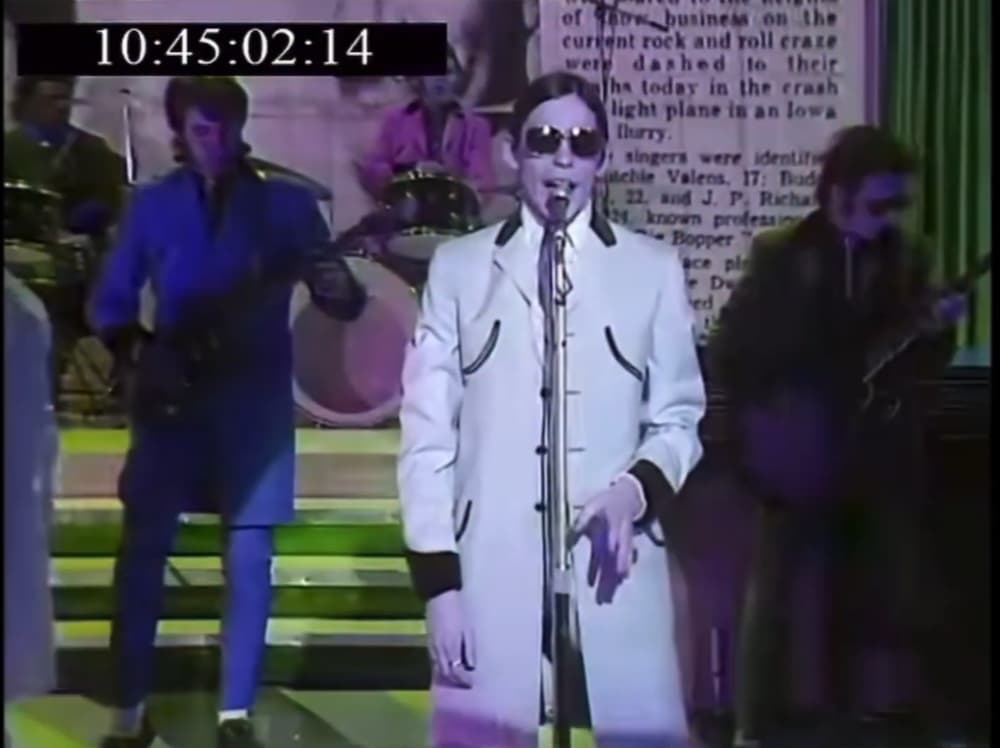
A young band finding its reflection under bright studio lights, where revival meets ambition and the past is reborn with restless energy.
In December 1973, Showaddywaddy appeared on New Faces, a moment that now feels like the first clear outline of a long and remarkably consistent career. At that point, they were not yet the chart-regular hitmakers they would soon become, but the elements were already in place—tight harmonies, an unmistakable sense of rhythm, and above all, a deep affection for the sounds of 1950s rock and roll, reshaped for a new decade that was itself searching for direction.
Their breakthrough would come shortly after, when “Hey Rock and Roll” reached No. 2 on the UK Singles Chart in 1974, marking the beginning of a string of hits that would define their presence in British pop culture throughout the mid to late 1970s. Songs like “Three Steps to Heaven” (UK No. 2, 1975) and “Under the Moon of Love” (UK No. 1, 1976) would follow, establishing Showaddywaddy not as a novelty act, but as one of the most commercially successful revivalist bands of their era. But in that December 1973 television appearance, none of that success was guaranteed. It existed only as potential, waiting to be recognized.
What makes this performance on New Faces so compelling is the sense of transition it captures. The early 1970s in Britain were a period of shifting musical identity. Glam rock was dominating the charts, progressive rock was expanding its reach, and yet there remained a quiet hunger for something more direct, more rooted. Showaddywaddy answered that hunger not by reinventing the past, but by embracing it fully—bringing doo wop harmonies, rock and roll rhythms, and a sense of uncomplicated joy back into the spotlight.
Visually and musically, they presented themselves with a clarity that set them apart. There was no irony in their performance, no sense of distance from the material they drew inspiration from. Instead, there was commitment. The twin lead vocal approach, supported by strong backing harmonies, created a fullness of sound that felt both nostalgic and immediate. Watching them on New Faces, one can sense that they were not simply performing for approval—they were establishing an identity, one rooted in respect for tradition but driven by contemporary energy.
There is also something quietly revealing in the format of the show itself. New Faces was designed to discover talent, to give emerging artists a platform from which they might step into a wider public consciousness. For Showaddywaddy, this appearance functioned exactly in that way. It placed them in front of an audience that may not have known what to expect, and in doing so, allowed the band’s straightforward, rhythm-driven sound to speak for itself.
Looking back, it is easy to see this moment as the beginning of a trajectory that would lead to sustained chart success and enduring popularity. But within the performance itself, there is no sense of certainty. There is only effort, precision, and a kind of collective belief that what they were doing mattered. That belief would prove to be well-founded.
The deeper significance of this appearance lies in what it represents beyond the immediate performance. It is a reminder that music often moves in cycles, that sounds once considered past can return with new relevance when delivered with sincerity. Showaddywaddy did not attempt to modernize rock and roll beyond recognition. Instead, they trusted in its original appeal—the steady beat, the layered voices, the direct emotional connection—and presented it in a way that felt alive again.
In the years that followed, their success would confirm that this approach resonated widely. Yet there is something uniquely compelling about seeing them at this early stage, before the hits, before the certainty. It is the sound of a band at the threshold, carrying the weight of the past while stepping into an uncertain future.
And in that moment, under the studio lights of New Faces in December 1973, Showaddywaddy did something quietly remarkable. They reminded listeners that sometimes the most powerful way forward is not to abandon what came before, but to hold onto it with conviction—and let it speak again, in a voice that feels both familiar and new.