
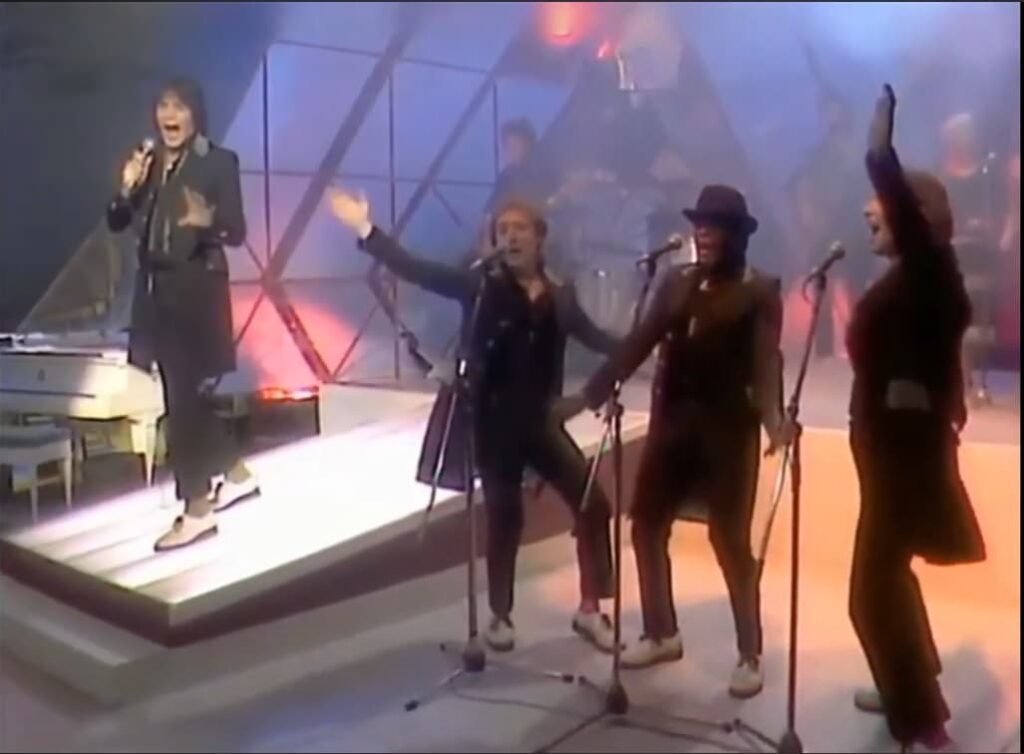
A familiar melody returns like a quiet echo of youth, where every step forward carries the soft imprint of what once was.
By the time Showaddywaddy performed “Footsteps” on Get It Together on November 24, 1981, the band was no longer in pursuit of recognition—they were, instead, preserving something that had already begun to fade from the center of popular music. The late 1970s had been their golden period, with a remarkable run of UK hits including “Under the Moon of Love” reaching No. 1 on the UK Singles Chart in 1976, and “Three Steps to Heaven” climbing to No. 2 in 1975. Yet by 1981, the musical landscape had shifted. New wave, synth-driven sounds, and changing tastes had moved the spotlight elsewhere. What remained for Showaddywaddy was not dominance, but devotion—to a style, a sound, and a feeling that refused to disappear entirely.
“Footsteps”, originally recorded by Steve Lawrence in 1960, had never been about grand declarations. It is, at its core, a song of quiet heartbreak—the lingering presence of someone who is no longer there, heard not in words but in the imagined echo of footsteps that will not return. In choosing to perform this song, Showaddywaddy were not simply revisiting an old hit. They were stepping into its emotional space, carrying forward a tradition of storytelling that values restraint over excess, suggestion over explanation.
Their interpretation remains faithful to that spirit. The arrangement is gentle, almost deliberately unadorned, allowing the vocal harmonies to take precedence. There is a softness in the delivery, a sense that the song is being remembered as much as it is being performed. Unlike their more upbeat, rhythm-driven hits, “Footsteps” asks for patience—from both the performers and the listener. It unfolds slowly, each line settling into place with a quiet inevitability.
The setting of Get It Together adds another layer to the performance. As a television program aimed at a younger audience during a rapidly changing musical era, it might seem an unlikely stage for a song rooted in early 1960s sentiment. And yet, this contrast is precisely what gives the performance its weight. Surrounded by a world moving forward at increasing speed, Showaddywaddy pause, look back, and invite the audience to do the same. Not in defiance of change, but in acknowledgment that some emotions do not belong to any single moment in time.
There is something particularly striking in the way the band carries itself during this performance. The confidence remains, but it is no longer the confidence of rising success. It is quieter, more settled, shaped by years of experience and the understanding that not every song needs to compete for attention. Some simply need to exist, to be heard, and then to linger.
Looking back, this 1981 appearance feels like a gentle act of preservation. While the charts may no longer have reflected their earlier dominance, the essence of what Showaddywaddy represented had not diminished. If anything, it had become more defined. They were no longer just a successful revivalist band—they were custodians of a sound, keeping alive the emotional clarity and melodic simplicity that had once defined an earlier era of popular music.
And in “Footsteps”, that role becomes especially clear. The song itself speaks of absence, of something that can no longer be touched but can still be felt. In performing it, Showaddywaddy seem to mirror that sentiment, standing as a link between past and present, between what was and what remains.
In the end, this performance is not about reclaiming past success or adapting to new trends. It is about continuity. About the quiet understanding that music, like memory, does not simply disappear. It lingers—in melodies, in voices, in moments like this one, where a song written decades earlier finds new life, not by changing, but by being remembered exactly as it was meant to be.