
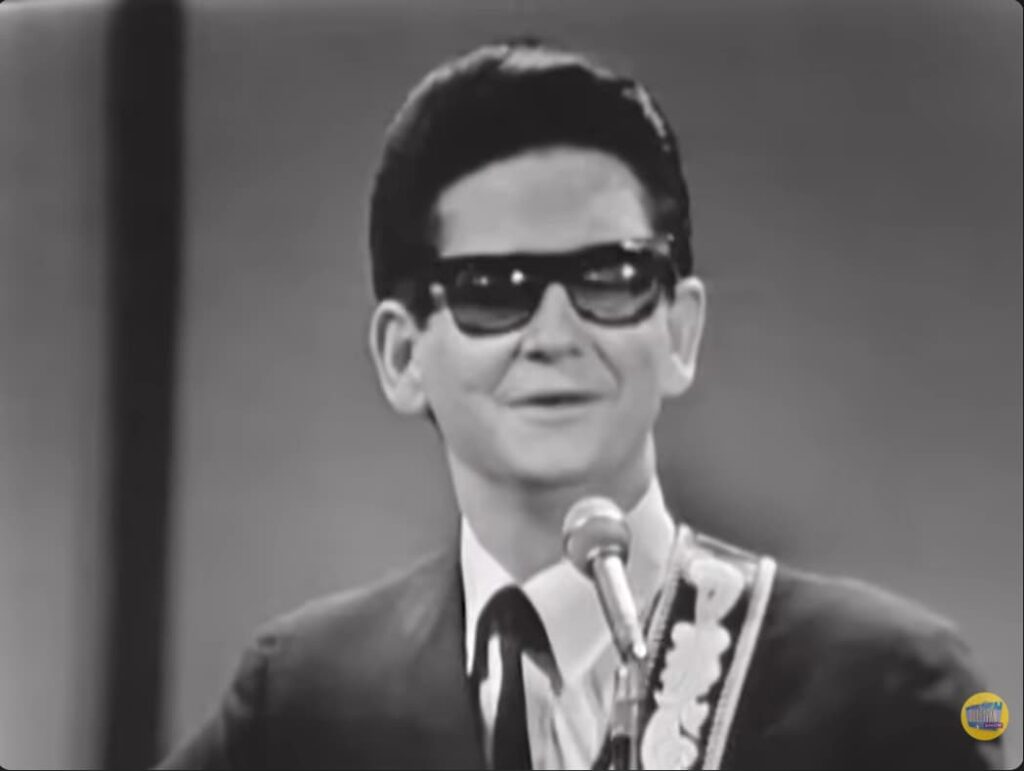
A fleeting glance turned into legend—“Oh, Pretty Woman” captures the moment desire meets doubt, brought to life with unmistakable intensity by Roy Orbison
When Roy Orbison stepped onto the stage of The Ed Sullivan Show to perform “Oh, Pretty Woman,” he was not simply presenting a hit song—he was reinforcing a moment in popular music that had already begun to define the mid-1960s. Released in 1964, the single quickly rose to No. 1 on the Billboard Hot 100, where it remained for three consecutive weeks, while also reaching No. 1 in the UK Singles Chart. It became one of the most recognizable recordings of the era, a song whose opening guitar riff alone could summon an entire decade.
Written by Roy Orbison and Bill Dees, the song was famously conceived in a spontaneous moment. As the story goes, Orbison’s wife, Claudette, mentioned she was going out, prompting Dees to remark, “A pretty woman never needs any money.” Orbison picked up a guitar, and within minutes, the foundation of “Oh, Pretty Woman” began to take shape. What followed was not just a song, but a narrative distilled into under three minutes—a chance encounter, filled with admiration, uncertainty, and a touch of vulnerability.
By the time of his appearance on The Ed Sullivan Show, Roy Orbison was already known for his distinctive presence. Unlike many of his contemporaries, he did not rely on overt movement or theatrical gestures. Dressed in black, often standing still behind dark glasses, he allowed the voice to carry everything. And in “Oh, Pretty Woman,” that voice takes on a different character—more direct, more rhythmic, yet still unmistakably his.
The performance itself carries a quiet confidence. There is no need to amplify the energy artificially; the song does that on its own. The driving beat, the sharp guitar line, and the call-and-response structure create a sense of forward motion that contrasts with Orbison’s stillness. It is this contrast that gives the performance its unique tension—the music moves, while the man delivering it remains grounded.
Lyrically, “Oh, Pretty Woman” is deceptively simple. A man sees a woman passing by and is struck by her presence. He calls out, unsure whether he will be acknowledged. There is admiration, but also hesitation—a brief moment where confidence falters. When she finally turns back, the song resolves not with triumph, but with relief.
In Orbison’s delivery, that emotional shift is subtle but unmistakable. He does not overplay the longing or the doubt. Instead, he allows it to exist within the phrasing, within the slight changes in tone that occur as the song progresses. This restraint is what elevates the performance beyond its structure. It becomes not just a story, but a feeling—something immediate, recognizable, and quietly universal.
Musically, the song marked a departure from some of Orbison’s earlier, more operatic ballads like “Crying” or “Only the Lonely.” Here, the arrangement is tighter, more grounded in rock and roll, yet it retains a certain elegance. The famous guitar riff, played by Billy Sanford, provides a foundation that is both catchy and enduring, anchoring the song firmly in the listener’s memory.
The Ed Sullivan Show performance adds another layer to the song’s legacy. At a time when television appearances could define an artist’s reach, Orbison’s presence introduced the song to an even wider audience. Yet he did not alter himself to fit the medium. He remained consistent—reserved, focused, allowing the music to speak without distraction.
Looking back, this performance captures something essential about Roy Orbison as an artist. He did not need to command attention in conventional ways. He drew it inward, creating a space where the listener was invited to lean in rather than be overwhelmed.
And in “Oh, Pretty Woman,” that approach finds its perfect balance. A song built on a simple moment becomes something enduring—not because it is grand, but because it is honest.
The passing glance, the uncertain call, the brief connection—these are not extraordinary events. Yet in Orbison’s hands, they become unforgettable.
And long after the stage lights fade, the rhythm remains, steady and familiar, carrying with it the echo of a voice that never needed to shout to be heard.