
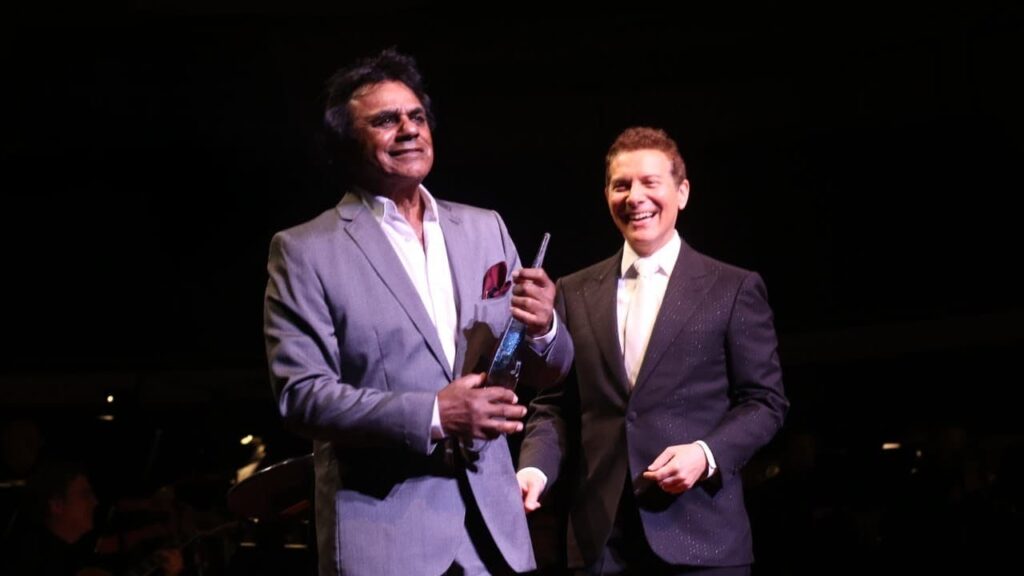
A lifetime carried on melody—Johnny Mathis at the 2014 Songbook Hall of Fame stands as a quiet testament to endurance, elegance, and the timeless language of romance
In 2014, when Johnny Mathis was inducted into the Great American Songbook Hall of Fame, the moment felt less like a ceremonial recognition and more like a gentle acknowledgment of something long understood. By then, he had already spent nearly six decades shaping the sound of popular music—not through reinvention or spectacle, but through consistency, refinement, and an unwavering commitment to emotional truth.
To speak of Johnny Mathis is to speak of longevity in its most graceful form. His career began in the mid-1950s, but it was 1957 that defined his arrival. With “Chances Are”, he reached No. 1 on the Billboard Most Played by Jockeys chart, while “It’s Not for Me to Say” climbed to No. 5 on the same chart. These were not merely successful singles—they were introductions to a voice that would come to define an entire mood in American music. Shortly after, “Misty” would reach No. 12 on the Billboard Hot 100 in 1959, becoming one of his most enduring recordings and a cornerstone of his identity as “The Voice of Romance.”
Yet the significance of the 2014 induction lies not only in these early triumphs, but in what followed. Over the decades, Johnny Mathis demonstrated a rare versatility. He moved effortlessly between genres—interpreting Broadway compositions, jazz standards, contemporary pop, and holiday music—without ever losing the distinctive warmth that defined his sound. Albums like “Johnny’s Greatest Hits” (1958), which spent an unprecedented 490 weeks on the Billboard charts, stand as evidence of both commercial success and cultural permanence.
The Songbook Hall of Fame itself exists to honor those who have preserved and elevated the tradition of classic songwriting. In that context, Mathis was not simply a participant—he was a custodian. His interpretations did not seek to alter the compositions he sang; instead, they revealed them more clearly, allowing their emotional core to remain intact.
During the induction, there was a sense of reflection—not only on the songs themselves, but on the passage of time they carried. Each performance, each recording, seemed to exist as part of a larger continuum. The voice heard in 2014 was not identical to the one from 1957, yet it retained its essential character. There was a maturity, a subtle deepening, but never a loss of clarity.
His honors over the years reinforce this legacy. Though nominated for multiple Grammy Awards, it is perhaps more telling that he received the Grammy Lifetime Achievement Award and saw three of his recordings inducted into the Grammy Hall of Fame. These are not accolades given for momentary success—they are reserved for artists whose work continues to resonate across generations.
What makes Johnny Mathis particularly remarkable is the absence of urgency in his career. He never appeared to chase trends or adapt himself to shifting musical landscapes. Instead, he remained anchored in a style that valued melody, phrasing, and emotional sincerity. In doing so, he allowed the world to come to him, rather than the other way around.
Listening to his body of work, one begins to understand that his music was never about grand declarations. It was about nuance—the way a single note could carry meaning, the way a pause could speak as clearly as a lyric. This restraint, often overlooked in louder eras, is what gives his recordings their enduring quality.
By 2014, the phrase “six decades as a recording artist” was not simply a measure of time—it was a reflection of continuity. Through changing decades, evolving tastes, and shifting audiences, Johnny Mathis remained present, not as a relic of the past, but as a living voice that continued to interpret, to connect, and to endure.
And perhaps that is the most lasting image from his Songbook Hall of Fame induction. Not a figure looking back on a completed journey, but an artist still standing within it—steady, composed, and quietly aware that the true measure of a song is not how loudly it is heard, but how long it remains.