
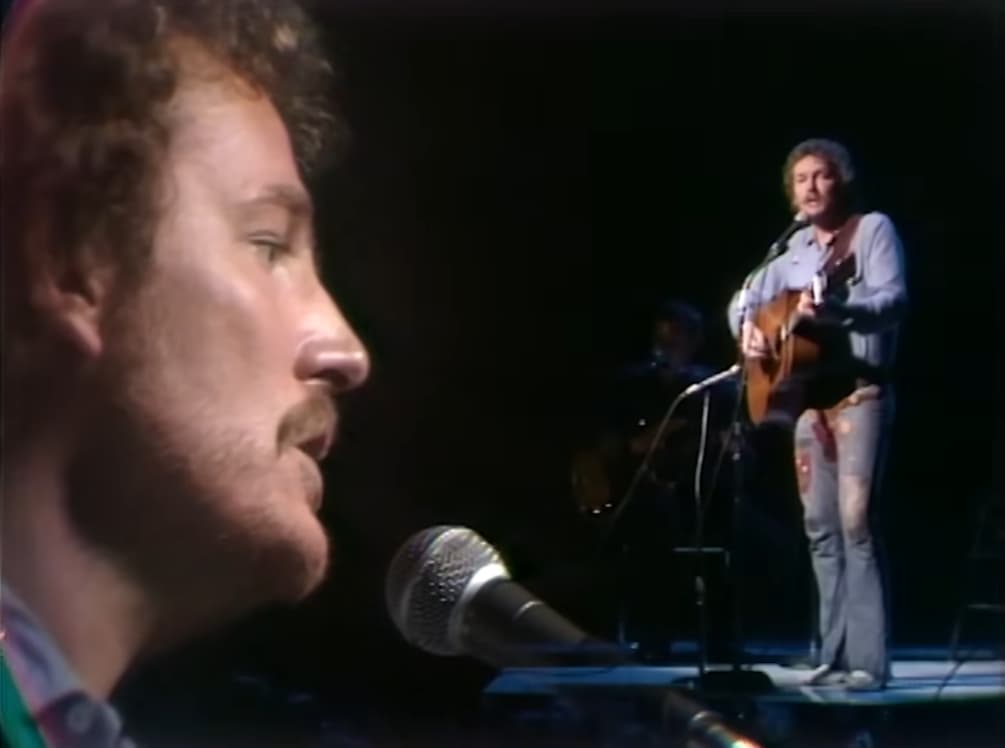
A confession set to melody—“If You Could Read My Mind” reveals the quiet unraveling of love, carried with fragile honesty in Gordon Lightfoot’s voice
When Gordon Lightfoot performed “If You Could Read My Mind” on The Midnight Special on February 22, 1974, the song was already firmly established as one of the most introspective and emotionally precise works of the early 1970s. Originally released in 1970 on the album “Sit Down Young Stranger” (later reissued as “If You Could Read My Mind”), the song reached No. 5 on the Billboard Hot 100 and climbed to No. 1 on the Billboard Easy Listening chart. In Canada, it also became a defining hit, solidifying Lightfoot’s reputation as one of the most thoughtful voices in folk and pop songwriting.
Unlike many songs that gain their strength through arrangement or vocal power, “If You Could Read My Mind” draws its weight from restraint. It is, at its core, a quiet unraveling—a reflection on the end of a relationship, told not through anger or accusation, but through recognition. The lyrics do not seek resolution. They simply acknowledge what has already been lost.
The story behind the song is deeply personal. Gordon Lightfoot wrote it during the breakdown of his marriage, a period marked by emotional distance and inevitable separation. What makes the song remarkable is not just that it addresses this experience, but how it does so. There is no dramatization, no attempt to assign blame. Instead, Lightfoot presents the situation with a clarity that feels almost detached, as though he is observing his own life from a distance he cannot quite control.
In the Midnight Special performance, that sense of distance becomes even more pronounced. Standing with his guitar, Lightfoot delivers the song with a calm that borders on stillness. There is no theatrical gesture, no visible attempt to emphasize emotion. And yet, the feeling is unmistakable. It exists within the phrasing, within the slight hesitations between lines, within the way certain words seem to linger just a moment longer than expected.
The opening lines—“If you could read my mind, love…”—immediately establish the tone. This is not a declaration; it is an invitation, though one that arrives too late. The implication is clear: understanding might have changed something, but that understanding was never fully reached.
What follows is a series of images—ghosts, castles, stories that no longer hold their meaning. These metaphors are not elaborate for the sake of poetry; they reflect the way memory reshapes experience. The relationship becomes something that once felt solid but now exists only in fragments, in interpretations that shift over time.
Musically, the arrangement supports this introspection. The gentle acoustic guitar provides a steady foundation, while the orchestration—subtle strings and soft accompaniment—adds depth without overwhelming the vocal. This balance allows the listener to remain focused on the narrative, on the quiet unfolding of realization that defines the song.
By the time of the 1974 performance, Gordon Lightfoot had already become known for his ability to merge storytelling with emotional precision. Songs like “Sundown” (which would reach No. 1 on the Billboard Hot 100 later that same year) would further expand his audience, but “If You Could Read My Mind” remains distinct. It is less outward, less concerned with narrative structure, and more focused on internal reflection.
There is something enduring about that inward focus. The song does not age in the way more topical material might. Its themes—misunderstanding, distance, the quiet end of something once meaningful—remain constant, regardless of time or context.
Watching the Midnight Special performance now, there is a sense of stillness that feels almost rare. The absence of distraction allows the song to exist fully in its own space. It does not compete for attention; it simply waits to be heard.
And when it is heard, it leaves behind something that is difficult to define. Not sadness, exactly. Not regret alone. But a recognition—of moments that could not be changed, of words that were never quite spoken in time.
In Gordon Lightfoot’s hands, “If You Could Read My Mind” becomes more than a song about love lost. It becomes a quiet acknowledgment of how little we sometimes understand, even when we believe we are closest.
And in that acknowledgment, it finds its lasting power—soft, unassuming, and impossible to forget.