
A shadow that never quite fades—“Sundown” returns in later years as a quiet reckoning, where memory and time meet in Gordon Lightfoot’s enduring voice
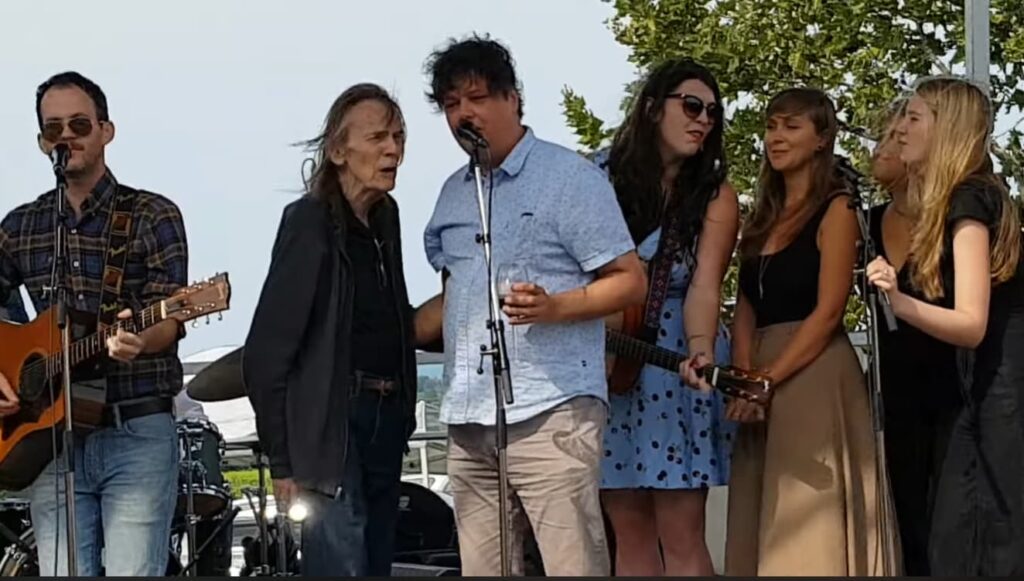
By the summer of 2017, when Gordon Lightfoot performed “Sundown” alongside friends, the song had already traveled more than four decades through the lives of those who had carried it with them. First released in 1974 as the title track of his album “Sundown,” the song reached No. 1 on the Billboard Hot 100 and also topped the Billboard Easy Listening chart, marking the peak of Lightfoot’s commercial success. It was a rare moment when introspective songwriting aligned perfectly with mainstream appeal.
Yet “Sundown” was never simply a hit song. From the beginning, it carried something more elusive—a tension that could not be easily resolved. Written during a period of personal uncertainty, the song reflects Lightfoot’s relationship with Cathy Smith, a connection often described as passionate but troubled. In that context, the lyrics take on a sharper edge. This is not a love song in the traditional sense. It is a song about suspicion, vulnerability, and the quiet fear of losing control over something deeply felt.
The famous line—“Sundown, you better take care…”—is not a warning delivered outward. It feels inward, almost like a thought spoken aloud. There is a sense that the singer is not entirely certain of what he fears, only that it exists. That ambiguity is what gives the song its lasting resonance.
In the original 1974 recording, there is a tightness to the arrangement. The rhythm is steady, almost hypnotic, driven by a subtle groove that contrasts with the unease in the lyrics. Gordon Lightfoot’s voice, clear and controlled, delivers the lines with a restraint that makes the tension more palpable. He does not overstate the emotion; he allows it to linger beneath the surface.
But in the 2017 performance, something shifts. Time has altered the relationship between the artist and the song. The voice is older now—slightly weathered, carrying the marks of years lived both on and off the stage. And with that change comes a different kind of understanding.
Performing with friends, the arrangement feels more open, less confined by the structure of the original recording. There is a sense of ease in the interplay between musicians, a quiet camaraderie that softens the edges of the song without diminishing its core. The rhythm remains, but it breathes more freely.
What becomes most striking is the way Lightfoot approaches the lyrics. The urgency that once defined them has given way to reflection. The suspicion, the tension, the uncertainty—they are still present, but they no longer dominate. Instead, they feel like memories, revisited with a kind of acceptance that only time can provide.
This transformation does not weaken the song. It deepens it.
There is a particular poignancy in hearing “Sundown” performed decades after its creation. The questions it raises—about trust, about emotional distance, about the complexities of human connection—do not disappear with time. But they change in tone. What once felt immediate becomes contemplative. What once felt unresolved becomes something that can be lived with, even if it is never fully answered.
Within the broader arc of Gordon Lightfoot’s career, “Sundown” remains a defining moment. It represents not only his commercial peak but also his ability to translate personal experience into something universally recognizable. And in the 2017 performance, that ability is reaffirmed—not through reinvention, but through continuity.
There is no attempt to modernize the song, no effort to reshape it for a different audience. It is presented as it has always been, but with the added dimension of time. The listener is not just hearing the song; they are hearing its history.
As the performance unfolds, there is a quiet realization that “Sundown” was never about a single moment or a single relationship. It was about a feeling—one that exists in many forms, across many years.
And in that summer of 2017, Gordon Lightfoot does not revisit the past in search of answers. He simply stands within it, allowing the song to speak once more—steady, familiar, and still carrying the shadow it always did.