
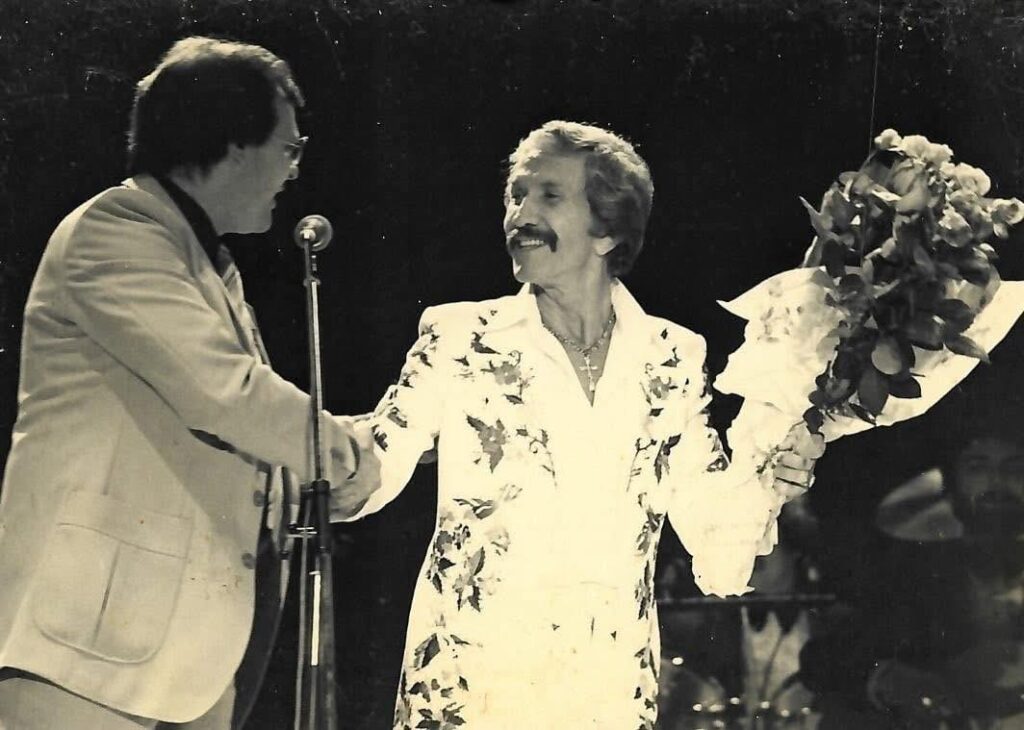
A fleeting moment of grace and brotherhood—where music became memory, and legends revealed the quiet humanity behind their brilliance
There are nights in music history that cannot be measured by charts, awards, or sales figures—nights that live on not in statistics, but in the fragile, glowing space of memory. The concert held on April 12, 1982, in Rotterdam, Netherlands, was one of those rare gatherings. A stage shared by towering figures such as Roy Orbison, Johnny Cash, Jerry Lee Lewis, and at its heart, the quietly magnetic presence of Marty Robbins. It was not merely a concert; it was a convergence of eras, voices, and stories—each artist carrying decades of triumph, sorrow, and resilience.
Among the many recollections from that evening, one moment continues to echo with particular tenderness: the embrace between host Cor Sanne and Marty Robbins. It was not rehearsed, not staged for applause. It was something simpler, and therefore far more profound—a gesture of respect, of admiration, of shared understanding between two men who recognized the fleeting nature of such moments.
By 1982, Marty Robbins was already a revered figure in country and western music. His legacy had long been secured through timeless songs like “El Paso”—a recording that had reached No. 1 on the Billboard Hot 100 in 1960, an extraordinary achievement for a narrative ballad of its kind. Yet, on that Rotterdam stage, there was no sense of resting on past glory. According to those who witnessed it, Robbins performed with an intensity that felt almost defiant—as if each note carried the awareness that time, relentless as it is, does not wait for anyone.
Cor Sanne’s later reflections, spoken from afar yet filled with immediacy, paint a vivid picture of that night. He described not just a performance, but an experience—one where Marty Robbins seemed to pour every ounce of himself into the music. There are artists who perform, and there are those who live their songs in real time. Robbins belonged firmly to the latter. His voice, always rich with narrative depth, carried something more that evening—something unspoken, something deeply human.
What makes this memory particularly moving is the absence of measurable achievement. There were no new chart positions to celebrate, no records being broken. And yet, in a way, that is precisely why it endures. Because what unfolded on that stage transcended the need for validation. It was music in its purest form—communication, connection, and presence.
The phrase, “They don’t make them that way anymore…”, lingers like a quiet refrain over the entire story. It speaks not only of Marty Robbins, but of an entire generation of artists who approached their craft with a certain sincerity—an unpolished honesty that feels increasingly rare. These were performers who understood the weight of a lyric, the importance of a pause, the power of simply standing still and letting a song breathe.
The photograph taken that night—now aged, softened by time—serves as a silent witness. It captures more than faces; it captures a feeling. There is warmth in it, a sense of camaraderie that cannot be manufactured. The mention of names like Diane Jordan, the gentle closing words “Happy trails,” all contribute to a tapestry of remembrance that feels deeply personal, even to those who were not there.
And perhaps that is the enduring magic of Marty Robbins. His music, his presence, his very way of being on stage—these were not confined to a single moment or audience. They continue to resonate, to reach across years and distances, touching something universal within those who listen.
In the end, what remains is not the noise of applause, but the quiet after it fades. The memory of a voice, steady and true. The image of an embrace that needed no explanation. And the lingering realization that some artists do more than perform—they leave behind fragments of themselves, scattered gently across time.
Yes, they don’t make them that way anymore. And perhaps that is why such moments feel all the more precious—because they remind us of what once was, and of what, in some quiet corner of memory, still is.